Intelligent Autonomous Vehicle Makes It To Maker Faire

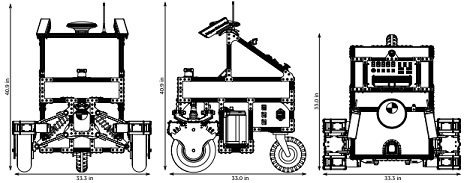
A few guys from Rutgers showed up at Maker Faire with Navi, their vehicle for the 2012 Intelligent Ground Vehicle Competition. Powered by two huge lead acid batteries, Navi features enough high-end hardware to hopefully make it through or around just about any terrain.

Loaded up with a laser range finder, a stereo camera setup, compass, GPS receiver, and a pair of motors capable of pulling 40A, Navi has the all the hardware sensors required to make it around a track with no human intervention. Everything is controlled by a small netbook underneath the control panel, itself loaded up with enough switches and an 8×32 LED matrix to be utterly incomprehensible.

In the videos after the break, the guys from Rutgers show off the systems that went into Navi. There’s also a video showing off Navi’s suspension, an impressive custom-built wishbone setup that will hopefully keep Navi on an even keel throughout the competition.

Also of note: A PDF design report for Navi and Navi’s own blog.

Continue reading “Intelligent Autonomous Vehicle Makes It To Maker Faire”
Checking In With [Ian] From Dangerous Prototypes

Former Hackaday writer and electronic wizard [Ian] from Dangerous Prototypes made his way to the Maker Faire last weekend. He had a ton of cool stuff to show off, and luckily we were able to grab a few videos.

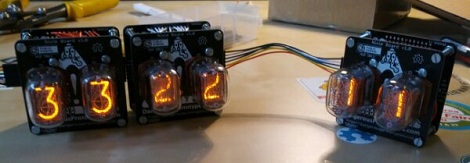
First up is a chainable Nixie module. [Ian], like all gurus of his caliber, had a box full of Nixie tubes waiting to be used in a project. These tubes never quite made it into their planned projects, mostly due to the difficulty of getting these old Nixies working. To remedy this problem, [Ian] created a chainable Nixie tube module – just hook up a high voltage supply to the board, connect it to the microcontroller of your choice, and you’ve got 2 Nixie tubes for your project.

[Ian] also showed off an ingenious solution to one of every maker’s problems. After designing a few cool boards like the Bus Pirate, Flash Destroyer, and Logic Sniffer, he realized he never made two boards that were the same size. This meant it was nigh impossible to have a standardized set of cases for his (and other maker’s) projects. The result is the Sick of Beige standard for electronics projects.

This standard provides PCB layouts in both square and golden rectangle formats complete with mounting holes, radiused corners, keepout areas, and suggested placement locations for USB ports and SD cards. The idea behind Sick of Beige is to get makers and fabbers using the same board dimensions so a set of standardized cases can be constructed. It’s an awesome idea and something we highly recommend for your next project.

Videos after the break.   Continue reading “Checking In With [Ian] From Dangerous Prototypes”

Whatever A Phobia Of Fingers Is Called, This Is It.

[youtube=http://www.youtube.com/watch?v=7LSXvhLKjCU&w=470]

Touched is a project by [Rebecca Strauss] that integrates servos, strings, and felt into a horrifying kinetic sculpture made up of a dozen mechanical fingers straight from a Boschian nightmare.

The fingers are made up of segments of wood articulated with the help of a small string. Each pair of fingers is controlled by a single servo, and the tips of each pair of fingers is controlled by a second servo.

After covering them in felt, [Rebecca] wrapped conductive thread around each of the fingers. When some of the fingers are touched, they all recoil as if controlled by a demon living just under a mountain of felt.

[Rebecca] brought in another kinetic sculpture using her servo controlled fingers; in the video up at the top and after the break, you can see the inner workings of this floor-mounted version. When the IR proximity sensor goes off, the fingers recoil but can be coaxed out again by gently stroking one of the phalanges.

Continue reading “Whatever A Phobia Of Fingers Is Called, This Is It.”

Nixie Suduku And On-die LEDs

The best booths at Maker Faire draw you in with something unbelievably cool or ridiculously absurd, and bring out a state-of-the-art technology just as your curiosity for the main feature starts to wane. [John Sarik]’s booth for a class he’s TAing at Columbia – Modern Display Science and Technology – is one of these booths.

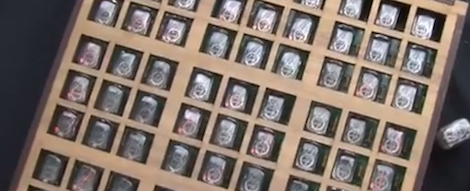
The main feature of the booth is a suduku board filled with 81 Nixie tubes. As shown in the video below, you control the cursor (the decimal point of the Nixies) with a pair of pots. After moving the cursor to the desired location, there’s a keypad to change the number at any one of the 81 locations on a suduku puzzle.

[John]’s presentation then continued to what he’s working on up at Columbia: he’s working on a project to put arrays of LEDs onto silicon, just like any other integrated circuit. He demoed a small LED display built in to a DIP-40 package with a glass (or maybe quartz) window. Yes, it’s a really tiny LED matrix display with a pixel pitch probably much smaller than a traditional LCD display.

Video of the suduku machine after the break, as well as a gallery of the LED matrix on a chip. The matrix was very hard to photograph, so if [John] would be so kind as to send a few more pics in, we’ll be happy to put them up. There’s also a proper video from [John]’s YouTube showing off the Nixie Suduku puzzle solving itself with a recursive algorithm.

Continue reading “Nixie Suduku And On-die LEDs”

Escape From New York: Hackaday Edition

Woo we’re home from Maker Faire! The Hackaday boss man [Caleb] and [Scott], [Phil], and [Andrew] from Squidfoo are back in Springfield, Missouri. I’m safely back in the bosom of Appalachia in Pensyltucky, and we hope every one else at Maker Faire NYC 2012 made it back home safely.

Don’t think this is the end of our coverage of Maker Faire, though. Honestly, the Internet situation was terrible at Maker Faire, and between tethering on my droid and a MiFi, I was lucky to post what I did. There’s more stuff coming down the pipe, and now that I have a decent connection we’ll be posting more videos to the Hackaday YouTube channel.

Of course this wouldn’t be a proper Hackaday post without a hack, therefore I will humbly submit something I discovered around the Delaware Water Gap: Every GPS unit has a setting to avoid New Jersey. All you have to do is enable the ‘avoid toll roads’ setting. Yes, it’s an easy modification to preserve your health and sanity, lest you accidentally find your way into a suburban swampland.

Picking Locks With Toool

What Maker Faire would be complete without teaching children the joys of jiggling and twisting locks until they’ve opened? Toool, the open organisation of lockpickers made their way to New York this weekend to show off their bumping skills and get the kids interested in manipulating small mechanical devices.

The guys from Toool had a very cool setup – just a bunch of tables and chairs with a few picks and torsion wrenches. There were a few classic Master Locks on the table, but also a series of six tumbler locks each labeled with a number 1 through 6 signifying how many pins were in the lock. The idea is to get someone started on a one-pin lock, and eventually have them work their way up to the full six pins.

In the video after the break, one of the more animated guys from Toool explains why they were there, and also shows off picking a Master Lock twice in under 30 seconds. Seriously, people: educate yourself on locks before buying one.

Continue reading “Picking Locks With Toool”

Running Into The Form 1 Printer At Maker Faire

[youtube=http://www.youtube.com/watch?v=yxNqMg_dwJI&w=470]

The Form 1 resin printer Kickstarter met its funding goal in just about 8 hours, and after five days is on track to be the most successful Kickstarter to date. Being so successful meant we had to drop by the FormLabs booth at Maker Faire to see what the hubub is.

From the sample prints floating around the booth, the Form 1 printer has amazing resolution – a 3 inch tall statue of a Greek god had as many features as a life-sized statue.

In the video (both above the fold and after the break), [David Cranor] goes over the features and finishing process of objects made on the Form 1.

Continue reading “Running Into The Form 1 Printer At Maker Faire”