3D Printing A Rocket Engine

Most any rocket engine you’d find on a spacecraft – save for solid or hybrid rockets – use an engine system that’s fairly complex. Because of the intense heat, the fuel is circulated around the chamber before ignition giving a motor its regeneratively cooled nomenclature. This arrangement leads to a few complicated welding and machining processes, but surprisingly these obstacles can be overcome by simply printing a rocket engine on a 3D printer.

The current engine is quite small, but still fueled just like any other proper rocket engine that makes it into Earth orbit. The fuel is propane, the oxidizer is NO2, and the entire device is ignited with an automotive spark plug. Of course this was an expensive proposition; a motor with 12 pounds of thrust cost somewhere in the range of four figures.

Printing a rocket engine has a few advantages over traditional manufacturing techniques. [Rocket Moonlighting] explains that traditional techniques (mills, lathes and other heavy equipment) are bound by labor, material, and time. The costs of printing a rocket engine are only bound by the volume of the finished piece, meaning the most expensive engine per unit of thrust is the one that will fit in your pocket; scaling up means more efficiency for less cost.

There are a few videos up after the break showing the engine in action at full throttle, a few start and restart tests, and a test that involved throttling the engine. It’s an extremely impressive piece of kit, and hopefully [Rocket Moonlighting] will release the CAD source so we can make our own.

EDIT: [RM] tells me his engine cost less than $2000 to make. If just 10 people wanted their own engine from a ‘group buy,’ the price would drop by more than half. If you’d like your own 3D printed rocket engine, you might do well to drop [Rocket Moonlighting] a line.

Continue reading “3D Printing A Rocket Engine”

Wrapping Up Maker Faire With [Ben Heck], Giant Arduinos, And An Apple Lisa

All good things, and apparently our coverage of Maker Faire, must come to an end. Here’s a few more things we saw in New York this last weekend that piqued our interest:

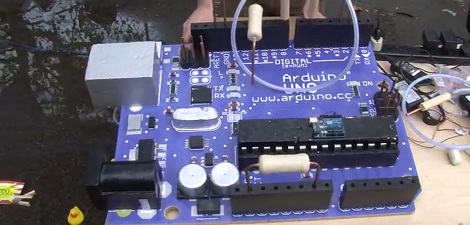
A 10x scale Arduino

[Robert Fitzsimons] of Part Fusion Electronics made a gigantic Arduino. It wasn’t quite functional, but [Robert] did manage to make a few 10:1 scale LEDs (with built-in circuit protection), 1 inch pitch headers, and a few other miscellaneous components out of foam and paint.

Since he’s from Dublin, Ireland, [Robert] didn’t want to take this giant board home with him. He graciously gave it to me in the hopes of turning it in to a proper working Arduino. I’ll do my best, [Robert].

There are hundreds of Lisas buried in a landfill in Utah.

Tekserve, an indie Apple store located in the heart of Manhattan, really knows how to put on a good show. For the entirety of their stay at Maker Faire, they had people showing off one of the first digital cameras, Apple Newtons, and an awesome collection of vintage Macs. No, your eyes do not deceive you; that’s a real Lisa there in the bunch.

Sadly, they didn’t have the boot disk to turn any of these on. Pity.

Yes, there were celebrities at Maker Faire

Well, celebrities to the Hackaday crowd, at least. [Ben Heck] showed off the electronic automatic sunglasses he built. It’s a pair of lensless glasses, a servo, light detector, and a pair of clip-on sunglasses. When [Ben] is out in daylight, the sunglasses swivel down. Inside, the amount of light received by the detector decreases and the shades rotate up.

Continue reading “Wrapping Up Maker Faire With [Ben Heck], Giant Arduinos, And An Apple Lisa”

Basking In The Vintage Glory Of InfoAge

Last weekend’s Maker Faire wasn’t only about the latest and greatest. Some of the groups there brought up the latest and greatest from earlier eras. InfoAge is a historical science and technology learning center based out of the former Camp Evans in Wall, New Jersey, and they really know how to put on a show using old technology.

I made it to two booths at Maker Faire claimed by members or associates of InfoAge. First up is the booth from MARCH, the Mid-Atlantic Retro Computing Hobbyists. They’ve got a PDP-8, a PDP-11/20, a few VAXxen, IBM mainframes, entire kilobytes of core memory, and enough C64s, TRS-80s, Commodore PETs, teletypes, and punch cards to get to the moon several times over.

The feature of MARCH’s booth was a nearly 100% accurate Apple I reproduction. Yes, the same computer built by hand by [the Steves] who later went on to found Apple Computers. In the video (above, and after the break), a MARCH member demonstrates booting BASIC from a cassette interface with the help of an iPod and typing in a simple program.

Next up are the guys from the radio technology museum at InfoAge. They decided to celebrate the 100th anniversary of [Edwin Armstrong]’s invention of the regenerative radio receiver.

The regenerative radio receiver is an extremely simple device; it can be built out of baling wire and some variants use only one tube. In the video, [Al] shows off his recreation of a regenerative receiver with fancy olde tymie components that include a variable capacitor and a B cell battery (it’s a recreation using a bunch of 9 Volts, but yes, B batteries do exist).

It goes without saying that InfoAge is really cool, and certainly worth the visit if you’re ever in the area. Bonus: it’s only 20 miles away from where [Penzias] and [Wilson] earned their Nobel Prize for discovering the Big Bang.

Continue reading “Basking In The Vintage Glory Of InfoAge”

Octopus Submarine Is Something Out Of [Jules Verne]’s Imagination

Making an octopus on a Reprap or Makerbot isn’t that terribly hard. There were dozens of these octopuses at nearly every Maker Faire booth with a 3D printer. These octopuses have almost become a right of passage for new owners of 3D printers, and serves as a wonderful reference object on par with the Utah teapot and the Stanford bunny.

[Sean Charlesworth] wasn’t happy with any old octopus; no, he had to build a better octopus, and what better way to do as such then to make a steampunk and [Jules Verne]-inspired model submarine?

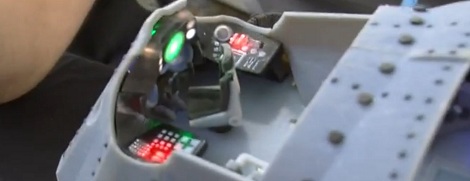
[Sean]’s Octopod underwater salvage vehicle was almost entirely printed on a very expensive printer. Save for a few LEDs, electronics, and armature wire, the entire model sub/octopus was printed on an Objet 500 Connex printer.

The Objet is unique among most 3D printers in that it can print objects made of several types of materials. In [Sean]’s show and tell he showed me how the tentacles were made of a hard plastic material and a bendable rubber material. [Sean] put a piece of wire through the length of each tentacle so he could pose the Octopod in just about any way imaginable.

The hull of the Octopod is an amazing amount of work. The cockpit features miniature controls, an illuminated display for a very tiny pilot, and even moving parts that include a mechanical iris in the recovery bay, a winch that works, and even doors that open and close.

[Sean] put a bunch of glamour shots of the Octopod on his web site along with a few videos of the construction process. You can check those videos alongside my interview after the break.

Continue reading “Octopus Submarine Is Something Out Of [Jules Verne]’s Imagination”

Seeed Studio Shows Off Their Wares

Everyone’s favorite Open Hardware store – Seeed Studio – was at Maker Faire this last weekend. They showed off a bunch of cool toys, oscilloscopes, Arduino shields and other hardware goodness, but one of the more interesting products was from their B Squares line.

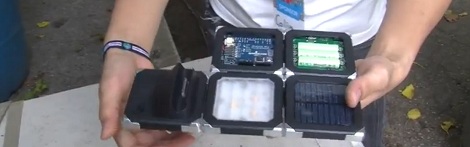
As [Colin] from Seeed showed us, each B Square is a small plastic enclosure about the size of a drink coaster. The corners of these squares are clad in metal, and each one has magnets inside. The idea behind the B Squares system is to provide power to other B Square boards via magnetic connections.

So far, Seeed has released an Arduino square, battery, solar, and LED squares, as well as iPod docks and prototyping boards. These boards can also be orthogonally, meaning it’s entirely possible to turn six B Squares into a B Cube.

These magnetic connections only provide power connections; there is currently no way to transfer data between different B Squares. We suspect, though, that anyone wanting to replicate the Apple MagSafe power adapter and invent a magnetic I2C bus would find these boards perfectly suited to the task.

Video after the break.

Continue reading “Seeed Studio Shows Off Their Wares”

200 Pound, WiFi Deploying Robot Ran Over My Foot

[Adam Bercu] and [Dan Landers] from Artisan’s Asylum in Somerville, MA brought a very, very cool toy to Maker Faire this year. It’s a two hundred pound WiFi repeater deploying robot able to amble across unforgiving terrain and my foot.

The robot is controlled through a web interface with the help of a front-mounted web cam with pan and tilt controls. All the signals are sent through a WiFi connection to a node.js web server; not the best way to communicate with a robot over long distances, but [Adam] and [Dan] have a few tricks up their sleeve.

On the back of the robot are two Pelican cases loaded up with a battery and a Linksys WRT54G wireless router. When the robot reaches the limits of its range, it activates a solenoid, dropping a WiFi repeater. This repeater has enough battery juice to stay powered for about a day and a half, meaning the robot can make multiple trips to deploy a wireless network through some very hostile terrain. Perfect for disaster and search and rescue operations.

There are two videos after the break: the first is [Dan] going over the capabilities of his tank bot and the second is a short demo of the bot tearing up the grass at Maker Faire.

Continue reading “200 Pound, WiFi Deploying Robot Ran Over My Foot”

Finally, An ARM-powered Arduino

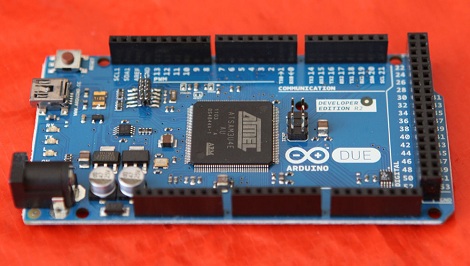
Far removed from the legions of 3D printers featured at this year’s Maker Faire in New York was a much smaller, but far more impressive announcement: The ARM-powered Arduino DUE is going to be released later this month.

Instead of the 8-bit AVR microcontrollers usually found in Arduinos, the DUE is powered by an ATSAM3X8E microcontroller, itself based on the ARM Cortex-M3 platform. There are a few very neat features in the DUE, namely a USB On The Go port to allow makers and tinkerers to connect keyboards, mice, smartphones (hey, someone should port IOIO firmware to this thing), and maybe even standard desktop inkjet or laser printers.

The board looks strikingly similar to the already common Arduino Mega. That’s no mistake; the DUE is compatible with existing shields, so connecting a RAMPS board for your 3D printer should be a snap.

Here’s a PDF the Arduino and Atmel guys were handing out at their booth. A few DUE boards have already made it into the hands of important people in the Arduino community, including 3D printer guru [Josef Prusa]. Sadly, the folks at Arduino didn’t think media personalities needed a DUE before its release, so you’ll have to wait until we get our hands on one later this month for a review.