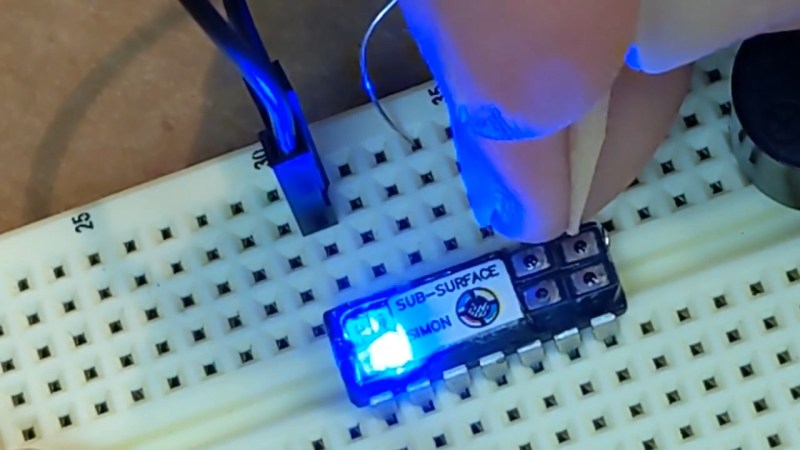
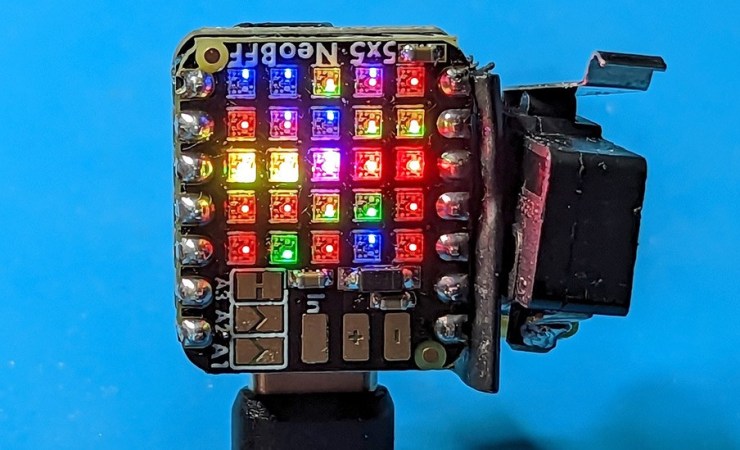
Left: the ATtinyBoy and cartridges inside a custom case. Right: ATTinyBoy under the hood.

2024 Tiny Games Contest: ATtinyBoy Does It With Tiny Cartridges

What is it about tangible media? There’s just something neat about having an individual thing that represents each game, each album, each whatever. Sure, you can have a little console with a thousand games loaded on it, but what’s the fun in that?

A Tetris cartridge made of a broken-out ATtiny85 and header pins.Enter the ATtinyBoy. [Bram]’s entry into the Tiny Games Contest is based on the ATtiny85, and the whole thing is smaller than a credit card. In fact, each little game cartridge contains its own ATtiny85, with the pins broken out into headers.

That is, although the schematic is based on [Billy Cheung]’s gametiny, which uses an ATtiny85 as the brain, ATtinyBoy’s brain is divided among each of the games.

This certainly checks a lot of boxes when it comes to contest rules and requirements, and it’s just awesome besides. We particularly like the custom box that holds ATtinyBoy and all his distributed knowledge. If you want to make one of your own, the schematic, code, and STLs are all available over on IO.

Two types of polymer clay hand warmers with a digital temperature controller.

Adjustable Electric Hand Warmers

It may be the last gasp of summer here in the Northern Hemisphere, but it’s always cold somewhere, whether it’s outdoors or inside. If you suffer from cold, stiff hands, you know how difficult it can be to work comfortably on a computer all day. Somehow, all that typing and mousing does little to warm things up. What you need are hand warmers, obviously, and they might as well be smart and made to fit your hands.

Using a heat gun to cure polymer clay. Fifteen-year-old [Printerforge] created these bad boys in an effort to learn how to code LCDs and control heat like Magneto controls ferrous metals. Thanks to digital control, they can heat up to specific temperatures, and they happen to run for a long time.

Power-wise, these warmers use a 18650 cell and a TP4056 charging module. Everything is controlled by an Arduino Nano, which reads from both a thermistor and a potentiometer to control the output.

[Printerforge] really thought this project through, as you’ll see in the Instructable. There’s everything from a table of design requirements to quick but thorough explanations of nichrome wire and basic electronic theory.

And then there’s the material consideration. [Printerforge] decided that polymer clay offers the best balance of heat conductivity and durability. They ended up with two styles — flat, and joystick grip. The best part is, everything can fit in a generous pocket.

Clay is good for a lot of things, like making the perfect custom mouse.

A mini Cyclone game consisting of an Arduino, an LED ring, and button, plus a scoreboard on a 16x2 LCD.

2024 Tiny Games Contest: Mini Cyclone Tests Reaction Time

Round and round goes the red LED, and if you can push the button when it overlaps the green LED, then you win. Cyclone is almost too simple of a game, and that’s probably part of why it’s so addictive.

The back side of the mini Cyclone game, showing the guts.Want to make one for your desk? All it takes is an Arduino Nano R3 or comparable microcontroller, an RGB LED ring with 12 LEDs, a 16×2 LCD, a buzzer, and a momentary push button switch.

Interestingly, there aren’t successive levels with increasing speed, but each round begins with a randomized speed value. Of course, this can all be easily changed in the code, which is modified from [Joern Weise]’s original.

This is a tinier version of [mircemk]’s original project, which uses a 60-LED ring and does contain levels. As usual with [mircemk]’s builds, this project is mounted on their trademark 3 mm PVC board and covered with peel-and-stick wallpaper. Be sure to check out the demo and build video after the break.

Don’t forget! You have until Tuesday, September 10th to enter the 2024 Tiny Games Contest, so get crackin’!

Continue reading “2024 Tiny Games Contest: Mini Cyclone Tests Reaction Time”

A tricked-out kids' Jeep in black and silver.

Driven To Over-Engineer A Kids’ Car

You know, it feels as though it’s getting more and more difficult to compete for Father of the Year around here. And [Jon Petter Skagmo] just laid down a new gauntlet — the incredibly overly-engineered kids car.

Close-up of the dash panel of an overly-engineered kids' car.While the original plan was to build the entire car from scratch, [Jon] eventually opted to use an off-the-shelf car that had a dead battery.

While the original architecture was quite simple, the new hardware has just about everything a kid could want in a tricked-out ride, most of which is accessible through the really cool dashboard.

We’re talking headlights, a music player, a siren, a selfie video cam that doubles as two-way communication with the driver, and even a garage door opener that uses an MQTT connection.

Under the cute little hood is where you’ll find most of the electronics. The car’s brain is a Raspberry Pi 3B, and there’s a custom daughter board that includes GPS/GNSS. This was originally meant to geofence [Baby Girl Skagmo] in, but Dad quickly realized that kids are gonna kid and disabled it pretty soon after.

This isn’t the first high-tech rebuild of a kiddie car that we’ve seen here at Hackaday. Makes us wish we were quite a bit smaller…

Continue reading “Driven To Over-Engineer A Kids’ Car”

The blind maze -- a box with three buttons and three light-up panels that indicate walls.

2024 Tiny Games Contest: Blind Maze Is Fun For All

If you think about it, even difficult mazes on paper are pretty easy. You can see all the places you can and can’t go, and if you use a pencil instead of a pen, well, that’s almost like cheating.

The innards of the blind maze.However, using a pencil is pretty much a necessity to play [penumbriel]’s Blind Maze. In this game, you can’t even see the maze, or where you are. Well, that’s not exactly true — you can “touch” the wall (or lack thereof) in front of you and to the sides, but that’s it. So you’re going to need that pencil to draw out a map as you go along.

This game runs on an Arduino Nano and a 18650 cell. There are three LEDs deep within the enclosure, which is meant to give the depth of walls. But, even the vision-impaired can play the Blind Maze, because there’s haptic feedback thanks to a small vibration motor.

If you want to play in hard mode, there’s a hidden paperclip-accessible switch that turns off the LEDs. This way, you have to rely on hitting the walls with your head. Be sure to check out the video below.

Continue reading “2024 Tiny Games Contest: Blind Maze Is Fun For All”

Boss Byproducts: Fordites Are Pieces Of American History

Some of the neatest products are made from the byproducts of other industries. Take petroleum jelly, for example. Its inventor, Robert Chesebrough, a chemist from New York, came upon his idea while visiting the oil fields of Titusville, Pennsylvania in 1859. It took him ten years to perfect his formula, but the product has been a household staple ever since. Chesebrough so believed in Vaseline that he ingested a spoonful of it every day, and attributed his 96-year longevity to doing so.

Well, some byproducts can simply be beautiful, or at least interesting. On that note, welcome to a new series called Boss Byproducts. We recently ran an article about a laser-engraved painting technique that is similar to the production of Fordite. I had never heard of Fordite, but as soon as I found out what it was, I had to have some. So, here we go!

Continue reading “Boss Byproducts: Fordites Are Pieces Of American History”

Illustrated Kristina with an IBM Model M keyboard floating between her hands.

Keebin’ With Kristina: The One With The Folding Typewriter

Have you built yourself a macro pad yet? They’re all sorts of programmable fun, whether you game, stream, or just plain work, and there are tons of ideas out there.

A DIY macro pad with key switches, dual linear pots, a rotary encoder, a screen, and a speaker.
Image by [CiferTech] via Hackaday.IO
But if you don’t want to re-invent the wheel, [CiferTech]’s MicroClick (or MacroClick — the jury is still out) might be just what you need to get started straight down the keyboard rabbit hole.

This baby runs on an ATmega32U4, which known for its Human Interface Device (HID) capabilities. [CiferTech] went with my own personal favorite, blue switches, but of course, the choice is yours.

There are not one but two linear potentiometers for volume, and these are integrated with WS2812 LEDs to show where you are, loudness-wise. For everything else, there’s an SSD1306 OLED display.

But that’s not all — there’s a secondary microcontroller, an ESP8266-07 module that in the current build serves as a packet monitor. There’s also a rotary encoder for navigating menus and such. Make it yours, and show us!

Continue reading “Keebin’ With Kristina: The One With The Folding Typewriter”