The Chip Shortage Leads To The Strangest Things

The global chip shortage has not made the life of the electronic design engineer an easy one, as products have been designed around whatever parts are available rather than the first choices. This has manifested itself in some unexpected ways, including as [CNX software] investigates, products whose multiple-choice bill of materials has led to mistakes being made in manufacture.

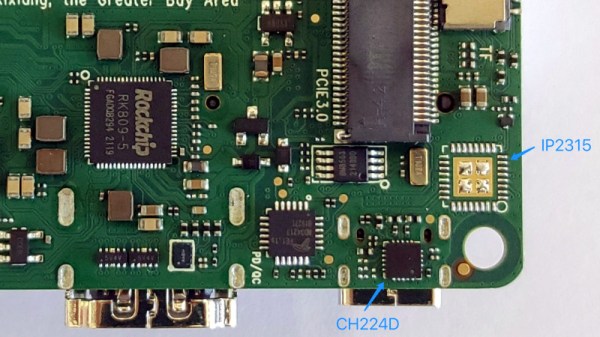
On the face of it, designing a PCB with two sets of footprints to accommodate more than one part choice is a clever move. But as Radxa found out with their Rock 3A single board computer, this could lead to a production mishap as some boards left the production line with a mix-and-match BoM in their USB PD circuitry which left them unable to operate from voltages above 5 V. The board has footprints for both an Injoinic and a WCH part, and the faulty boards appear to have the support components fitted for the other chip to the one on the board.

We’d join [CNX] in congratulating Radxa for coming clean, and we like that one of the options to fix it is to be sent the chip to fit yourself. We’re left rather glad that it wasn’t us on whose watch such a mistake occurred, as from experience we know these things can happen all too easily.

Has the chip shortage led to any similar production mistakes in your life? Let us know in the comments.


Hackaday Prize 2022: Solar Power Through Pyrolysis

We’re all familiar with solar cells, be they photovoltaic, or for heating water. But they are only the more common ways of converting the sun’s energey into usable power, and to the extended list there is now an addition courtesy of [Dennis]. He’s using the sun to drive the pyrolysis of biomass waste, releasing hydrogen fuel.

For those who aren’t familiar with the chemistry, pyrolysis refers to chemical reactions triggered by heat. In this case, when organic biomass is heated in the absence of oxygen it breaks down and releases the gaseous products of that breakdown as well as a mass of carbon. The idea behind this pyrolysis cell is that a Fresnel lens will focus the sun on a reaction chamber, providing the required heat for the reaction to occur. A test with a magnifier and a test tube proves that there’s something in it.

Of course, sharp-eyed readers will notice that this isn’t quite in the same vein as other cells which convert the Sun’s energy into a usable form, in that while it provides an input of energy for the pyrolysis the chemical energy in the resulting gas comes mostly from the original biomass. There is a silver lining to the prospect of burning gas though, in that the left-over carbon can be incorporated into the soil as biochar, an effective carbon sink.

We’ve seen a project pursuing a similar chemistry before, though not using solar energy to do it.

A Fast Linear Actuator Entirely In One PCB

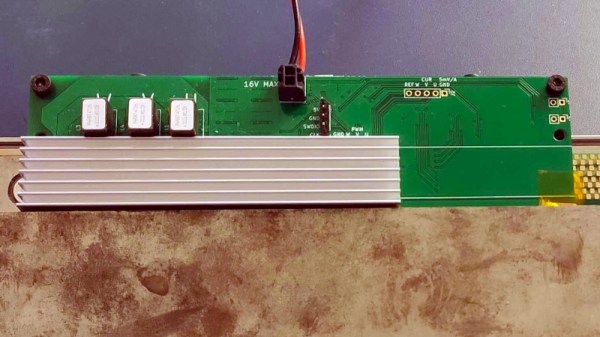
There are many ways to make a linear actuator, a device for moving something is a straight line. Most of the easier to make ones use a conventional motor and a mechanical linkage such as a rack and pinion or a lead screw, but [Ben Wang] has gone for something far more elegant. His linear actuator uses a linear motor, a linear array of coils for the motor phases, working against a line of magnets. Even better than that, he’s managed to make the whole motor out of a single PCB. And it’s fast!

This represents something of an engineering challenge, because achieving the required magnetic field from the relatively few turns possible on a PCB is no easy task. He’s done it by using a four-layer board to gather enough turns for the required magnetic field, and a simple view of the board doesn’t quite convey what lies beneath.

PCB motors are perhaps one of those areas where the state of the art is still evolving, and the exciting part is that their limits are being pushed right there in our community. And this isn’t the only linear motor we’ve seen recently either, here’s one used in a model train.

What Goes Into A Hacker Camp

Long-time readers of Hackaday will know that we attend quite a few events, including summer hacker camps. Here in Europe this year there are two large events, the British Electromagnetic Field, and the Dutch MCH, or May Contain Hackers. These events are put together by volunteers from within the community, and as part of the MCH setup I noticed they needed drivers for their off-site logistics. I have a licence to drive medium-sized trucks in Europe so it seemed like a perfect fit. I traveled early on the first set-up day to the Dutch city of Utrecht, and found myself behind the wheel of a large Volkswagen box van. My brief career as a trucker had begun!

An Empty Field Of Dreams

A field with a few tents and a blue sky
The tents stand in isolation at the end of day one.

The Netherlands is a relatively small country and the MCH site at Zeewolde is roughly in its centre, so while the traffic could be heavy the distances weren’t large by American or even British standards. There were however a wide variety of loads waiting for me and my fellow driver, and a few obstacles such as the hottest days of the year and angry Dutch farmers blockading the roads. If you’re interested in the logistics behind a large hacker camp then our journeys provided an insight that maybe wandering around the field doesn’t quite deliver.

Arriving on site on the first day gives a perspective on how much of the infrastructure comes from specialist contractors and thus isn’t delivered by the hackers. Articulated trucks from the marquee company were disgorging the main tents, with their crews expertly assembling them in record time. The toilets and showers were arriving as self-contained hook lift container units, and yet more contractors were delivering fencing or tables and chairs. I can add the power infrastructure to this list, but due I’m told to delays at another event this wasn’t on site on the first day. Continue reading “What Goes Into A Hacker Camp”

A Steam Box For Not A Lot

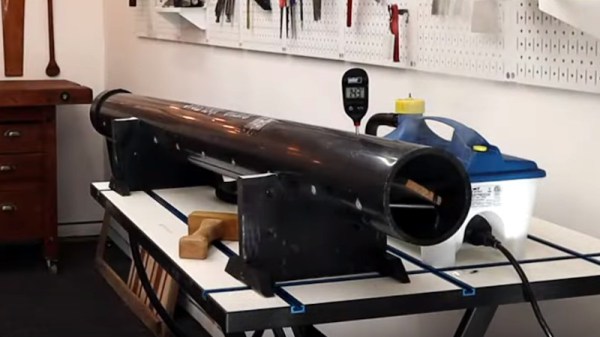
If you have ever marveled at the complex wooden curves used by shipbuilders or some furniture makers, then you have probably at some point hankered after a steam box. This is as its name suggests, a chamber in which a piece of wood is steamed until it becomes flexible, at which point it can be pressed into a new shape that it will retain once cooled. The ever-resourceful [Xyla Foxlin] shows us how to make a steam box using easy-to-find parts, as can be seen in the video below the break.

The steam supply comes from a commercial steam boiler of the type used by decorators for wallpaper stripping, and the steam box itself is made from a length of PVC pipe. Inside the pipe are a series of aluminium dowels that form a rack upon which the wood sits away from any condensation, and the whole things sits at a slant with the steam inlet and a condensation drain at the bottom end.

In use, a piece of wood is loaded into the tube and steamed, before being bent using a set of forms in a vice.  The process looks straightforward enough that even we could give it a go, so we’re sure Hackaday readers will find it interesting.

We think this may be the first steam box we’ve brought you, but it’s not the first time we’ve discussed bending wood.

Continue reading “A Steam Box For Not A Lot”

Hackaday Prize 2022: A Plasma Tweeter For Ultimate Clarity

In the world of audio there are a huge variety of esoteric technologies which are rarely seen. One such is the plasma tweeter, a type of loudspeaker which generates sound by modulating a small electrical discharge. The benefit of this design comes in its delivering the closest possible to a point audio source, in effect the theoretical ideal speaker for treble frequencies. They’re a little hazardous due to the voltage but aren’t too difficult to make, as demonstrated by [Mircemk] whose version uses a recycled power pentode tube — which is how it showed up in the Hack it Back round of the Hackaday Prize.

It can be thought of as a cousin of the Tesla coil, with the same resonant oscillator but no capacity hat. Instead the top of the coil ends in a point, from which in the perfect speaker a ball of plasma replaces the Tesla’s impressive sparks. In this case the pentode is joined by a high-voltage TV line output transistor as a bias supply, which is in turn modulated with the audio through a small amplifier. It sometimes needs the plasma teasing out of it through discharge to a screwdriver, but the result is a very effective and clear plasma tweeter.

If plasma tweeters interest you, we’ve featured them before.

Was There A Programmable PONG Chip?

Students of game console history will reach back into the 1970s for the primordial machines, tracing from the Magnavox Odyssey onwards, and thence via the Fairchild Channel F into the world of microprocessors and the chain of machines that lead us to those we enjoy today. In the early days there was a parallel evolution for a few years of dedicated video game consoles with no interchangeable cartridges or microprocessors, these took their inspiration from the legendary PONG arcade game and used dedicated non-programmable hardware in custom chips to create their video. But was there a programmable PONG chip lurking among all the others? [Old VCR] takes a look.

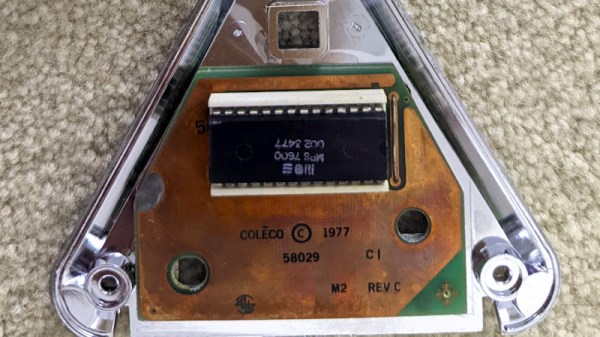
Many readers will be familiar with MOS Technology as the originator of the 6502 processor used in so many 8-bit home computers. But perhaps many of our attention spans will have passed over another of their products, the MOS 7600 and 7601. These were the chip company’s entry into the surprisingly congested mid-70s PONG-in-a-chip market, and the article investigates the question of whether they might in fact be mask-programmed microcontrollers masquerading as dedicated chips.

It’s a fascinating tour through the mid-70s in terms of games consoles, MOS, and through their eventual takeover, Commodore. The possibility of a mask-programmed PONG chip is explored in detail and discounted, though like [Old VCR], we’d love to see one decapped and reverse engineered. For us a stronger line of evidence comes in asking why MOS would stop at PONG if they had a mask-programmed microcontroller in their catalogue, and that our not having seen MOS microcontrollers appearing all over Commodore’s subsequent products suggests that it may be simply another dedicated PONG chip like all the others.

We’ve seen quite a few variants of this iconic game over the years, but few as impressive as one made from discrete components.