2025 One Hertz Challenge: A Discrete Component Divider Chain

Most of us know that a quartz clock uses a higher frequency crystal oscillator and a chain of divider circuits to generate a 1 Hz pulse train. It’s usual to have a 32.768 kHz crystal and a 15-stage divider chain, which in turn normally sits inside an integrated circuit. Not so for [Bobricius], who’s created just such a divider chain using discrete components.

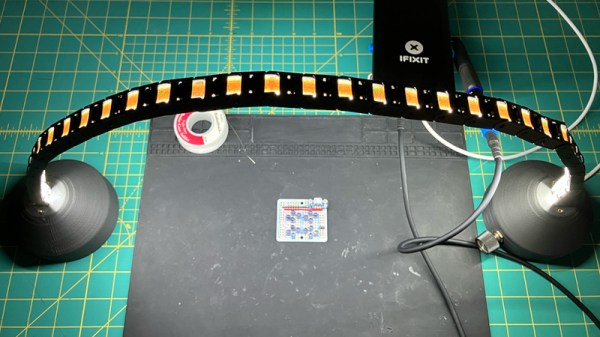
The circuit of a transistor divider is simple enough, and he’s simply replicated it fifteen times in surface mount parts on a PCB with an oscillator forming the remaining square in a 4 by 4 grid. In the video below the break we can see him measuring the frequency at each point, down to the final second. It’s used as the timing generator for an all transistor clock, and as we can see it continues that trend. Below the break is a video showing all the frequencies in the chain.

This project is part of our awesome 2025 One Hertz Challenge, for all things working on one second cycles. Enter your own things that go tick and tock, we’d live to see them!

Continue reading “2025 One Hertz Challenge: A Discrete Component Divider Chain”

USB-C-ing All The Things

Wall warts. Plug mounted power supplies that turn mains voltage into low voltage DC on a barrel jack to power a piece of equipment. We’ve all got a load of them for our various devices, most of us to the extent that it becomes annoying. [Mikeselectricstuff] has the solution, in the shape of a USB-C PD power supply designed to replace a barrel jack socket on a PCB.

The video below provides a comprehensive introduction to the topic before diving into the design. The chip in question is the CH224K, and he goes into detail on ordering the boards for yourself. As the design files are freely available, we wouldn’t be surprised if they start turning up from the usual suppliers before too long.

We like this project and we can see that it would be useful, after all it’s easy to end up in wall wart hell. We’ve remarked before that USB-C PD is a new technology done right, and this is the perfect demonstration of its potential.

Continue reading “USB-C-ing All The Things”

2025 One Hertz Challenge: An Ancient Transistor Counts The Seconds

If you’ve worked with germanium transistors, you’ll know that many of them have a disappointingly low maximum frequency of operation. This has more to do with some of the popular ones dating from the earliest years of the transistor age than it does to germanium being inherently a low frequency semiconductor, but it’s fair to say you won’t be using an OC71 in a high frequency RF application. It’s clear that [Ken Yap]’s project is taking no chances though, because he’s using a vintage germanium transistor at a very low frequency — 1 Hz, to be exact.

The circuit is a simple enough phase shift oscillator that flashes a white LED, in which a two transistor amplifier feeds back on itself through an RC phase shift network. The germanium part is a CV7001, while the other transistor is more modern but still pretty old these days silicon part, a BC109. The phase shift network has a higher value resistor than you might expect at 1.8 MOhms, because of the low frequency of operation. Power meanwhile comes from a pair of AA cells.

We like this project not least for its use of very period passive components and stripboard to accompany the vintage semiconductor parts. Perhaps it won’t met atomic standards for timing, but that’s hardly the point.

This project is an entry in the 2025 One Hertz Challenge. Why not enter your own second-accurate project?

Listen To The Sound Of The Crystals

We’re all used to crystal resonators — they provide pretty accurate frequency references for oscillators with low enough drift for most of our purposes. As the quartz equivalent of a tuning fork, they work by vibrating at their physical resonant frequency, which means that just like a tuning fork, it should be possible to listen to them.

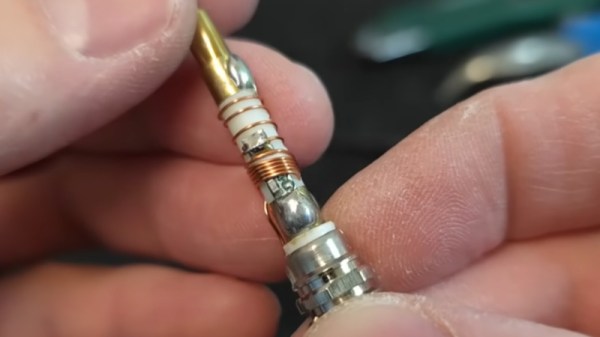
A crystal in the MHz might be difficult to listen to, but for a 32,768 Hz watch crystal it’s possible with a standard microphone and sound card. [SimonArchipoff] has written a piece of software that graphs the frequency of a watch crystal oscillator, to enable small adjustments to be made for timekeeping.

Assuming a microphone and sound card that aren’t too awful, it should be easy enough to listen to the oscillation, so the challenge lies in keeping accurate time. The frequency is compared to the sound card clock which is by no means perfect, but the trick lies in using the operating system clock to calibrate that. This master clock can be measured against online NTP sources, and can thus become a known quantity.

We think of quartz clocks as pretty good, but he points out how little it takes to cause a significant drift over month-scale timings. if your quartz clock’s accuracy is important to you, perhaps you should give it a look. You might need it for your time reference.


Header: Multicherry, CC BY-SA 4.0.

Crunching The News For Fun And Little Profit

Do you ever look at the news, and wonder about the process behind the news cycle? I did, and for the last couple of decades it’s been the subject of one of my projects. The Raspberry Pi on my shelf runs my word trend analysis tool for news content, and since my journey from curious geek to having my own large corpus analysis system has taken twenty years it’s worth a second look.

How Career Turmoil Led To A Two Decade Project

A hanging sign surrounded by ornate metalwork, with the legend "Cyder house".
This is very much a minority spelling. Colin Smith, CC BY-SA 2.0.

In the middle of the 2000s I had come out of the dotcom crash mostly intact, and was working for a small web shop. When they went bust I was casting around as one does, and spent a while as a Google quality rater while I looked for a new permie job. These teams are employed by the search giant through temporary employment agencies, and in loose terms their job is to be the trained monkeys against whom the algorithm is tested. The algorithm chose X, and if the humans also chose X, the algorithm is probably getting it right. Being a quality rater is not in any way a high-profile job, but with the big shiny G on my CV I soon found myself in demand from web companies seeking some white-hat search engine marketing expertise. What I learned mirrored my lesson from a decade earlier in the CD-ROM business, that on the web as in any other electronic publishing medium, good content well presented has priority over any black-hat tricks.

But what makes good content? Forget an obsession with stuffing bogus keywords in the text, and instead talk about the right things, and do it authoritatively. What are the right things in this context? If you are covering a subject, you need to do so using the right language; that which the majority uses rather than language only you use. I can think of a bunch of examples which I probably shouldn’t talk about, but an example close to home for me comes in cider. In the UK, cider is a fermented alcoholic drink made from apples, and as a craft cidermaker of many years standing I have a good grasp of its vocabulary. The accepted spelling is “Cider”, but there’s an alternate spelling of “Cyder” used by some commercial producers of the drink. It doesn’t take long to realise that online, hardly anyone uses cyder with a Y, and thus pages concentrating on that word will do less well than those talking about cider.

A graph of the word football versus the word soccer in British news.
We Brits rarely use the word “soccer” unless there’s a story about the Club World Cup in America.

I started to build software to analyse language around a given topic, with the aim of discerning the metaphorical cider from the cyder. It was a great surprise a few years later to discover that I had invented for myself the already-existing field of computational linguistics, something that would have saved me a lot of time had I known about it when I began. I was taking a corpus of text and computing the frequencies and collocates (words that appear alongside each other) of the words within it, and from that I could quickly see which wording mattered around a subject, and which didn’t. This led seamlessly to an interest in what the same process would look like for news data with a time axis added, so I created a version which harvested its corpus from RSS feeds. Thus began my decades-long project.

Continue reading “Crunching The News For Fun And Little Profit”

The Hackaday Summer Reading List: No AI Involvement, Guaranteed

If you have any empathy at all for those of us in the journalistic profession, have some pity for the poor editor at the Chicago Sun-Times, who let through an AI-generated summer reading list made up of novels which didn’t exist.  The fake works all had real authors and thus looked plausible, thus we expect that librarians and booksellers throughout the paper’s distribution area were left scratching their heads as to why they’re not in the catalogue.

Here at Hackaday we’re refreshingly meat-based, so with a guarantee of no machine involvement, we’d like to present our own summer reading list. They’re none of them new works but we think you’ll find them as entertaining, informative, or downright useful as we did when we read them. What are you reading this summer? Continue reading “The Hackaday Summer Reading List: No AI Involvement, Guaranteed”

A Feast Of 1970s Gaming History, And An 8080 Arcade Board

Sometimes a write-up of a piece of retrocomputing hardware goes way beyond the hardware itself and into the industry that spawned it, and thus it is with [OldVCR]’s resurrection of a Blasto arcade board from 1978. It charts the history of Gremlin Industries, a largely forgotten American pioneer in the world of arcade games, and though it’s a long read it’s well worth it.

The board itself uses an Intel 8080, and is fairly typical of microcomputer systems from the late 1970s. Wiring it up requires a bit of detective work, particularly around triggering the 8080’s reset, but eventually it’s up and playing with a pair of Atari joysticks. The 8080 is a CPU we rarely see here.

The history of the company is fascinating, well researched, and entertaining. What started as an electronics business moved into wall games, early coin-op electronic games, and thence into the arcade segment with an 8080 based system that’s the precursor of the one here. They even released a rather impressive computer system based on the same hardware, but since it was built into a full-sized desk it didn’t sell well. For those of us new to Gremlin Industries the surprise comes at the end, they were bought by Sega and became that company’s American operation. In that sense they never went away, as their successor is very much still with us. Meanwhile if you have an interest in the 8080, we have been there for you.