Teardown: Alcatel Telic 1 Minitel Terminal

For British teenagers in the 1980s, the delights of 8-bit computers such as the Sinclair Spectrum, Commodore 64, or BBC Micro were firmly restricted to the offline arena. We would read about the BBS scene on the other side of the Atlantic, but without cheap local calls and with a modem costing a small fortune, the chances of us ever experiencing one was zero. When we took the British school rite of passage of a trip to France though, we were astounded to see that every French person was not merely online, but that they were doing so with a neat little all-in-one terminal. We’d just been introduced to the French Minitel system, and in that minute shared a glimpse of the future.

Un Réseau Trés Français
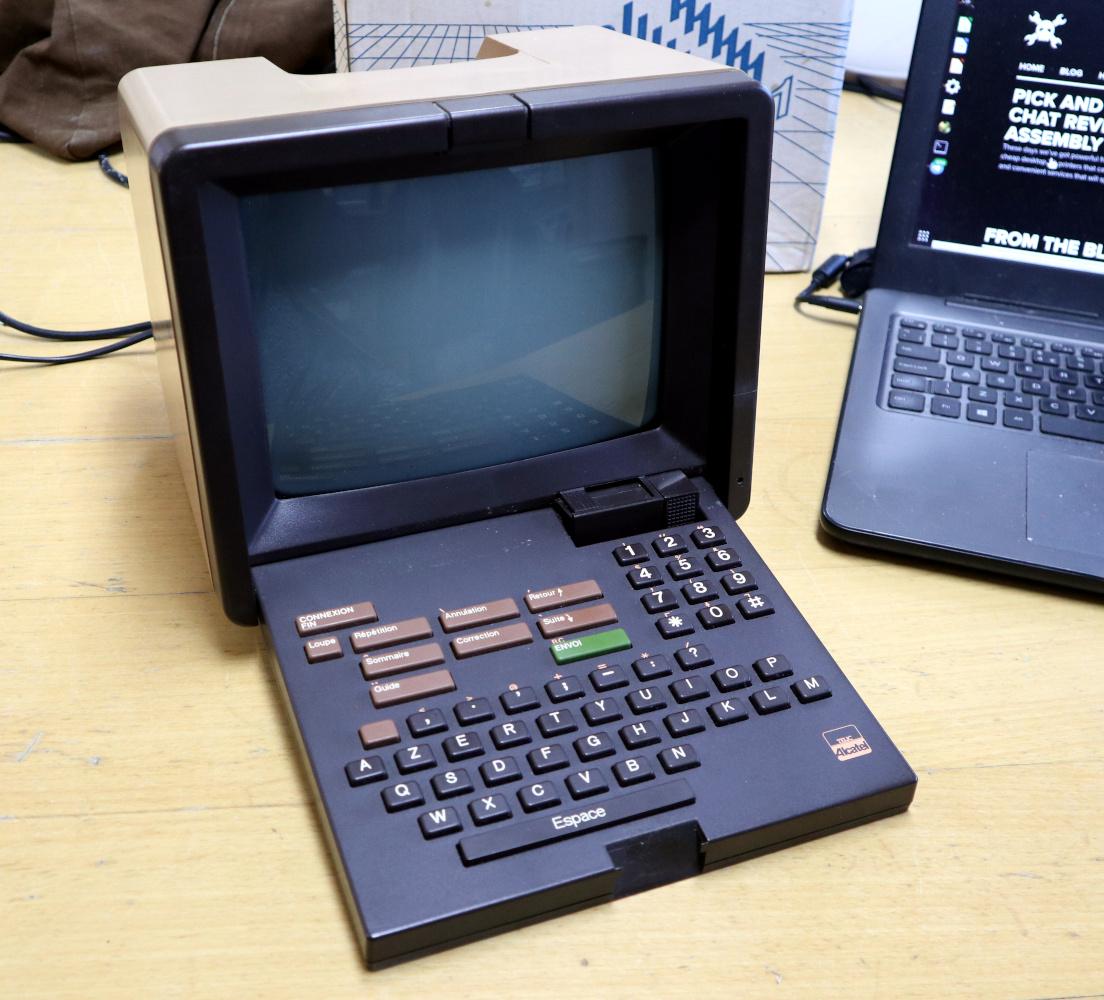
The Minitel terminal is a small CRT monitor with a fold-down alphanumeric keyboard.
My Alcatel Minitel terminal

In the 1970s and 1980s, so-called videotext systems, terminal-based phoneline access to information services on central computers, were seen as an obvious next step for telephone network operators with an interest in profitable new products. In most countries this resulted in services such as the UK’s Prestel, a subscription service relying on costly hardware, but France Télécom instead pursued the bold path of making the terminals free to subscribers with free access to phone listings and yellow pages, but a business model based on pay-to-use premium services.

Thus, through the 1980s all French households had a Minitel terminal beside the phone, and the service became a runaway success. Ever since seeing Minitel terminals as a tourist I’d been fascinated by the service, so here in the 2020s when a friend was visiting their family in France I asked whether he could pick up an old Minitel terminal for me. Thus I found myself parting with around $25 and being rewarded with a slightly battered Minitel cardboard box containing one of the familiar brown Alcatel terminals. I certainly wasn’t expecting one in its original packaging. Continue reading “Teardown: Alcatel Telic 1 Minitel Terminal”

Accurately Track Your Mains Frequency

Depending upon where in the world you live, AC mains frequency is either 50Hz or 60Hz, and that frequency is maintained accurately enough over time that it can be used as a time reference for a clock. Oddly it’s rarely exactly that figure though, instead it varies slightly with load on the network and the operators will adjust it to keep a constant frequency over a longer period. These small variations in frequency can easily be measured, and [jp3141] has created a circuit that does exactly that.

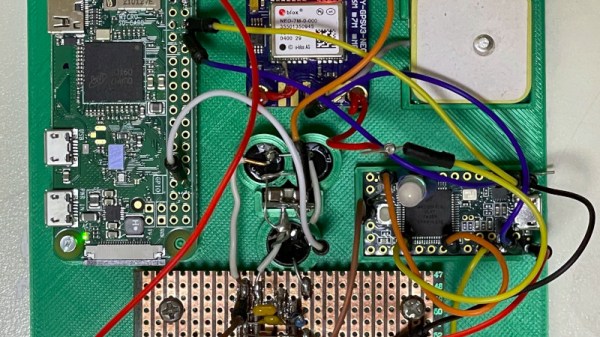
It’s a surprisingly straightforward device, in which a Teensy takes its power supply from a very conventional if now a little old-school mains transformer, rectifier, and regulator. A sample of the AC from the transformer passes through a low-pass filer and a clamp, and thence to the Teensy where it is fed into one of the on-board comparators from which its period is measured using one of the timers. Even then the on-board crystal isn’t considered accurate enough, so it is in turn disciplined by a 1 pulse per second (PPS) signal from a GPS receiver.

The Teensy then reports its readings over a serial line every five seconds to a Raspberry Pi, which collates and graphs the data. In case you are wondering what the effect of mains frequency variations might be, we once covered the story of how an entire continent lost six minutes.

This Minibike Will Land You In Hot Water

The minibike is an American phenomenon which fascinates those of us from countries in which such contraptions are illegal on the road; they seem to deliver bucketloads of low-octane fun in which we are unable to participate. [HowToLou] has one, and as it’s something for use in the Great Outdoors it naturally requires some means of fixing a brew. His solution to the need for a mug of boiling water in out-of-the-way places? A gravity-fed heat exchanger for the exhaust pipe, fed from a reservoir made using an upturned bottle.

As can be seen in the video below the break it’s a simple enough piece of work but surprisingly effective. A piece of small-bore copper tube is passed through a cork into the bottle, then wrapped round a piece of pipe which forms an exhaust The resulting heat exchanger is insulated, the engine started, and the cork loosened just enough to cause a bit of water to flow. The result – a good flow of hot water for that morning coffee.

It may not be the most practical of water heaters, but it’s certainly a bit of fun even if it might not work with all the minibikes we’ve covered.

Continue reading “This Minibike Will Land You In Hot Water”

Build Your Own CRT TV

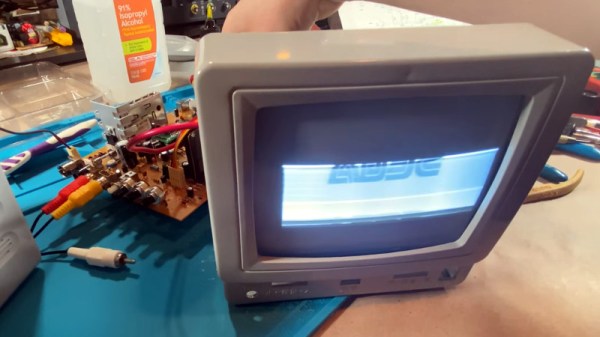
There was a time following the Second World War when TV sets for the nascent broadcast medium were still very expensive, but there was an ample supply of war-surplus electronic parts including ex-radar CRTs. Thus it wasn’t uncommon at all for electronics enthusiasts of the day to build their own TV set, and magazines would publish designs to enable them. With a burgeoning consumer electronics industry the price of a new TV quickly dropped to the point of affordability so nobody would consider building one themselves today. Perhaps that should be amended to almost nobody, because [Retro Tech or Die] has assembled a small black-and-white CRT TV from a kit he found on AliExpress.

We have to admit to having seen the same kit and despite a sincere love for analogue telly, to have balked at the price. It’s an exceptionally cheap set of the type that was available from discount stores for a laughably low price around the final few years of mainstream analogue TV broadcasting, and having a couple in the stable we can confirm that the value here lies in building the thing rather than owning it.

The unboxing and building proceeds as you might expect, with the addition of very poor documentation and extremely low-quality parts. Satisfyingly it works on first power-up, though some adjustment and the reversing of a deflection yoke connection is required for a stable picture. The scanned area doesn’t fill the screen and he doesn’t find the solution in the video, we hope that by his next video someone will have suggested moving the deflection yoke forwards.

Perhaps merely assembling a kit might not seem the most exciting subject for a Hackaday story, but this one is a little different here in 2022. CRT TV sets are now a long-gone anachronism, so for a younger generation there is very little chance to see them up close and thus watching one built has some value. If you want to spend the cash and build your own he’s dropped the link in the YouTube description, otherwise watch the progress in the video below the break.

Fancy learning a bit more about analogue TV? Have a dive into the video waveform. Or for a bit more CRT goodness, learn about converging a delta-gun colour set from the days when a TV weighed almost as much as you did.

Continue reading “Build Your Own CRT TV”

It’s Always Floppy Time!

On [Jan Derogee]’s desk is something that wouldn’t look out of place for many of us, a pile of computer magazines with a case of 3.5″ floppy disks on top of it. The causal observer would see nothing more than the detritus of a retrocomputer enthusiast’s existence, but stick around. In fact it’s a clock, and one of the most unusual ones we’ve seen in a long time.

How can a box of floppies tell us the time? Selected disks have custom labels that look as though they might be authentic game collections, but in reality are fakes that carry numbers alongside the game art. An ingenious system of cams hidden in the hollowed out pile of magazines raises the correct floppies to tell the time, hours on the left row and minutes to the closest five minutes on the right. The floppies are modified by the removal of some plastic and the disk itself, because early versions had a habit of shredding disks. A final touch comes in the form of a Nokia phone on the desk next to the clock which plays a tune in lieu of chimes on the hour. You can see the clock in action in the video below the break.

Continue reading “It’s Always Floppy Time!”

A Bugatti Without The Inconvenience Of Wealth

There are many of us who might have toyed with the idea of building a car, indeed perhaps more than a few readers might even have taken to the road in a machine of their own creation. Perhaps it was a design of your own, or maybe a kit car. We think that very few of you will have gone as far as [Vũ Văn Nam] and his friends in Vietnam. In their latest video they compress a year’s work into 47 minutes as they craft a beautifully built replica of a Bugatti supercar. If you haven’t got a few million dollars but you’ve got the time, this is the video for you.

The skill involved in making a scratch-built car is impressive enough, but where there guys take it to the next level is in their clay modeling to create the moulds for the fibreglass bodywork. Taking their local clay and a steel frame, they carefully hand-sculpt the car with the skill of an Italian master stylist, before clothing it in fibreglass and removing the clay. The resulting fibreglass shell can be used to make the finished bodywork, which they do with an exceptional attention to detail. It might be a steel-tube home-made spaceframe with a wheezy 4-cylinder Toyota engine behind the driver instead of a 1000 HP powerhouse, but it surely looks the part!

Looking at the construction we’re guessing it wouldn’t pass an Individual Vehicle Approval test for roadworthiness where this is being written, but at the same time it wouldn’t be impossible to incorporate the extra work as this is a proper road-going car. The video is below the break, and though the few pieces of dialogue in it are in Vietnamese you probably won’t need to turn on the auto-translate to follow it.

This isn’t their first fake supercar, there’s already a Ferrari in this particular stable. Meanwhile if you’re of a mind to make a car, consider the world’s most hackable vehicle.

Continue reading “A Bugatti Without The Inconvenience Of Wealth”

Gaming Twitter’s Trending Algorithm To Make A Point

If you have ever taken to Twitter to gauge the zeitgeist, you’ll have noticed that among the trending hashtags related to major events of the day there are sometimes outliers of minority interest associated with single-issue causes. When a cause with a distasteful pedigree was cited one as proof of widespread public support in a debate in the UK’s House of Lords there were concerns raised that a flaw in the ranking algorithm might be responsible, and it was left to [Mallory Moore] to prove the hypothesis by getting a #ThisIsAnExploit hashtag trending without a groundswell of popular support.

Some previous detective work had established that equal ranking might be awarded equally not simply for Tweeting a hashtag but also for retweeting it. The exploit takes advantage of this by means of a relatively small cadre of people all Tweeting the tag a number of times, then retweeting all other instances of it. The resulting rank gain is then in the order of the square of the number of accounts interacting with the tag, and thus hugely inflated over the number of real participants. To test this she created the #ThisIsAnExploit tag and asked her followers to do just that: Tweet it and retweet all others containing it. In a short time the exploit succeeded, beating a very high-profile tag associated with the travails of the British Prime Minister in the process, and with most of the effort due to only 50 accounts.

Our world is now significantly influenced by social media because for many it appears more trustworthy than the old-style mass media with a print origin. Work like this is important because a reminder that transferring the message from newspaper proprietors to tech barons does not confer credibility is sorely needed. Meanwhile now the weakness is in the wild we wonder how Hackaday readers might have fun with it. Does anyone want to see a #RaiseTheJollyWrencher hashtag top the pile?