A Tiny Sharp MZ-80K That Really Works!

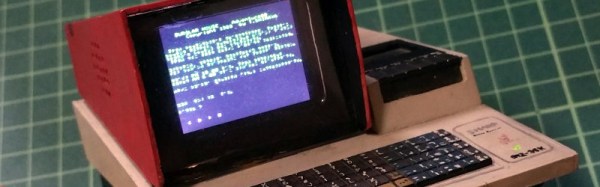
If you were a computer enthusiast in the late 1970s and early 1980s, one of your objects of desire may well have been a Sharp MZ-80K. This was an all-in-one machine from the Japanese electronics giant, and like Commodore’s PET line it included a CRT monitor, full alphanumeric keyboard and cassette tape drive in a smart console.

[Yasushi Enari] is a modeller of miniatures, and while at high school back in 1981 he made a perfect 1/5 scale model of an MZ-80K as an art project. Fast-forward to 2017, and with the help of a Raspberry Pi Zero, a miniature LCD composite video screen, and a Li-Po battery, he’s turned his 1981 model into a functioning computer.

Sadly he was not able to make his tiny 1981 plastic keyboard work, so an external Bluetooth unit is required to perform that function. And he makes no mention of running an MZ-80K emulator on the little machine, either. But the result is a work of art, and an odd collaboration between his adult and teenage self, something we are guessing most readers would be proud to own.

This isn’t the first tiny replica computer we’ve shown you, an Odroid W went into making this tiny Powermac from an American Girl doll’s toy computer.

Thanks [RC2014] for the tip.

Hands On With The SHACamp 2017 Badge

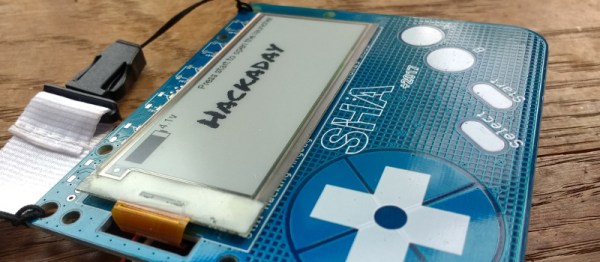
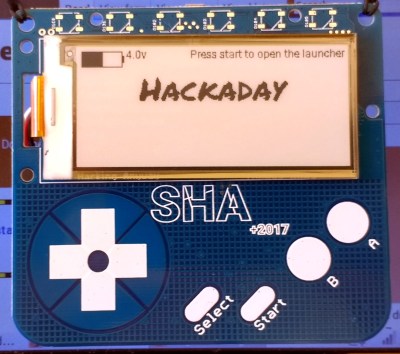
The badge has become one of the defining features of a modern hacker camp, a wearable electronic device that serves as both event computer and platform for some mild software and hardware hacking. Some events have had astoundingly sophisticated badges while others are more simple affairs, and the phenomenon has even spawned an ecosystem of unofficial badges which have nothing to do with the event in question.


The SHACamp 2017 badge is the latest to come the way of a Hackaday writer, and certainly contains enough to be taken as representative of the state of hacker camp badges in 2017. It doesn’t have a star turn like CCCCamp 2015’s software defined radio, instead it’s an extremely handy little computer in its own right.

Continue reading “Hands On With The SHACamp 2017 Badge”

From Handheld Bandsaw To Shop Bandsaw

If you grow up around a workshop then the chances are that you’ll have the most respect for saws. Formative years being constantly warned by parents about their risks leave an indelible mark on the nascent maker, and leave them visibly less cavalier on the matter than for example other hackspace members. The fact remains that saws offer some of the most ready opportunities for danger in your workshop. But which are the least hazardous? In the workshop near where this is being written, definitely a bandsaw is far preferable to a circular saw when it comes to finger retention.

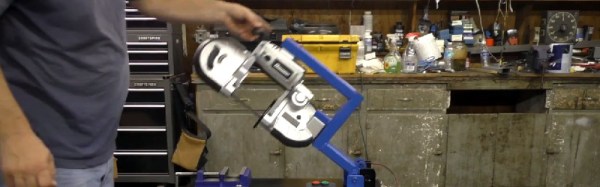
[Making Stuff] has a portable bandsaw, contained in effect within a large handheld power tool. He’s put up a video detailing how he modified it to serve as a more conventional vertical or horizontal bandsaw, with the addition of a sturdily built welded tubular frame and table.

The video starts with the removal of the plastic surround to the trigger and  hand grip, then proceeds through the various stages of cutting, measuring, drilling, and welding. The pivot point is the crank bearing from a bicycle, and in a slightly overcomplex touch the switch is a solid state relay rather than something conventional. The metal work is well executed, and while the engineering is noting special and most Hackaday readers could do similar, it has the compelling quality of a workshop video in which everything is done right and the results are well presented. You might not make this saw, but if you had one it wouldn’t disappoint you. The full video is below the break.

Continue reading “From Handheld Bandsaw To Shop Bandsaw”

A Tale Of Two Raft Races

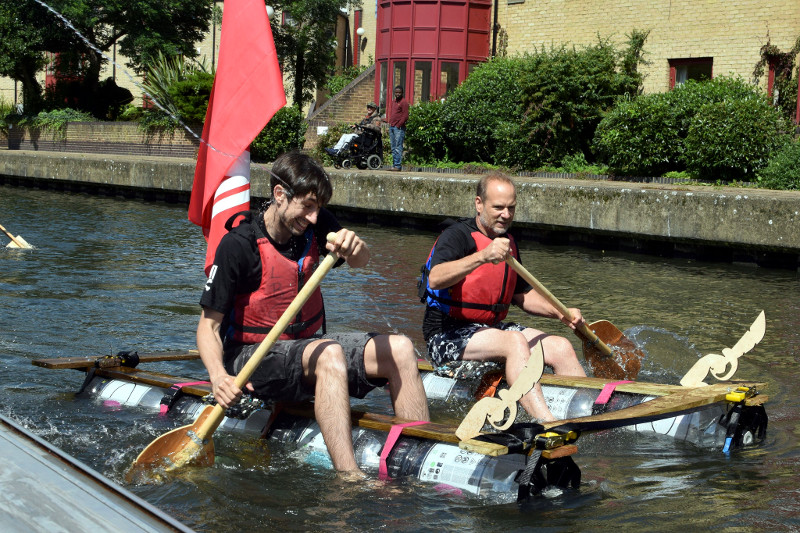
It’s the height of summer in the Northern Hemisphere, and hackers and makers everywhere are letting their hair down and enjoying the hot weather on the water. By coincidence last weekend there were two very different raft races in the European hackspace community, at the SHACamp2017 gathering in the Netherlands the villages competed in a cardboard raft race, while on the other side of the English Channel the various hackspaces in and around London came together in a raft race using more conventional materials.

Some of the SHA entries needed a little help.

The SHA race came about through the happy confluence of a surplus of disposable cardboard tents, a sunny afternoon, and the inviting waters of the Nuldemauw. The aim of the contest was for hacker camp villages to make it from the bank to the end of the boat dock, a distance of about 100m, in a boat made from cardboard there and then at the camp. Meanwhile the London spaces met at City Road Basin in London with their more robust watercraft for a series of races, the aim of which seems to have been to be the first to get their crew disembarked at the other end of the course. and sitting in a chair on the bank.

Full steam ahead for South London Makerspace. Toby *Spark (CC BY-NC-SA 2.0)

In both races the inventiveness of the entrants showed itself in a wide range of boat designs. As you might expect those craft with a wider beam fared better than the far less stable narrower ones, with capsizes a feature at each location. Clear winners in the Netherlands were a pair of German teenagers in a very stable wide raft, while in London it was South London Makerspace’s catamaran that scooped the crown. There is a video of the London race which we’ve placed below the break.

The hackspace and makerspace spirit is at its strongest when bonds are forged between members of different spaces. Skills and capabilities are shared, collaboration opportunities abound. The sight of a bunch of European makers getting wet might serve more as entertainment than edification, but behind it lies an important facet of hackspace culture. If you’ve not yet been the spaces closest to yours, do so. You never know, one day you might end up on a capsizing raft because of it.

Continue reading “A Tale Of Two Raft Races”

Reverse Engineering A BLE Service To Control A Light Bulb

So, you buy an Internet of Things light bulb, it’s a fun toy that allows you to bathe your environment in pretty colours at the touch of an app, but eventually you want more. You start to wonder how you might do more with it, and begin to investigate its inner workings. Then to your horror you discover that far from having bought a device with a convenient API for you to use, it has an impenetrable closed protocol that defies easy access.

This was the problem facing [Ayan Pahwa] when he bought a Syska Smartlight Rainbow LED bulb, and discovered that its Bluetooth Low Energy  interface used a closed protocol. But instead of giving up, he proceeded to reverse engineer the communication between bulb and app, and his write-up makes for an interesting read that provides a basic primer on some of BLE’s workings for the uninitiated.

BLE allows a device manufacturer to define their own device service specific to their functionality alongside standard ones for common device types. Using a handy Android app from Nordic Semiconductor he was able to identify the services defined for the light bulb, but sadly they lacked any human-readable information to help him as to their purpose. He thus had to sniff BLE packets directly, and lacking dedicated hardware for this task he relied on a developer feature built into Android versions since KitKat, allowing packets to be captured and logged. By analysing the resulting packet files he was able to identify the Texas Instruments chip inside the bulb, and to deduce the sequences required to control its colours. Then he was able to use the Bluez utilities to talk directly to it, and as if by magic, his colours appeared! Take a look at the video we’ve placed below the break.

Many of us may never need to reverse engineer a BLE device. But if we are BLE novices, after reading [Ayan]’s piece we will at least have some idea of its inner workings. And that can only be a positive thing.

Continue reading “Reverse Engineering A BLE Service To Control A Light Bulb”

Another Arduino Compatible? This Time, It’s A Sony

When it comes to microcontroller development boards, we have a plethora of choices at our disposal. Each has its strengths and weaknesses, be they associated with its support and community, its interface capabilities, or its choice of processor family. Most boards you’ll find in our communities come from niche manufacturers, or at least from manufacturers who started as such. Just occasionally though along comes one whose manufacturer you will have heard of, even whose manufacturer the Man in the Street will have heard of.

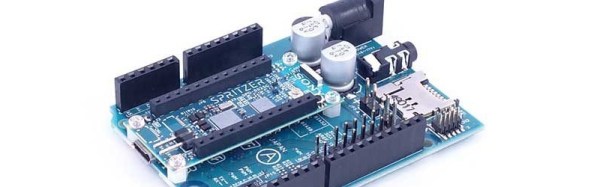
Which brings us neatly to today’s story, the quiet announcement from Sony, of a new microcontroller development board called the Spritzer. This is Arduino compatible in both physical footprint and IDE, is intended for IoT applications, and packs GPS, an audio codec, and an ARM Cortex M4 at 156 MHz. There is a Japanese page with a little more detail (Google Translate link), on which they talk about applications including audio beam forming with up to eight microphones, and a camera interface. 

The board is due to be available sometime early next year, and while it looks as though it will be an interesting device we’d sound a note of caution to Sony. It is not good enough to have an amazing piece of hardware; the software and community support must be more than just make-believe. If they can crack that then they might just have a winner on their hands, if they fail to make any effort then they will inevitably follow Intel into the graveyard of also-ran boards.

Thanks [Chris] for the tip.

Do You Have An Endangered Craft?

It is probably fair to say that as Hackaday readers, you will all be people with the ability to make things. Some of you can make incredible things, as your writers we are in constant awe of the projects that pass through our hands. But even if you feel that your skills in the maker department aren’t particularly elite, you’ll have a propensity for work in this direction or you wouldn’t be here.

Most of the craft we feature involves technologies that are still very modern indeed to the majority of the population. We for example know that the first 3D printers were built decades ago and that we take them for granted on our benches, but to the Man In The Street they are still right up there with flying cars and time-travelling police telephone boxes.

We use 3D printers and microcontrollers because they are the tools of our age, but how different might our crafts have been if we’d been born a few centuries ago? Apprenticed to a master craftsman as teenagers, we (well, at least you boys!) would have learned  a single craft to a high level of expertise, making by hand the day-to-day products of life in those times.

The Industrial Revolution brought mechanisation and mass production, and today very few of the products you use will be hand-made. There may still be a few craftsmen with the skills to produce them by hand, but in the face of the mass-produced alternative there is little business for them and they are in inevitable decline. In an effort to do something about this and save what skills remain, the Heritage Crafts Association in the UK has published a list of dying crafts, that you can view either alphabetically, or by category of risk.

It’s a list with a British flavour as you might expect from the organisation behind it, after all for example hand stitched cricket balls are not in high demand in the Americas. But it serves also as a catalogue of some fascinating crafts, as well as plenty that will undoubtedly be of interest to Hackaday readers. Making hand-made planes, saws, or spades, for example, or at least where this is being written, coracle making.

As your Hackaday scribe this is close to home, a blacksmith carrying on her father’s business can’t earn enough to live in Southern England while an electronic engineer and technical journalist can. Eventually there will be one less blacksmith plying the craft, and though his tools and some of his skills will live on here, the business will not. Take a look at the list of crafts, do any of you have them? Or do you know of any craftspeople who have any of the skills listed, that the HCA might not know about? Let us know in the comments.

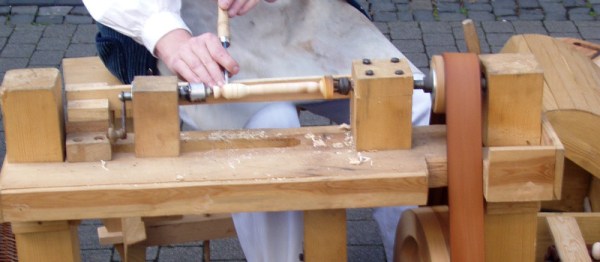
Treadle lathe image: Patrick-Emil Zörner (Paddy) [CC BY-SA 2.0].