You Know This Font, But You Don’t Really Know It

Typography enthusiasts reach a point at which they can recognise a font after seeing only a few letters in the wild, and usually identify its close family if not the font itself. It’s unusual then for a font to leave them completely stumped, but that’s where [Marcin Wichary] found himself. He noticed a font which many of you will also have seen, on typewriter and older terminal keys. It has a few unusual features that run contrary to normal font design such as slightly odd-shaped letters and a constant width line, and once he started looking, it appeared everywhere. Finding its origin led back well over a century, and led him to places as diverse as New York street furniture and NASA elevators.

The font in question is called Gorton, and it came from the Gorton Machine Co, a Wisconsin manufacturer. It’s a font designed for a mechanical router, which is why it appears on so much custom signage and utilitarian components such as keyboard keys. Surprisingly its history leads back into the 19th century, predating many of the much more well-know sans serif fonts. So keep an eye out for it on your retro tech, and you’ll find that you’ve seen a lot more of it than you ever knew. If you are a fellow font-head, you might also know the Hershey Font, and we just ran a piece on the magnetic check fonts last week.

Thanks [Martina] for the tip!

Hackaday Podcast Episode 308: The Worst 1 Ever, Google’s Find My Opened, And SAR On A Drone

It’s Valentine’s Day today, and what better way to capture your beloved’s heart than by settling down together and listening to the Hackaday Podcast! Elliot Williams is joined by Jenny List for this week’s roundup of what’s cool in the world of hardware. We start by reminding listeners that Hackaday Europe is but a month away, and that a weekend immersed in both hardware hacking and the unique culture offered by the city of Berlin can be yours.

The stand-out hack of the week is introduced by Elliot, Henrik Forstén’s synthetic aperture radar system mounted on a cheap quadcopter, pushing the limits of construction, design, and computation to create landscape imagery of astounding detail. Most of us will never create our own SAR system, but we can all learn a lot about this field from his work. Meanwhile Jenny brings us Sylvain Munaut’s software defined radio made using different projects that are part of Tiny Tapeout ASICs. The SDR isn’t the best one ever, but for us it represents a major milestone in which Tiny Tapeout makes the jump from proof of concept to component. We look forward to more of this at more reasonable prices in the future. Beyond that we looked at the porting of Google Find My to the ESP32, how to repair broken zippers, and tuning in to ultrasonic sounds. Have fun listening, and come back next week for episode 309! Continue reading “Hackaday Podcast Episode 308: The Worst 1 Ever, Google’s Find My Opened, And SAR On A Drone”

A 3D Printed Camera You Can Now Download, Shutter And All

A couple of years ago we were excited to read news of an entirely 3D printed camera, right down to the shutter. We wrote it up back then but sadly the required STL files were not yet available. Now after time away with his family, its creator [Mark Hiltz] is back. The medium-format Pioneer Camera can now be downloaded for printing in its entirety under a Creative Commons licence.

Looking at the design, it appears to be a relatively straightforward build. The shutter is extremely simple, as far as we can see, relying on magnets to ensure that the open part of its rotation is at an unstable repulsing point between stable magnetic poles. The images aren’t perfect because he’s using a very simple lens, but this is part of the charm of a camera like this one. We hope that people will take it and produce refinements to the design making for a cheap and good entry to medium format photography.

While you’re printing your own Pioneer, take a look at our original coverage.

Push Your Toy Train No More, With This Locomotive!

One of the most popular evergreen toys is also one of the simplest, wooden track with push-along trains. We all know the brand name, and savvy parents know to pick up the much cheaper knock-off because the kid won’t know the difference. But a really cool kid shouldn’t have to push their train around by hand, and thus [Lauri] has given the wooden track a real, powered, locomotive.

In the 3D printed chassis goes a small geared motor driving one axle, with an ESP32 and a motor driver taking care of the smarts. Power comes from an 18650 cell, which almost looks like the right scale for a fake steam boiler. The surprise with this train comes in the front axle, this machine has steering. We’re curious, because isn’t the whole point of a train that the track directs it where it needs to go? Or perhaps a little help is required in the absence of a child’s guidance when it comes to points. Either way, with remote control we guess there would be few kids who wouldn’t want one. We certainly do.

A Tiny Computer With A 3D Printed QWERTY Keyboard

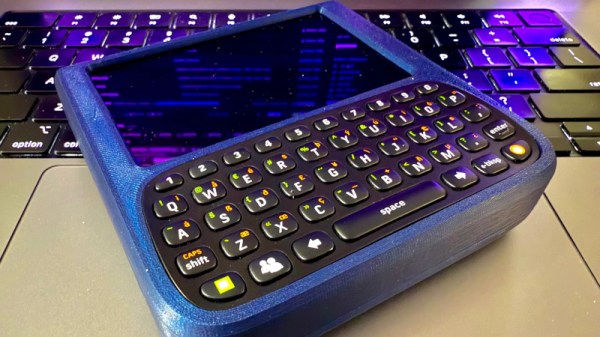
The ESP32 family are the microcontrollers which just keep on giving, as new versions keep them up-to-date and plenty of hackers come up with new things for them. A popular device is a general purpose computer with a QWERTY keypad, and the latest of many we’ve seen comes from [StabbyJack]. It’s a credit card sized machine whose special trick is that its keyboard is integrated in the 3D printing of its case. We’ve seen rubber membranes and push in keys, but this one has flexible print-in-place keys that line up on the switches on its PCB.

It’s not complete yet but the hardware appears to be pretty much there, and aside from that keyboard it has an ESP32-S3 and a 1.9″ SPI LCD. When finished it aims for an ambitious specification, with thermal camera and time-of-flight range finder hardware, along with an OS and software to suit. We like it a lot, though we suspect it might be a little small for our fingers.

If you like this project you may appreciate another similar one, and perhaps your version will need an OS.

A Tiny Tapeout SDR

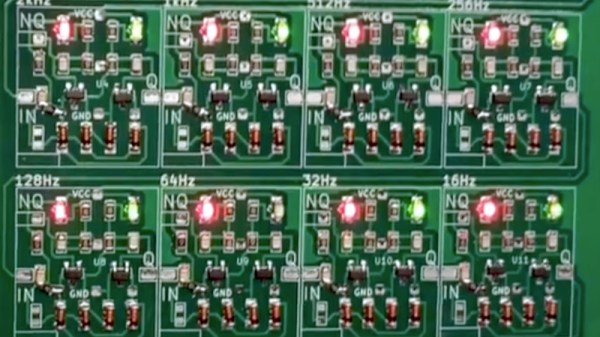
The Tiny Tapeout custom ASIC project has been around for a while now, and has passed through several iterations of its production. On each Tiny Tapeout chip are multiple designs, each representing an individual project, and in use the chip is configured to present that project to its pins. Given enough Tiny Tapeout chips it was inevitable that someone whould eventually make a project using two such functions, and here’s [Sylvain Munaut] with an SDR using Tiny Tapeouts 6 and 7.

At its heart is [Carsten Wulff]’s 8 bit ADC from Tiny Tapeout 6, fed by [Kolos Koblász]’s Gilbert cell RF mixer from Tiny Tapeout 7. There’s a local oscillator provided by an RP2040, and a USB interface board which sends the data to a host computer where GNU Radio does the maths. On the bench it’s receiving an FM signal generated around 30MHz by a signal generator, followed by some slightly indistinct commercial radio stations.

It’s clear that there are many better SDRs than this one, and that (as yet) Tiny Tapeout is perhaps not the radio enthusiast’s choice. But it does demonstrate beautifully how the chips are more than just curios, and we’re definitely in the era of useful on-demand ASICs.

The video is below the break, meanwhile you can learn about Tiny Tapeout from [Matt Venn]’s Supercon talk.

Continue reading “A Tiny Tapeout SDR”

Basically, It’s BASIC

The BASIC language may be considered old-hat here in 2025, and the days when a computer came as a matter of course with a BASIC interpreter are far behind us, but it can still provide many hours of challenge and fun. Even with our love of all things 8-bit, though, we’re still somewhat blown away by [Matthew Begg]’s BASIC interpreter written in 10 lines of BASIC. It’s an entry in the BASIC 10-liner competition, and it’s written to run on a Sinclair ZX Spectrum.

The listing can be viewed as a PNG file on the linked page. It is enough to cause even the most seasoned retrocomputer enthusiasts a headache because, as you might expect, it pushes the limits of the language and the Sinclair interpreter.  It implements Tiny Basic as a subset of the more full-featured BASICs, and he’s the first to admit it’s not fast by any means. He gives a line-by-line explanation, and yes, it’s about as far away from the simple Frogger clones we remember bashing in on our Sinclairs as it’s possible to get.

We love it that there are still boundaries to be pushed, even on machines over four decades old, and especially that this one exceeds what we thought was a pretty good knowledge of Sinclair BASIC. Does this language still have a place in the world? We always look forward to the BASIC 10-liner competition.

Header: background by Bill Bertram, CC BY-SA 2.5.