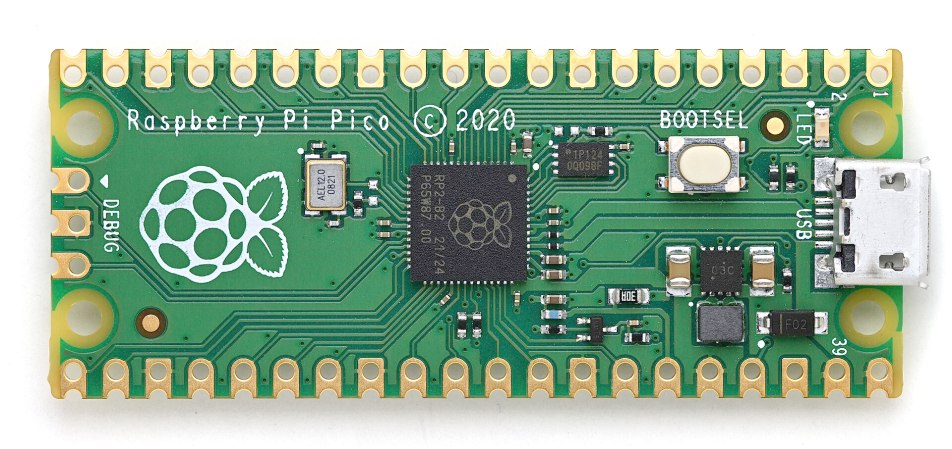
Making a software defined radio (SDR) receiver is a relatively straightforward process, given the right radio front end electronics and analogue-to-digital converters. Two separate data streams are generated using clocks at a 90 degree phase shift, and these are passed to the software signal processing for demodulation. But what happens if you lack a pair of radio front ends and a suitable clock generator? Along comes [Mordae] with an SDR using only the hardware on a Raspberry Pi Pico. The result is a fascinating piece of lateral thinking, extracting something from the hardware that it was never designed to do.
The onboard RP2040 ADC is of course far too slow for the task, so instead an input is used, with a negative feedback arrangement from another GPIO to form a crude 1-bit ADC. A PIO peripheral is then used to perform the quadrature mixing, resulting in the requisite pair of data streams. At this point these are sent over USB to GNU Radio for demodulating, mainly for convenience rather than necessarily because the microcontroller lacks the power.
The result is a working SDR front end, demonstrated pulling in an FM broadcast station. The Pico has to be overclocked to reach that frequency and it’s more than a little noisy, but we’re extremely impressed with how much has been done with so little. Oddly it isn’t the first Pico SDR we’ve seen, but the previous one was a much more conventional and lower-frequency affair for the European Long Wave band.

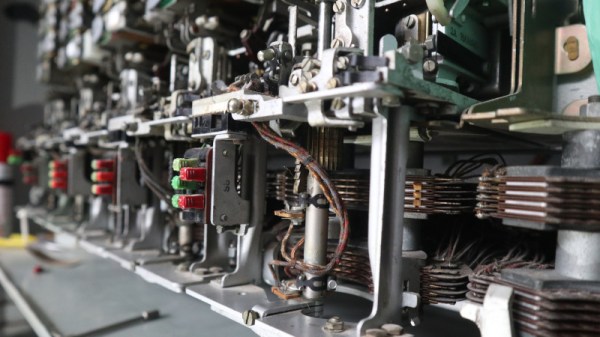
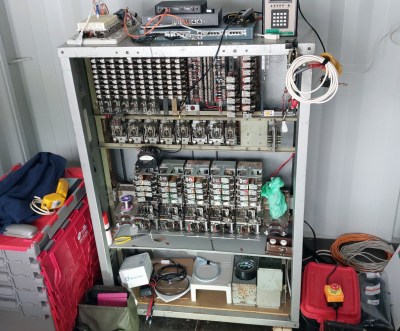 It stood at the back of the container, with a row of four telephones in front of it. We particularly liked the angular “Trimphone”, the height of 1960s and 70s chic. You could dial the other phones in the network with a two digit number, and watch the exchange clicking in the background as you did so. Some of the sounds weren’t quite the same as the full-sized equivalents, with the various tones being replaced by vibrating reeds.
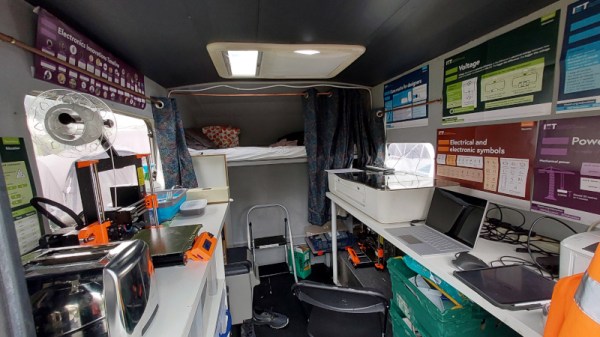
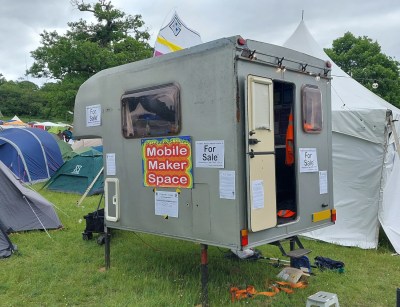 Here at Hackaday we’re neither estate agents or in the want-ads business, so we’re unaccustomed to property promotion. We’re still not immune to the attraction of a portable makerspace to take to events though, and this one provides a very practical basis. It started life as what Brits call a Luton van body, a box van, and inside it’s gained a small kitchen, benches and shelves either side, and up in the space over the cab, a double bed. Sadly the laser cutter and 3D printers aren’t included.