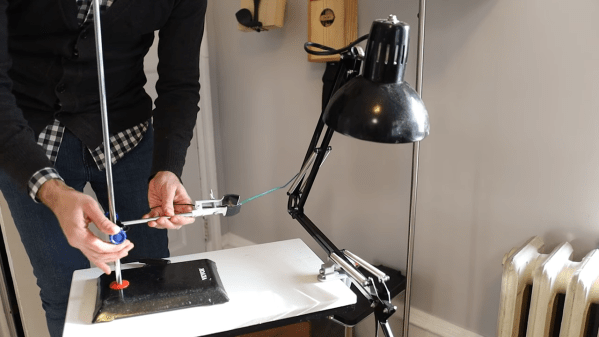
Folding Lamp Becomes A Tasty Reverb Tank

If you’re a musician and you want a reverb effect, there are lots of ways to go about it. You can use software plugins, all kinds of rack-mount effects, or pedals. Or, as [David] has done, you could go with a lamp.

[David’s] build is straightforward enough in concept—he just chose a relatively unconventional item to use as a reverb tank. The lamp might seem like an odd choice, but it actually does a decent job at resonating because of its metal construction and the multiple springs that tension the structure. [David] turns the lamp into a reverb by fitting it with a Vidsonix Ghost audio transducer to put sound into the structure—picture the magnetic driver of a loudspeaker without the cone fitted, and you get the idea. Piezo elements were then used as contact mics to pick up reverberations from the lamp itself. Everything was assembled with a bunch of lab stands that give the build a rather nice aesthetic. The reverb time isn’t particularly long, but the sound is hauntingly beautiful.

Continue reading “Folding Lamp Becomes A Tasty Reverb Tank”

Pi Zero Powers A Little Indoor Rover

Not every robot has to be big. Sometimes, you can build something fun that’s better sized for exploring your tabletop rather than the wastelands of Mars. To that end, [philosiraptor] built the diminutive PITANK rover.

As you might guess from the name, the rover is based on the Raspberry Pi Zero 2. It uses the GPIO pins to output PWM signals, commanding a pair of servos that drive the tracks on either side of the ‘bot. The drivetrain and chassis are made from 3D-printed components. Controlling the robot is handled via a web interface, which [philosiraptor] coded in C# to be as responsive as possible. So you can see where you’re driving, the ‘bot is also kitted out with a camera to provide a live video feed.

Given its low ground clearance and diminutive size, you’re not going to go on big outdoor adventures with PITANK. However, if you wish to explore a nice flat indoor environment, its simple tracked drivetrain should do nicely. We’ve featured a great many rovers over the years; if you’ve got a particularly special one, don’t hesitate to notify the tipsline!

Building A Rubik’s Cube That Solves Itself

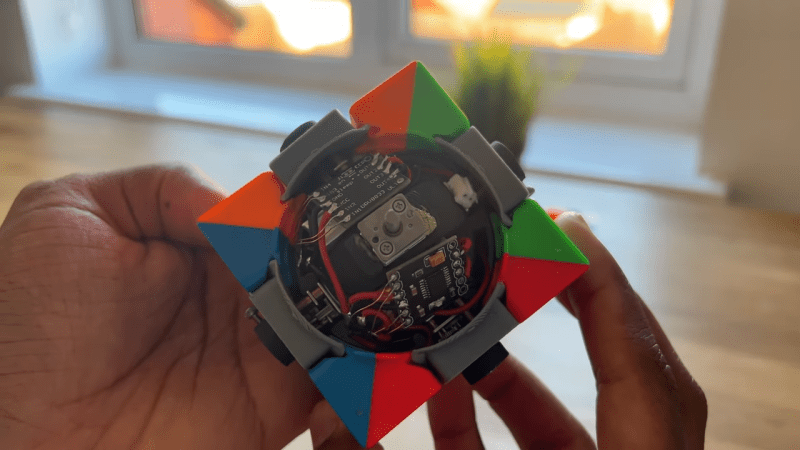
If you’re really good, it’s possible to solve a Rubik’s Cube in under 10 seconds. For the rest of us, though, it can be an exceedingly tedious task. For that reason, you might like a Rubik’s Cube that can solve itself, like the one [zeroshot] is trying to build.

What [zeroshot] built is essentially a very small robotic platform inside the center section of an existing Rubik’s Cube. It uses five gear motors that are assembled into the cube’s core, which have enough torque to rotate the individual faces quite easily. While six motors would allow more efficient solves in fewer moves, it was easier to fit just five motors inside the cube, and they’d still get the job done. The motors are controlled by an ESP32, hooked up to a bank of DRV8833 motor drivers. For now, the cube is still a work in progress. While the core can move the faces, [zeroshot] is trying to figure out how to best tackle the problem of feedback in the limited space available. After all, the ESP32 needs to know where the faces are if it’s to make the right moves to reach a solved state. Soldering wires between individual modules can be quite space inefficient; this is one build that might benefit from being integrated onto a single tiny PCB.

We’re used to seeing robots that grab a Rubik’s cube and solve it for you; we haven’t seen a lot of cubes that solve themselves. Regardless, this feat has been achieved before. Video after the break.

Continue reading “Building A Rubik’s Cube That Solves Itself”

Multitasking On The Humble Z80 CPU

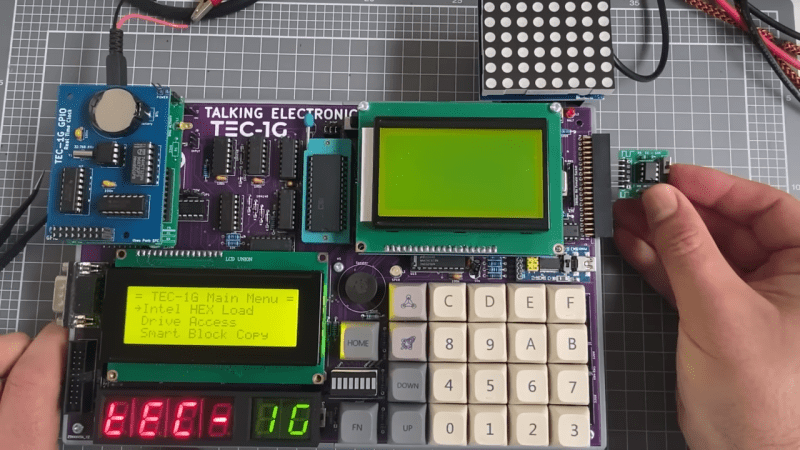
Multitasking is something we take for granted these days. Just about every computer we use, from our desktops to our phones, is capable of multitasking. It might sound silly to implement multitasking on lower-spec machines from many decades ago, given their limited resources, but it can be done, as [bchiha] demonstrates on a Z80-based machine.

[bchiha] has achieved pre-emptive multitasking on the TEC-1G Z80 computer, a modern reimagining of the classic Talking Electronics TEC-1 from the 1980s.  The proof of concept code allows running up to eight separate tasks at once. Task switching runs on interrupts, triggered at approximately 50 Hz. When an interrupt fires, the CPU registers are transferred onto that task’s stack, and the next task’s stack is swapped to the stack pointer to allow execution of the new task to proceed. There is an overhead, of course, with [bchiha] noting that the task swapping routine itself takes about 430 clock cycles to run in between tasks.

Continue reading “Multitasking On The Humble Z80 CPU”

An Audio Brick For Your Smart Home

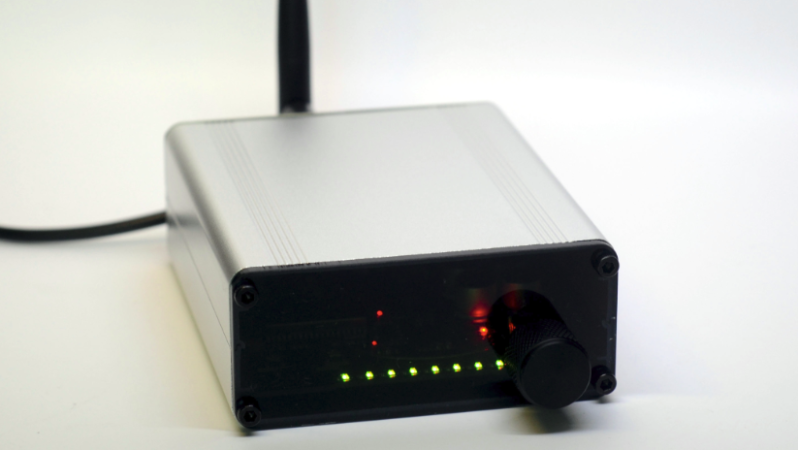
If you’ve ever wanted to pump sound to all the rooms of your house, you might use any one of a number of commercial solutions. Or, you could go the more DIY route and whip up something like the Esparagus Audio Brick built by [Andriy]. 

The concept is simple—it’s a small unit, roughly the size of a brick, which streams high-quality audio. It’s based around an ESP32, which pulls in digital audio over Wi-Fi or Ethernet. The microcontroller is hooked up to a TAS5825M DAC, which comes with a built-in amplifier for convenience. The Esparagus is designed for integration with Home Assistant, allowing for easy control as part of a smart home setup. It’s also compatible with Spotify Connect, AirPlay, and Snapcast—the latter of which provides excellent sync when using multiple units across several rooms.

Design files are available on Github for the curious. We’ve seen other neat projects in this space, before, too—like the charmingly-named OtterCast. Video after the break.

Continue reading “An Audio Brick For Your Smart Home”

Simple Device Can Freeze Wi-Fi Camera Feeds

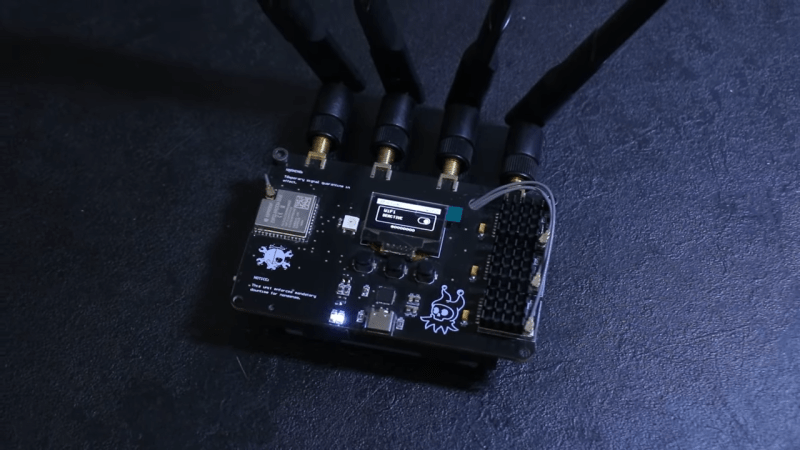
Wi-Fi cameras are everywhere these days, with wireless networking making surveillance systems easier to deploy than ever. [CiferTech] has been recently developing the RF Clown—a tool that can block transmissions from these cameras at some range.

The build is based around an ESP32, with three tactile switches and an OLED display for the user interface. The microcontroller is hooked up to a trio of GT—24 Mini radio modules, which feed a bank of antennas on top of the device. Depending on the mode the device is set to, it will command these modules to jam Bluetooth, BLE, or Wi-Fi traffic in the area with relatively crude transmissions.

The use of multiple radio modules isn’t particularly sophisticated—it just makes it easier to put out more signal on more bands at the same time, flooding the zone and making it less likely legitimate transmissions will get through. Specifically, [CiferTech] demonstrates the use case of taking out a Wi-Fi camera—with the device switched on, the video feed freezes because packets from the camera simply stop making it through.

It’s perhaps impolite to interfere with the operation of somebody else’s cameras, so keep that in mind before you pursue a project like this one. Files are on GitHub for the curious. Video after the break.

Continue reading “Simple Device Can Freeze Wi-Fi Camera Feeds”

Building A Clamshell Writer Deck

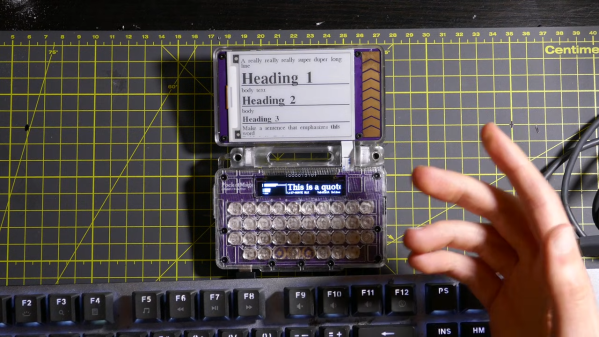
Most of us do our writing on computers these days, but the modern computing environment does present a lot of distractions. That’s let to the concept of the writer deck, a simplified device intended more specifically for word processing tasks. [Ashtf] has built a great example of the form with a modified version of the PocketMage device.

The PocketMage is a clamshell PDA device that [Ashtf] has been working on for some time. It’s powered by an ESP32, hooked up to a nice e-ink display. In its basic form, it’s not the ideal device for doing serious writing work, mostly because of its tiny keyboard. However, [Ashtf] has since added external keyboard support, which completely changes the game. With the use of a small USB C to USB A adapter, you can hook up any conventional USB keyboard that you like to best attain your maximum typing speed.

The result is a compact, simple device that lets you type away without distractions. If your latest fanfic isn’t coming along quickly enough because you keep losing focus to social media, perhaps this is a route you might like to go. [Ashtf] also included Markdown support so you can create richer documents on the device while operating in what is still fundamentally a text-only environment.

It’s neat to build custom devices that suit your own personal productivity needs. If you dig the PocketMage, you might like to check out the design files on Github. We’ve featured some other fun writer decks before, too. Video after the break.

Continue reading “Building A Clamshell Writer Deck”