Fantastic Micrometeorites And Where To Find Them

Space is very much the final frontier for humanity, at least as far as our current understanding of the universe takes us. Only a handful of countries and corporations on Earth have the hardware to readily get there, and even fewer are capable of reaching orbit. For these reasons, working in this field can seem out of reach for many. Nevertheless, there’s plenty about the great expanse beyond our atmosphere that can be studied by the dedicated citizen scientist. With the right equipment and know-how, it’s even possible to capture and study micrometeorites yourself!

While you don’t see a meteor shower every day, micrometeorites are actually astoundingly common. They’re just hard to find!

For those new to the field, the terms used can be confusing. Meteoroids are small metallic or rocky objects found in outer space, up to around 1 meter in size. When these burn up upon entering the atmosphere, they are referred to as a meteor, or colloquially known as a shooting star. If part of the object survives long enough to hit the ground, this is referred to as a meteorite, and as you’d expect the smaller ones are called micrometeorites, being on the scale of 2mm or less.

Stardust Proves Hard To Find

Being tiny and having fallen from space, micrometeorites present certain challenges to those who wish to find and identify them. In spite of this, they can be found by using the right techniques and a heck of a lot of hard work.

Continue reading “Fantastic Micrometeorites And Where To Find Them”
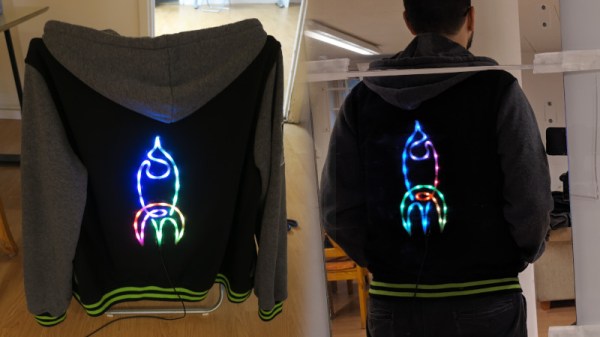
Rocket Jacket Looks Sharp For CCCamp 2019

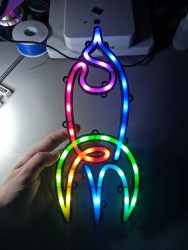
Making your own clothing can be fun, but it’s even better if you can throw some LEDs into the mix and give a new meaning to the term “glow up”. [arturo182] did just that with this custom rocket jacket for CCCamp2019.

We’re getting kind of a stained-glass vibe here.

To create the jacket, a 3D printed frame was created in the shape of CCCamp’s rocket logo. This was then filled with hot glue to act as a diffuser, and fitted with WS2818B LEDs. A Digispark is used as the microcontroller, with its compactness serving well for the wearable application. The assembly is then sewn into the back of a hoodie, with cardboard used on the inside as a backer to help keep things flat and support the weight of the hardware.

Hot glue works great as a diffuser in this application, and animation is easy thanks to the addressable LEDs used in the construction. It’s a great way to get a neon-like look, and we fully expect to see more of these glowy wearables in future!

Get Ready For Games Night With 3D Catan

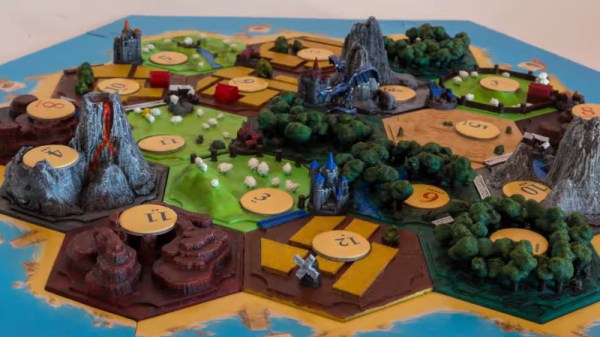
Settlers of Catan is a staple for boardgaming aficionados. Some fans like to express themselves by building a custom set of their own, and [Maclsk] is no different. Enter 3D Catan!

The models for the various pieces were designed in Blender, a great open source 3D modelling program. They were then printed on an Anycubic i3 Mega, taking about 80 hours and using 700 grams of PLA filament. With 116 game pieces, there was plenty of filing and sanding to do.

With this completed, it was then time for paint. [Maclsk] shows off a strong understanding of model painting fundamentals, from dry brushing to using PVA glue to give water elements a glossy sheen. If you’re new to the techniques, sit down with your local Warhammer players – they’ll be more than able to point you in the right direction.

Overall, it’s a great build that really pops on the gaming table. We’ve seen other die-hard Catan fans come out with their own builds, too. Video after the break.

Continue reading “Get Ready For Games Night With 3D Catan”

Putting The Coanda Effect To Work On A Quadcopter

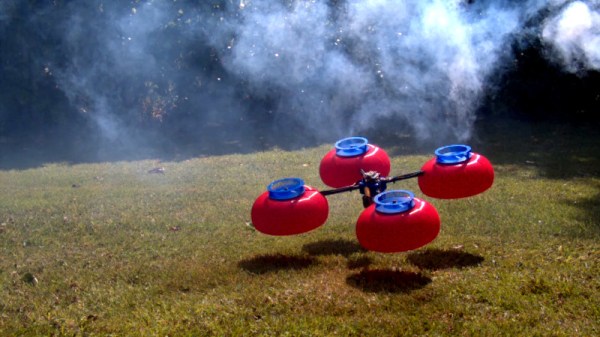
The Coanda effect is an aerodynamic principle regarding the way fluids tend to flow along curved surfaces. This can be used to direct a flow, and [Tom Stanton] wanted to try out its application on a quadcopter. (Video embedded below.)

The project began by firing up the 3D printer, which made experimenting with a variety of different aerodynamic forms easy. Wishing to avoid simply putting a large obstruction in the way of an otherwise efficient propeller, the experiment first used impellers to direct flow sideways, over the edge of the Coanda domes. The impellers, combined with the Coanda domes, were a factor of 5 less efficient at generating thrust compared to a standard prop setup, but [Tom] persevered.

In testing, the drone was unable to fly outside of ground effect, with its weight exceeding its maximum thrust. However, [Tom] noted that the Coanda domes helped create a cushion of air when flying in this ground effect region that was far more than experienced with a typical prop drone.

Wanting some further success, [Tom] then replaced the impellers with standard drone props. This greatly improved performance, with the drone now able to fly out of ground effect and use far less power. However, its performance was still worse than a standard drone without Coanda domes fitted. [Tom] suspects that this is due to the weight penalty most of all.

While it’s unlikely you’ll see Coanda effect drones going mainstream anytime soon, [Tom]’s project goes to show that you can perform viable aerodynamic research at home with little more than a 3D printer and a fog machine. There’s plenty more fun you can have with the Coanda effect, too. Video after the break.

Continue reading “Putting The Coanda Effect To Work On A Quadcopter”

DIY Gimbal For The Raspberry Pi Camera

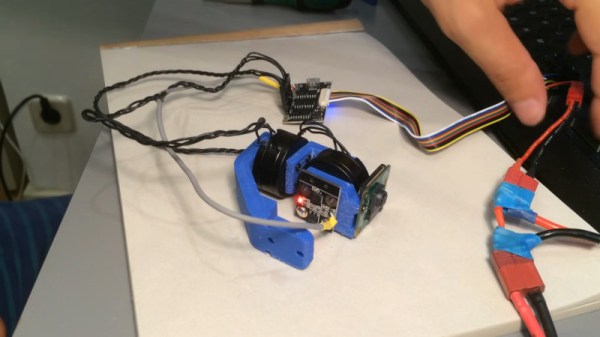
If one wants a stabilized video feed from a drone, a gimbal setup is the way to go. However, the cheaper offerings are all rather similar, suited to a certain size and type of drone. [Jean] was building a smaller craft, so set out to create his own design specifically fit for purpose.

The build begins in the CAD suite, with a series of 3D printed parts designed to link together with a pair of brushless motors to make a 2-axis set up. After printing, the gimbal arms are bolted together with the motors and the camera and IMU are installed, with everything being wired up to a GLB MiniSTorM32 brushless gimbal controller. These controllers make the process of building a gimbal easy, meaning that individual makers don’t have to go to the trouble of designing motor controller circuitry again and again.

The final result is a compact gimbal sized perfectly for the Raspberry Pi camera in [Jean]’s design. If you’re very particular about your gimbal’s performance, building your own doesn’t hurt. Video after the break.

Continue reading “DIY Gimbal For The Raspberry Pi Camera”

Great Artificial Daylight Via Broken TVs

[DIY Perks] has long been a fan of lights that accurately mimic real daylight. Often choosing high-quality LEDs for his projects, lately he’s taken a different tack – using broken televisions to produce attractive home lighting solutions.

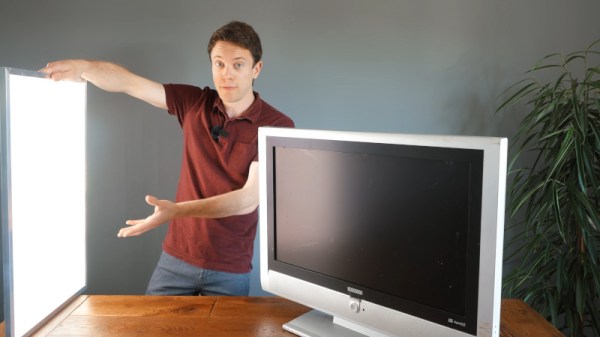
The hack involves removing the backlight from the damaged television or monitor. These have a powerful white light inside, but the real key is that they also features a Fresnel lens. This helps the backlight appear very similar to a real skylight, due to the way it scatters light around the room.

Due to the difficulty of driving most LED and CCFL backlights, the project strips the original lighting out and replaces it with a set of high-CRI LED strips readily available off eBay. These are easily driven from 12 volts and give a white light more similar to actual daylight compared to most backlights. With the LEDs in place, the monitor’s original diffusers and Fresnel lens are put back in place, and the light is finished off with an aluminium frame.

Fitted to an angled ceiling, the light really does look as if actual sunlight is streaming through a window on a rainy day. It’s a pleasant effect that does a great job of lighting a room, and we suspect it would be excellent for general video work, too. [DIY Perks] is no stranger to a good studio light build, after all. Video after the break.

Continue reading “Great Artificial Daylight Via Broken TVs”

Enjoy A Refreshing Beverage With The Chilled Drink Calculator

Hackers are quite often the price conscious type, unwilling to pay jacked up prices for cold beverages when they can be purchased warm and in bulk for much lower cost. However, when guests are on the way and time is running out, it’s crucial to chill the drinks down to the right temperature, and fast. To take the guessing out of the process, [Álvaro Díez] and [Tibor Pal] collaborated to create the Chilled Drink Calculator.

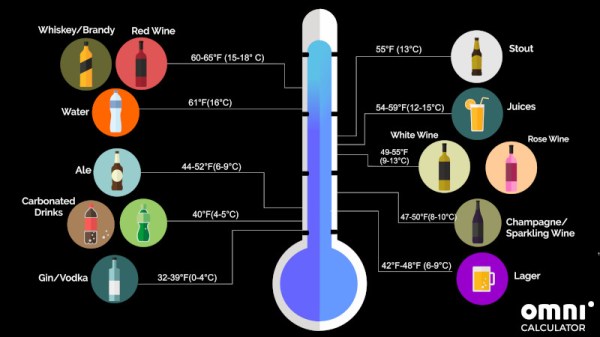
It’s a resource jam-packed full of everything you need to know to get your drinks cold, pronto. Based on heat transfer equations and data from empirical studies, the calculator is able to show you just how long it will take to cool practically any beverage to any temperature. There are presets for different types of container and cooling method, as well as information on the ideal serving temperatures for things like wine, beer and soft drinks. There’s even information on helpful hacks to help cool things down more quickly – with the salt and ice bath being devastatingly effective with minimal equipment requirements.

Keep the calculator in your bookmarks for the next time your pals show up with a case of beer that’s been sitting in the sun all day in the back of a pickup truck (Authors note: looking at you, Terry). Alternatively, consider building an advanced cooling apparatus.