Mach Cutoff: Bending The Sonic Boom

Supersonic air travel is great if you want to get somewhere quickly. Indeed, the Concorde could rush you from New York to London in less than three and a half hours, over twice as fast as a conventional modern airliner. Despite the speed, though, supersonic passenger service has never really been sustainable thanks to the noise involved. Disruption from sonic booms has meant that supersonic travel over land is near-universally banned. This strictly limits the available routes for supersonic passenger jets, and thus their economic viability.

Solving this problem has been a hot research topic for some time. Now, it appears there might be a way forward for supersonic air travel over land, using a neat quirk of Earth’s atmosphere.

Continue reading “Mach Cutoff: Bending The Sonic Boom”

Could Space Radiation Mutate Seeds For The Benefit Of Humanity?

Humans have forever been using all manner of techniques to better secure the food we need to sustain our lives. The practice of agriculture is intimately tied to the development of society, while techniques like selective breeding and animal husbandry have seen our plants and livestock deliver greater and more nourishing bounty as the millennia have gone by. More recently, more direct tools of genetic engineering have risen to prominence, further allowing us to tinker with our crops to make them do more of what we want.

Recently, however, scientists have been pursuing a bold new technique. Researchers have explored using radiation from space to potentially create greater crops to feed more of us than ever.

Continue reading “Could Space Radiation Mutate Seeds For The Benefit Of Humanity?”

The End Of The Hackintosh Is Upon Us

From the very dawn of the personal computing era, the PC and Apple platforms have gone very different ways. IBM compatibles surged in popularity, while Apple was able to more closely guard the Macintosh from imitators wanting to duplicate its hardware and run its software.

Things changed when Apple announced it would hop aboard the x86 bandwagon in 2005. Soon enough was born the Hackintosh. It was difficult, yet possible, to run MacOS on your own computer built with the PC parts your heart desired.

Only, the Hackintosh era is now coming to the end. With the transition to Apple Silicon all but complete, MacOS will abandon the Intel world once more.

Continue reading “The End Of The Hackintosh Is Upon Us”

Shadow Clock Shows The Time On The Wall

What if you build a clock that displayed the time not just on its own, but in its shadows as well? [Lewis] from [DIY Machines] has done just that, with a nifty 3D-printed shadow clock build.

The clock itself, based on a design by [shiura], has a hollow rim inside which are the two hands which actually display the time. The hands appear to almost float inside the clock, a tricky visual effect of the design which instantly catches the eye. The trick is simple—the minute hand is physically attached to the outer rotor, which sets its position. Meanwhile, the floating hour hand pivots freely around the center of the clock, with a secret magnet within. This magnet is attracted to a complementary magnet in the hour rotor—as that rotor turns, the hour hand points at the magnets inside.

So far, it’s already a cool clock. The bonus feature is that [Lewis] realized this design could show an even larger clockface on the wall behind, merely by using its shadows. Thus, the clock features an LED light source which can project the clock’s shadows into a much larger display than the desktop timepiece itself.

As for the electronics, it’s straightforward stuff. An ESP8266 devboard runs the show, turning stepper motors and controlling addressable LEDs to make the clock do its thing. It also queries a network time server in order to ensure the displayed time is always accurate to the second.

We’ve featured some other excellent clocks over the years, like this incredible thermochromic build. Video after the break.

Continue reading “Shadow Clock Shows The Time On The Wall”

Mapping Tool Helps Identify Usable Land For Building

How would you go about identifying usable land that suits your building tastes? [Scott Sexton] was specifically looking for land that’s not too steep to build on, and realized that existing resources didn’t easily offer him this information. He thus dived into the world of GIS to try and solve this issue for himself.

[Scott] hoped that USGS maps might provide the information he needed, but found they lacked grade information, only presenting elevation and topographic data instead. From past experience reading such maps, he knew that seeing a lot of topographical lines close together tended to indicate steeper areas, but wasn’t sure on how to actually get the computer to parse this and spit out the information on steepness and grade that he wanted.

Ultimately, he set about downloading USGS elevation data in three-meter resolution. He then applied some calculus to determine the rate of change of the slope across areas of the data in order to mathematically find what he was looking for. Namely, flatter areas that would be more suitable for future construction. He then took the work even further, tweaking the output of his tools and automating until he could quickly and readily generate usability maps of areas of interest. He was even able to sanity-check his work by verifying that it correctly identified roads as obviously flat areas.

If you’ve ever tinkered with GIS work, [Scott’s] usability project may be of some interest. We’ve also seen amusing examples of what can go wrong when digital mapping data is used without sanity checks. Meanwhile, if you’ve got your own GIS hacks on the go, don’t hesitate to notify us via the tipsline!

Smart Temp Sensors Helps You Nail Your Cooking

Cooking is all about temperature control: too cold isn’t good enough, and too hot can ruin everything. To aid in this regard, [Printerforge] created a smart temperature alarm to keep them aware of exactly what’s going on in the pot.

The device is simple — it uses an Arduino Nano hooked up to a thermistor to measure the temperature of fluid in a pot. The microcontroller displays the current temperature and the target temperature on a simple 16×2 character LCD. Upon the fluid reaching the target temperature, the alarm is sounded, indicating that the cooking has reached a given stage or must otherwise be seen to. The whole build is wrapped up in a simple 3D printed case, along with a lithium-ion cell with charging managed via a TP4056 module.

If you’re regularly letting your pasta overcook or your stews burn in the pot, this kind of tool could be useful for you. Similarly, if you’ve ever wanted to pursue the 64-degree egg, this could be a way to do it.  The trick is to make sure you build it safely—ensuring that any parts that come into contact with the food are rated as food safe for your given application.

If this build has you contemplating the possibilities of machine-assisted cooking, you might like to go even further. How about getting involved in the world of sous vide? Meanwhile, if you’ve got any kitchen hacks of your own, don’t hesitate to let us know on the tipsline!

Pez Blaster Shoots Candy Dangerously Fast

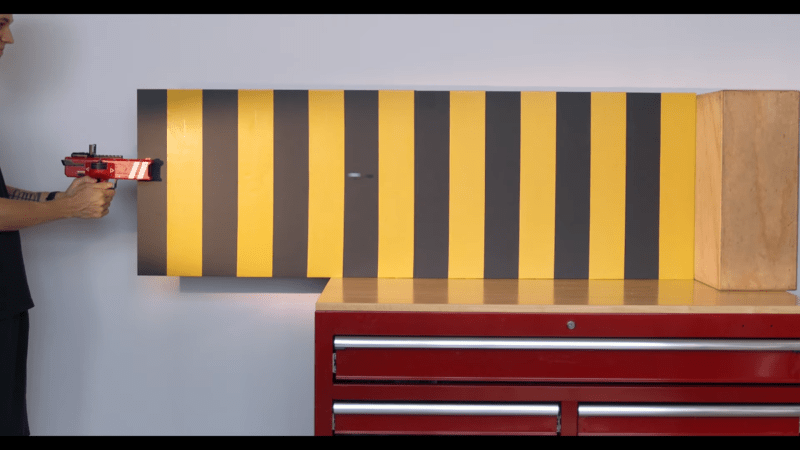
You could use a little pocket-sized Pez dispenser if you’re a humble, reserved person. Or, you could follow the example of [Backhaul Studios], and build a dangerously powerful blaster that shoots Pez fast enough to shatter them into pieces. Just don’t aim it at your own mouth.

As the video explains, Pez is really the perfect candy for this application. It’s compact, hard, and already designed to be dispensed via a magazine. It’s thus not a big stretch to set it up to be fired out of a pistol-like blaster. The build is of the flywheel type, where a pair of counter-rotating wheels fling the candy out at great speed. The wheels themselves are spun up to high speed with a pair of small brushless motors, running off hobby speed controllers and lithium-ion batteries. A simple trigger mechanism dispenses the rectangular candies into the wheel mechanism, sending them flying out of the blaster at will. It’s all 3D-printed, designed specifically for the purpose of high-speed candy delivery.

The video goes into great detail on the design, from the development of the TPU treads on the flywheels and other details that helped improve the effectiveness of the design. The final build shoots Pez fast enough that they practically detonate upon hitting a surface.

We’ve featured some innovative work in this space from [Backhaul Studios] before—the condiment cannon was really quite something. Video after the break.

Continue reading “Pez Blaster Shoots Candy Dangerously Fast”