If you’ve ever worked with produce, you might know about grading. In addition to deciding if, say, a strawberry is good or not, they also have to sort them by color. Turns out, you don’t care if one package of berries is a bit redder than another, but you do care if one package has too much color variation. [Pmalfa31] applied an ESP32 and machine learning to grading tomatoes.
The system knows in advance if you are processing standard tomatoes or cherry tomatoes and uses two different sets of learned data depending on which you select. The program receives raw data from an optical sensor and then processes it to remove empty belt images, compute statistical information, and group readings for a single fruit together.
A few weeks ago we published the first in a new series of articles, Know Your Food. It was born out of the realisation that most people know surprisingly little about what they eat, and to apply a bit of Hackaday curiosity to received opinion on the subject. As we put it then: “To know both how common foodstuffs should be made, as well as how they are made industrially, should be an essential for everyone” We’ll continue in that vein, with a look at organic food.
If you buy your food in a supermarket it’s likely that in the vegetable aisle you’ll be presented with a choice. On one hand you will have the normal vegetable, and on the other and usually for a slightly higher price, the organic version of the same vegetable. What’s going on?
So What Is This Organic Stuff All About?
It is unlikely that a typical organic farm in the 2020s will resemble this John Constable painting. John Constable, Public domain.
Organic production is a system of agriculture that emphasises natural fertilisers, pesticides, and farming methods over synthetic or intensive ones. It has its roots in the first half of the 20th century, and as the decades progressed it has become an important sector of agricultural industry. I grew up steeped in organic agriculture because my grandfather was an early adherent in the years following the war, so I’ve seen it from the sharpest end. There is a lot to commend organic production for and plenty of reasons to embrace it, but with that come some problematic aspects, and even dubious claims. Here I’ll try to unpick some of that.
It’s tempting to believe that all organic production is somehow a return to a 19th century rural idyl, complete with the obligatory chickens in the farmyard. Some organic producers do take a slice of this back-to-the-land approach to their craft, but the reality of organic farming is a very modern approach to managing the ecosystem. Organic farmers are not wary of progress, and neither are they reluctant to use pesticides or other chemicals. Instead they do so according to the principles of organic agriculture, so any techniques they use are designed to be beneficial to the ecosystem, and any chemicals have a natural origin. Continue reading “Know Your Food: Organic Production”→
There’s a thing that people who grew up on farms all share: a connection with food production that isn’t some mystical rose-tinted woo from a TV chef, but instead a practical general knowledge from being there on the ground. A glance at a crop in a field and you immediately recognise what it is, if it’s ploughing time you’ll know the soil type, and there’s always either too little, or too much rain. For a given foodstuff you’ll know far too much about where it came from, because if your dad wasn’t involved in its production, the chances are someone he knew was. You take this for granted, after all doesn’t everyone have this general knowledge? Seemingly not.
Hackaday is not a cooking channel, but I know we’re all interested here in how things are made. Shouldn’t that also extend to what we eat? It’s fashionable to follow a back-to-nature line that all commercial foodstuffs are somehow over-processed junk, but without the requisite knowledge you’re flying blind there. To know both how common foodstuffs should be made, as well as how they are made industrially, should be an essential for everyone.
Humans have forever been using all manner of techniques to better secure the food we need to sustain our lives. The practice of agriculture is intimately tied to the development of society, while techniques like selective breeding and animal husbandry have seen our plants and livestock deliver greater and more nourishing bounty as the millennia have gone by. More recently, more direct tools of genetic engineering have risen to prominence, further allowing us to tinker with our crops to make them do more of what we want.
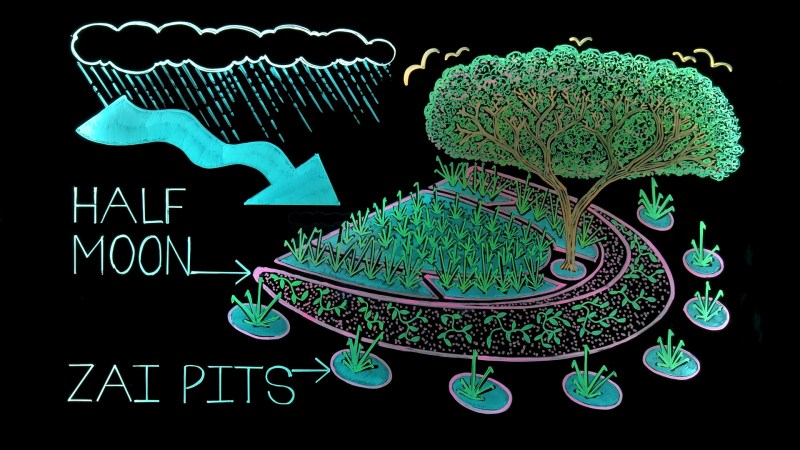
While the Sahara Desert is an important ecosystem in its own right, its human neighbors in the Sahel would like it to stop encroaching on their environment. [Andrew Millison] took a look at how the people in the region are using “half moons” and zai pits to fight desertification.
With assistance from the World Food Program, people in Niger and all throughout the Sahel have been working on restoring damaged landscapes using traditional techniques that capture water during the rainy season to restore the local aquifer. The water goes to plants which provide forage during the 9 drier months of the year.
The main trick is using pits and contouring of the soil to catch rain as it falls. Give the ground time to absorb the water instead of letting it run off. Not only does this restore the aquifers, it also reduces flooding during during the intense rain events in the area. With the water constrained, plants have time to develop, and a virtuous cycle of growth and water retention allows people to have a more pleasant microclimate as well as enhanced food security. In the last five years, 500,000 people in Niger no longer need long-term food assistance as a result of these resiliency projects.
If this seems familiar, we previously covered the Great Green Wall at a more macro level. While we’re restoring the environment with green infrastructure, can we plant a trillion trees?
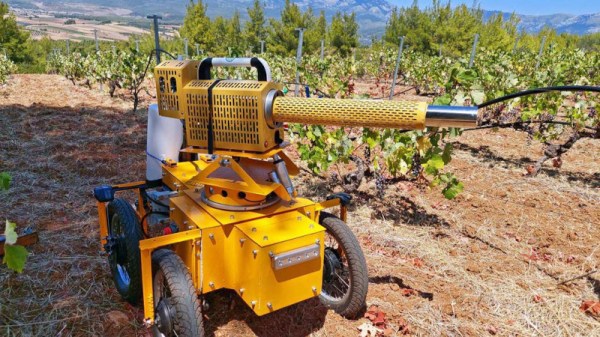
In the world of agriculture, not all enterprises are large arable cropland affairs upon which tractors do their work traversing strip by strip under the hot sun. Many farms raise far more intensive crops on a much smaller scale, and across varying terrain. When it comes to automation these farms offer their own special challenges, but with the benefit of a smaller machine reducing some of the engineering tasks. There’s an entry in this year’s Hackaday prize which typifies this, [KP]’s Agrofelis robot is a small four-wheeled carrier platform designed to deliver autonomous help on smaller farms. It’s shown servicing a vineyard with probably one of the most bad-ass pictures you could think of as a pesticide duster on its implement platform makes it look for all the world like a futuristic weapon.
A sturdy tubular frame houses the battery bank and brains, while motive power is provided by four bicycle derived motorized wheels with disk brakes. Interestingly this machine steers mechanically rather than the skid-steering found in so many such platforms. On top is a two degrees of freedom rotating mount which serves as the implement system — akin to a 3-point linkage on a tractor. This is the basis of the bad-ass pesticide duster turret mentioned above. Running it all is a Nvidia Jetson Nano, with input from a range of sensors including global positioning and LIDAR.
The attention to detail in this agricultural robot is clearly very high, and we could see machines like it becoming indispensable in the coming decades. Many tasks on a small farm are time-consuming and involve carrying or wheeling a small machine around performing the same task over and over. Something like this could take that load off the farmer. We’ve been there, and sure would appreciate something to do the job.
Commercial industrial agriculture is responsible for providing food to the world’s population at an incredibly low cost, especially when compared to most of human history when most or a majority of people would have been involved in agriculture. Now it’s a tiny fraction of humans that need to grow food, while the rest can spend their time in cities and towns largely divorced from needing to produce their own food to survive. But industrial agriculture isn’t without its downsides. Providing inexpensive food to the masses often involves farming practices that are damaging to the environment, whether that’s spreading huge amounts of synthetic, non-renewable fertilizers or blanket spraying crops with pesticides and herbicides. [NathanBuildsDIY] is tackling the latter problem, using an automated drone system to systemically target weeds to reduce his herbicide use.
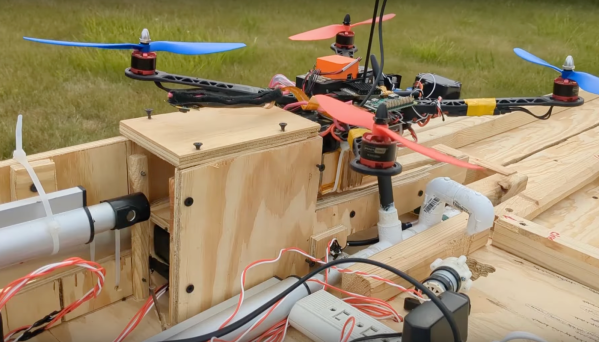
The specific issue that [NathanBuildsDIY] is faced with is an invasive blackberry that is taking over one of his fields. To take care of this issue, he set up a drone with a camera and image recognition software which can autonomously fly over the field thanks to Ardupilot and a LiDAR system, differentiate the blackberry weeds from other non-harmful plants, and give them a spray of herbicide. Since drones can’t fly indefinitely, he’s also build an automated landing pad complete with a battery swap and recharge station, which allows the drone to fly essentially until it is turned off and uses a minimum of herbicide in the process.
The entire setup, including drone and landing pad, was purchased for less than $2000 and largely open-source, which makes it accessible for even small-scale farmers. A depressing trend in farming is that the tools to make the work profitable are often only attainable for the largest, most corporate of farms. But a system like this is much more feasible for those working on a smaller scale and the automation easily frees up time that the farmer can use for other work. There are other ways of automating farm work besides using drones, though. Take a look at this open-source robotics platform that drives its way around the farm instead of flying.