Repairing A Legendary Elka Synthex Analog Synthesizer

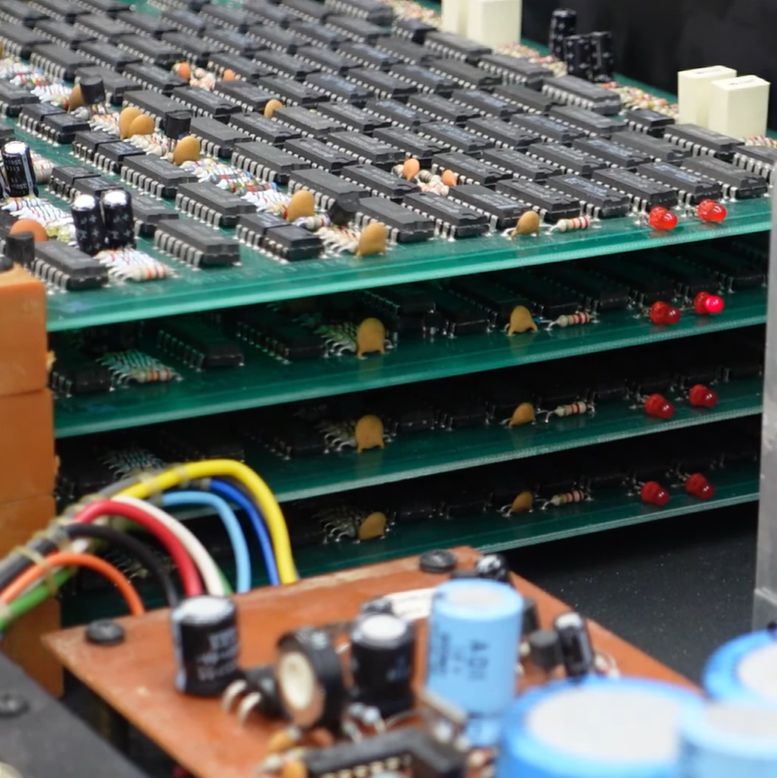
Handy diagnostic LEDs on the side of the tone generator boards. (Credit: Mend it Mark, YouTube)

Somehow, an Elka Synthex analog synthesizer made it onto [Mend it Mark]’s repair bench recently. It had a couple of dud buttons, and some keys produced the wrong tone. Remember, this is an analog synthesizer from the 1980s, so we’re talking basic 74LS chips and kin. Fortunately, Elka helped him with the complete repair manual, including schematics.

As usual, [Mark] starts by diagnosing the faults, using the schematics to mark the parts of the circuitry to focus on. Then, the synth’s bonnet is popped open to reveal its absolutely gobsmackingly delightful inner workings, with neatly modular PCBs attached to a central backplane. The entire unit is controlled by a 6502 MPU, with basic counter ICs handling tone generation, controlled by top panel settings.

The Elka Synthex is a polyphonic analog synthesizer produced from 1981 to 1985 and used by famous artists, including Jean-Michel Jarre. Due to its modular nature, [Mark] was quickly able to hunt down the few defective 74LS chips and replace them before testing the instrument by playing some synth tunes from Jean-Michel Jarre’s Oxygène album, as is proper with a 1980s synthesizer.

Looking for something simpler? Or, perhaps, you want something not quite that simple.

Continue reading “Repairing A Legendary Elka Synthex Analog Synthesizer”

Blue Ghost Watches Lunar Eclipse From The Lunar Surface

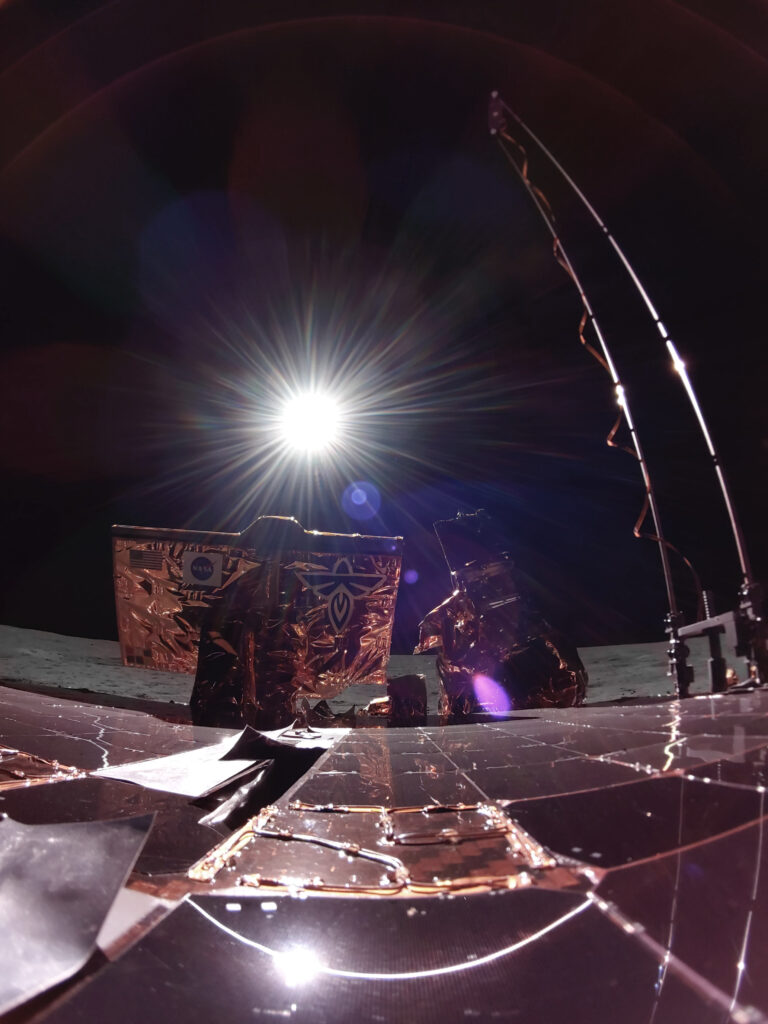
Firefly’s Blue Ghost lander's first look at the solar eclipse as it began to emerge from its Mare Crisium landing site on March 14 at 5:30 AM UTC. (Credit: Firefly Aerospace)
Firefly’s Blue Ghost lander’s first look at the solar eclipse as it began to emerge from its Mare Crisium landing site on March 14 at 5:30 AM UTC. (Credit: Firefly Aerospace)

After recently landing at the Moon’s Mare Crisium, Firefly’s Blue Ghost lunar lander craft was treated to a spectacle that’s rarely observed: a total solar eclipse as seen from the surface of the Moon. This entire experience was detailed on the Blue Ghost Mission 1 live blog. As the company notes, this is the first time that a commercial entity has been able to observe this phenomenon.

During this event, the Earth gradually moved in front of the Sun, as observed from the lunar surface. During this time, the Blue Ghost lander had to rely on its batteries as it was capturing the solar eclipse with a wide-angle camera on its top deck.

Unlike the Blood Moon seen from the Earth, there was no such cool effect observed from the Lunar surface. The Sun simply vanished, leaving a narrow ring of light around the Earth. The reason for the Blood Moon becomes obvious, however, as the refracting of the sunlight through Earth’s atmosphere changes the normal white-ish light to shift to an ominous red.

The entire sequence of images captured can be observed in the video embedded on the live blog and below, giving a truly unique view of something that few humans (and robots) have so far been able to observe.

Continue reading “Blue Ghost Watches Lunar Eclipse From The Lunar Surface”

Transmitting Wireless Power Over Longer Distances

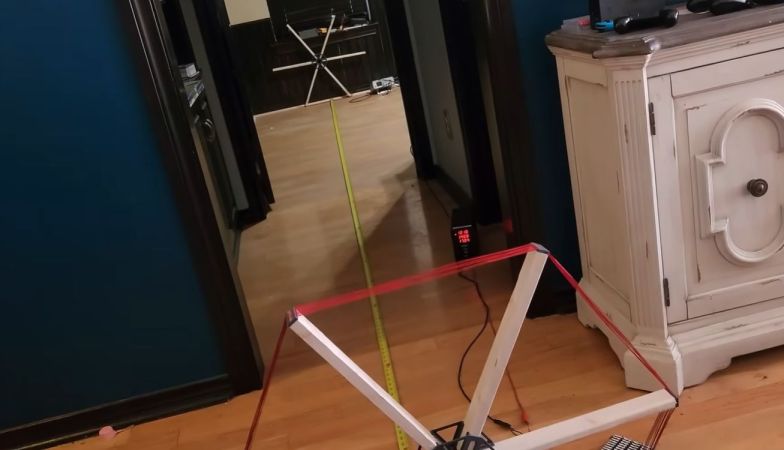
Proof-of-concept of the inductive coupling transmitter with the 12V version of the circuitry (Credit: Hyperspace Pirate, YouTube)

Everyone loves wireless power these days, almost vindicating [Nikola Tesla’s] push for wireless power. One reason why transmitting electricity this way is a terrible idea is the massive losses involved once you increase the distance between transmitter and receiver. That said, there are ways to optimize wireless power transfer using inductive coupling, as [Hyperspace Pirate] demonstrates in a recent video.

Starting with small-scale proof of concept coils, the final version of the transmitter is powered off 120 VAC. The system has 10 kV on the coil and uses a half-bridge driver to oscillate at 145 kHz. The receiver matches this frequency precisely for optimal efficiency. The transmitting antenna is a 4.6-meter hexagon with eight turns of 14 AWG wire. During tests, a receiver of similar size could light an LED at a distance of 40 meters with an open circuit voltage of 2.6 V.

Although it’s also an excellent example of why air core transformers like this are lousy for efficient remote power transfer, a fascinating finding is that intermediate (unpowered) coils between the transmitter and receiver can help to boost the range due to coupling effects. Even if it’s not a practical technology (sorry, [Tesla]), it’s undeniable that it makes for a great science demonstration.

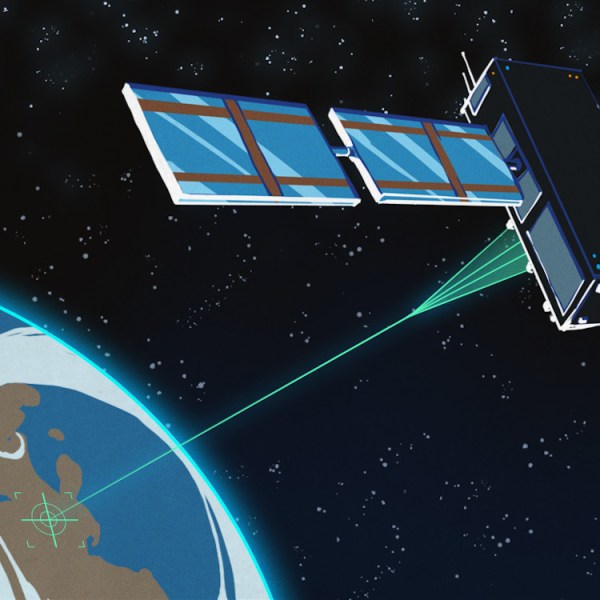
Of course, people do charge phones wirelessly. It works, but it trades efficiency for convenience. Modern attempts at beaming power around seem to focus more on microwaves or lasers.

Continue reading “Transmitting Wireless Power Over Longer Distances”

Building A Fully Automatic Birkeland-Eyde Reactor

Ever wanted to produce nitrogen fertilizer like they did in the 1900s? In that case, you’re probably looking at the Birkeland-Eyde process, which was the first industrial-scale atmospheric nitrogen fixation process. It was eventually replaced by the Haber-Bosch and Ostwald processes. [Markus Bindhammer] covers the construction of a hobbyist-sized, fully automated reactor in this video.

It uses tungsten electrodes to produce the requisite arc, with a copper rod brazed onto both. The frame is made of aluminium profiles mounted on a polypropylene board, supporting the reaction vessel. Powering the whole contraption is a 24 VDC, 20 A power supply, which powers the flyback transformer for the high-voltage arc, as well as an air pump and smaller electronics, including the Arduino Uno board controlling the system.

The air is dried by silica gel before entering the reactor, with the airflow measured by a mass air flow sensor and the reaction temperature by a temperature sensor. This should give the MCU a full picture of the state of the reaction, with the airflow having to be sufficiently high relative to the arc to extract the maximum yield for this already very low-yield (single-digit %) process.

Usually, we are more interested in getting our nitrogen in liquid form. We’ve also looked at the Haber-Bosch method in the past.

Continue reading “Building A Fully Automatic Birkeland-Eyde Reactor”

Firefox logo displayed on screen

Add WebUSB Support To Firefox With A Special USB Device

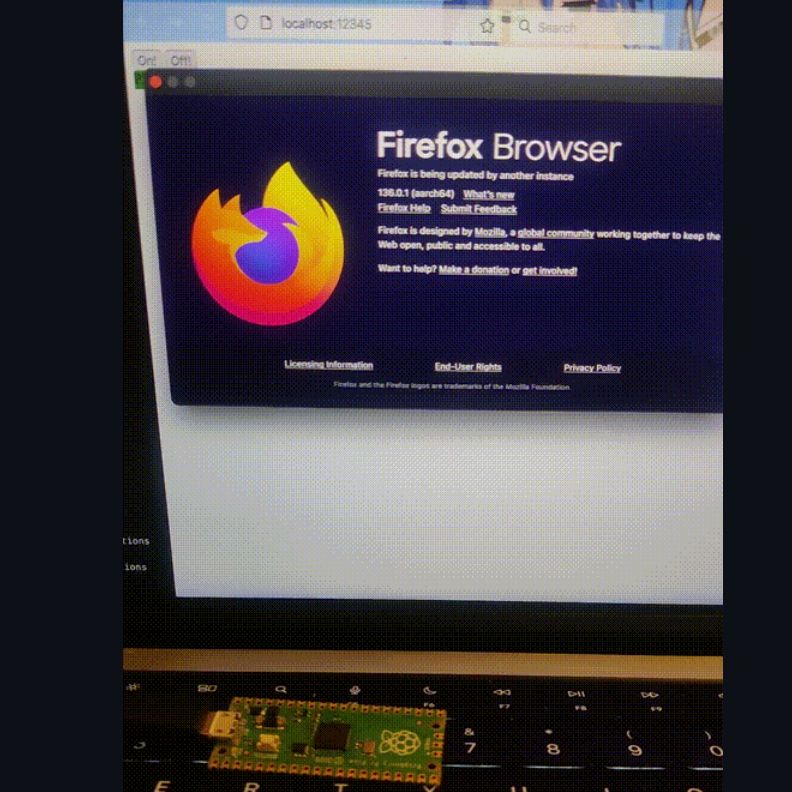
RP2040-based Pico board acting as U2F dongle with Firefox. (Credit: ArcaneNibble, GitHub)

The WebUSB standard is certainly controversial. Many consider it a security risk, and, to date,  only Chromium-based browsers support it. But there is a workaround that is, ironically, supposed to increase security. The adjacent Universal 2nd Factor (U2F) standard also adds (limited) USB support to browsers. Sure, this is meant solely to support U2F USB dongles for two-factor authentication purposes, but as [ArcaneNibble] demonstrates using U2F-compatible firmware on a Raspberry Pi RP2040, by hijacking the U2F payload, this API can be used to provide WebUSB-like functionality.

Continue reading “Add WebUSB Support To Firefox With A Special USB Device”

My Scammer Girlfriend: Baiting A Romance Fraudster

Nobody likes spam messages, but some of them contain rather fascinating scams. Case in point, [Ben Tasker] recently got a few romance scam emails that made him decide to take a poke at the scam behind these messages. This particular scam tries to draw in marks with an attached photo (pilfered from Facebook) and fake personal details. Naturally, contacting scammers is a bad idea, and you should never provide them with any personal information if you decide to have some ‘fun’.

The games begin once you contact them via the listed email address, as they’re all sent from hacked/spoofed email accounts. After this you have to wait for the scammers to return to the campaign on their monthly cycle, so give it a few weeks. Analyzing image metadata provides some clues (e.g. the FBMD prefix in IPTC tags set by Meta, as well as timezone info). The IP address from the email headers pointed to a VPN being used, so no easy solution here.

After establishing contact, the scammers try to coax the mark into ‘helping’ them move to their country, with Skype out-call numbers received on [Ben]’s burner phone that seem designed to add to the realism. Then ‘disaster’ strikes and the mark is asked to transfer a lot of money to help their new ‘love’. Naturally, [Ben] wasn’t a gullible mark, and set up a few traps, including a custom domain and website that’d log any visitor (i.e. the scammer).

Continue reading “My Scammer Girlfriend: Baiting A Romance Fraudster”

C+P: Combining The Usefulness Of C With The Excellence Of Prolog

In a move that will absolutely not over-excite anyone, nor lead to any heated arguments, [needleful] posits that their C Plus Prolog (C+P for short) programming language is the best possible language ever. This is due to it combining the best of the only good programming language (Prolog) with the best of the only useful programming language (C). Although the resulting mash-up syntax that results may trigger Objective-C flashbacks, it’s actually valid SWI-Prolog, that is subsequently converted to C for compilation.

Language flamewars aside, the motivation for C+P as explained in the project’s README was mostly the exploring of macros in a system programming language. More specifically, by implementing a language-within-a-language you can add just about any compile-time feature you want including – as demonstrated in C+P – a form of generics. Even as a way to have a bit of fun, C+P comes dangerously close to being a functional prototype. Its main flaw is probably the lack of validation and error messages, which likely leads to broken C being generated.

Also mentioned are the Nim and Haxe languages which can be compiled (transpiled) to C or C++, which is somewhat of a similar idea as C+P, as well as cmacro (based on Common Lisp) and the D language.