44 Mac Pros Racked Up To Replace Each Rack Of 64 Mac Minis

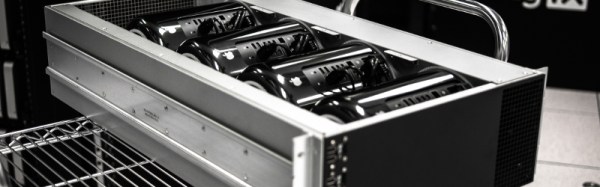
We were delighted at a seeing 96 MacBook Pros in a rack a couple of days ago which served as testing hardware. It’s pretty cool so see a similar exquisitely executed hack that is actually in use as a production server.  imgix is a startup that provides image resizing for major web platforms. This means they need some real image processing horsepower and recently finalized a design that installs 44 Mac Pro computers in each rack. This hardware was chosen because it’s more than capable of doing the heavy lifting when it comes to image processing. And it turns out to be a much better use of rack space than the 64 Mac Minis it replaces.

Racking Mac Pro for Production
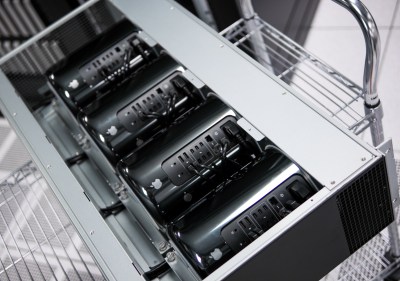
single-mac-pro-rack

Each of the 11 R2 panels like the one shown here holds 4 Mac Pro. Cooling was the first order of business, so each panel has a grate on the right side of it for cold-air intake. This is a sealed duct through which one side of each Pro is mounted. That allows the built-in exhaust fan of the computers to cool themselves, pulling in cold air and exhausting out the opposite side.

Port access to each is provided on the front of the panel as well. Connectors are mounted on the right side of the front plate which is out of frame in this image. Power and Ethernet run out the back of the rack.

The only downside of this method is that if one computer dies you need to pull the entire rack to replace it. This represents 9% of the total rack and so imgix designed the 44-node system to deal with that kind of processing loss without taking the entire rack down for service.

Why This Bests the Mac Mini
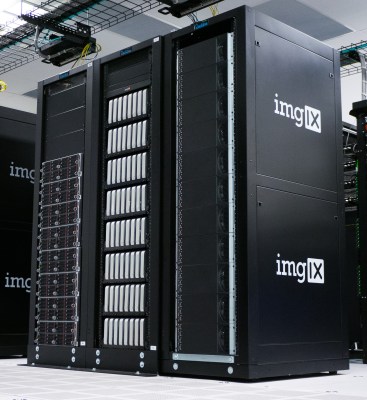
3 racks - Linux. Mac Min, Mac Pro
3 racks – Linux. Mac Min, Mac Pro

Here you can see the three different racks that the company is using. On the left is common server equipment running Linux. In the middle is the R1 design which uses 64 Mac Minis for graphic-intensive tasks. To the right is the new R2 rack which replace the R1 design.

Obviously each Mac Pro is more powerful than a Mac Mini, but I reached out to imgix to ask about what prompt them to move away from the R1 design that hosts eight rack panes each with eight Mac Minis. [Simon Kuhn], the Director of Production, makes the point that the original rack design is a good one, but in the end there’s just too little computing power in the space of one rack to make sense.

Although physically there is room for at least twice as many Mac Mini units — by mounting them two-deep in each space — this would have caused several problems. First up is heat. Keeping the second position of computers within safe operating temperatures would have been challenging, if not impossible. The second is automated power control. The R1 racks used two sets of 48 controllable outlets to power computers and cooling fans. This is important as the outlets allow them to power cycle mis-behaving units remotely. And finally, more units means more Ethernet connections to deal with.

We having a great time looking that custom server rack setups. If you have one of your own, or a favorite which someone else built, please let us know!

[Thanks to drw72 for mentioning R2 in a comment]

We Should 3D Scan People

In a perfect futuristic world you have pre-emptive 3D scans of your specific anatomy. They’d be useful to compare changes in your body over time, and to have a pristine blueprint to aid in the event of a catastrophe. As with all futuristic worlds there are some problems with actually getting there. The risks may outweigh the rewards, and cost is an issue, but having 3D imaging of a sick body’s anatomy does have some real benefits. Take a journey with me down the rabbit hole of 3D technology and Gray’s Anatomy.

Continue reading “We Should 3D Scan People”

The Best Of Boston Hackers At Artisan’s Asylum

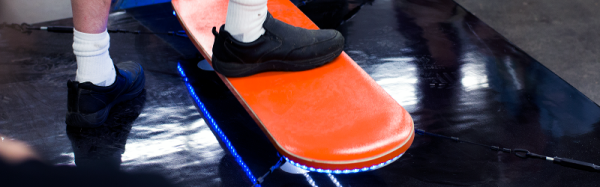
We were in Boston last week and Artistan’s Asylum welcomed us in to host a Hackaday Meetup. We usually pack the place when the Hackaday community turns out, but this was exceptional. This hackerspace has a sizeable open area that I’m told fits triple-digits and we were using all of it. In addition to food and beverage (courtesy of our parent company Supplyframe who also make trips like this one a possibility), we had lighting talks for people to show off their projects. One of the hits was a functional hoverboard shown above, but there were dozens of others.

Here is the quick gallery of images (from our Hackaday.io event page) to give you an overview. After the break you’ll find dozens more highlighting the builds which were being shown off.

Continue reading “The Best Of Boston Hackers At Artisan’s Asylum”

Dropping By The MIT Electronics Research Society

We’re in Boston this week and my first stop was at MITERS last night. This is the MIT Electronics Research Society, which started as a way to provide free access to computers for all students. Since those humble beginnings the organization has grown to include a slew of fabrication and test hardware, as well as a vibrant community that makes the group a great place to hang out.

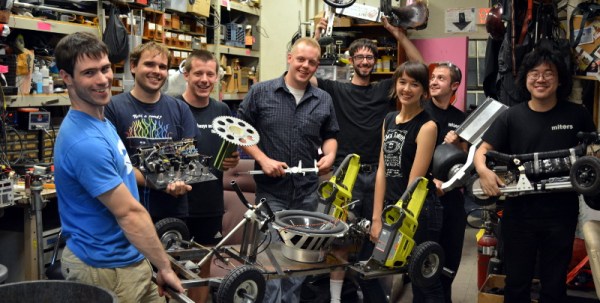
Walking into the building you’re greeted with double doors strewn with interesting electronics and many examples of fabrication in the form of the word MITERS. The group, which is pushing 60-years of existence, feels immediately like a hackerspace where creativity and anarchy duke it out in a wild dance of experimentation. On this particular Wednesday evening we encountered a room of about 10 people working feverishly to fabricate electric racers for the PRS racing circuit in Detroit this Saturday.

Like a hackerspace, MITERS is completely member (read: student) run. There is a board that helps keep things on the rails. There is no membership fee; funding for the organization is sourced from Swapfest, a weekly flea market during the summer.

There is a strong slant toward machine shop at this hackerspace. In addition to a respectable Bridgeport CNC Mill, the machine tools and hand tools provide for almost all your fabrication needs.

What can be built in this space? How about a unibalancer? This is a single-wheeled, human-ridable vehicle that has a 7-mile cruise radius between charges. For me the most interesting feature is the deadman’s switch. You know those black rubber strips on public buses that you press for the next stop? This unibalancer has one that you need to stand on to make it go.

The hackers at MITERS excel when it comes to electric vehicles and this time of year that means the Power (Wheels) Racing Series. There are restrictions on size, and power output so the teams squeeze every bit that they can. For me, the most interesting build is based off of a pair of Ryobi electric chainsaws. The 40V batteries for these are themselves quite formidable but not used at all in the build. The team has reverse-engineered the driver circuits and written their own firmware for the STM8 microcontrollers on the boards. The chainsaws use chains to drive the two rear wheels. The entire system is monitored with XBEE-based wireless data which is displayed on a tablet.

This isn’t the only PRS build. The MITERS plan to take three different vehicles with them this weekend. The one they can’t bring is the huge electric shopping cart (with mandatory wheelie bar) which hangs from the ceiling of the space.

In addition to the formidable fabrication projects, there are a multitude of electronic projects to be seen. There is a musical tesla coil which is the best I’ve ever heard. It could easily be mistaken as a proper speaker. If you need more bass there’s a massive ceiling-mounted sub-woofer for that. And if you want a more formidable tesla coil, the parts are there.

Look hard enough and you’ll even find battle robots. This one had diamond plate that spins with a variety of nasty accoutrements intended for maximum damage of its foe. On the underside you’ll see a brushless motor used the opposite of how you might think. The shaft is attached to the locomotion frame of the bot. The underside of the spinning diamond plate has a ring of antistatic mat against which this brushless motor body spins.

Thanks to the MITERS for welcoming us in. It was a blast seeing all of the projects they’re working on!

Meetup at Artisan’s Asylum Tonight

If you’re in the Boston area, head on over to Artisan’s Asylum tonight starting at 6. They were gracious enough to open their doors for a Hackaday Meetup. Bring some hardware to show off if you can, if you can’t that’s fine as well. We’ll have a few lightning talks, some social time, and maybe an afterbar!

To wrap things up, we have covered a few projects from MITERS already, like this Power Wheels Racing build, and an electric go kart done the right way. Now that we’ve met them in person we’ll be on the lookout for a lot more awesome hacks from them.

[Thanks John for suggesting we stop by!]

Review: Microchip Curiosity Is A Gorgeous New 8-bit Dev Board

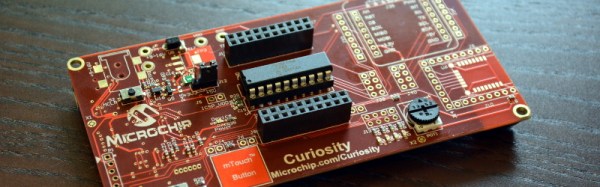
Microchip has unveiled a new dev board called the Curiosity Development Board. I had my first look at this at Bay Area Maker Faire back in May but was asked not to publicize the hardware since it wasn’t officially released yet. Yesterday I got my hands on one of the first “pilot program” demo units and spent some time working with it.

I requested a sample board out of my own curiosity. As you may know, Microchip is one of the sponsors of the 2015 Hackaday Prize, but that partnership does not include this review. However, since we do have this relationship we asked if they would throw in a few extra boards that we could give away and they obliged. More about that at the end of the post.

Continue reading “Review: Microchip Curiosity Is A Gorgeous New 8-bit Dev Board”

Spools Of Thread For 6,400 Pixel Color Display

This is not an LED display, it’s a thread display. The hardware artists over at Breakfast, a Brooklyn based rapid product and prototype company, built this color display that uses spools of thread for each pixel. 6,400 spools to be exact.

Serious work went into this thing, and the results couldn’t be better. Check out the video after the break to see for yourself. The trick is to increase the surface area of the spools of thread. This is done by using the spool as a pulley which guides a 5.5 foot length of “threaded fabric”. Up close, the fabric looks as if it’s just wrapped around the wooden spool, but the extra length provides enough room for 36 different colors, each blending into the next in a gradient effect. Index the location of the fabric in each pixel system and you have a wide range of color options.

The piece was commissioned by clothing retailer Forever 21 and has even been given its own website. The display pulls Instagram photos with the #F21threadscreen hashtag and displays them. You can watch a live stream for the next week, and the dedicated site has a search feature to find a recording of your own photo by username.

We must once again give credit for producing the kind of advertising we want to see. This is both interesting and awesome. It gave some talented people work producing it, and sharing the details of the build is both interesting and inspiring for us. Want to see some more interesting advertising like this? Check out that Beck’s bottle used as a phonograph cylinder, and the extreme engineering used to separate Oreos.

Continue reading “Spools Of Thread For 6,400 Pixel Color Display”

What It Means To Be A Product

We’re not giving away a prize. We’re making it your priority to share hard-earned knowledge. On August 17th we’ll start testing the Best Products. Ten will be recognized as finalists, one will be awarded $100,000 but everyone will benefit.

We want to highlight a set of amazing products. These are well-built designs that deserve recognition for doing the extra 90% of work involved in designing for production. This has not traditionally been the fun or sexy part of product development, but that will change.

What does it mean to be a product? Engineering something to be manufactured and sold is a different ball game compared to going from a concept to a working prototype. This is often the downfall of the crowd funding campaign. You were prepared to hammer out 100 units with your friends in someone’s basement. Oops, you now have 1400 backers and have overshot the point at which your plans could work. If properly engineered, a product can be scaled without completely redesigning it.

This is where we are right now. The barriers for having a professionally fabbed PCB made are completely non-existant. But the barriers for making that small-run PCB proof-of-concept into a product are still formidable. We’re changing that and you’re the key to it all. It starts by sharing great examples of how these problems are being overcome. Start-ups should be leading the way, pollinating this information by talking about your experience, your ideas, and your vision.

Write about your successes, failures, and solutions. Show us what happened during the evolution of your product and secure the title of Best Product.

[Photo Credit: Hilmers Studios Technical Illustrations]


Submit your entry for Best Product before 8/17/15. Don’t forget to opt-in for best product by using the “Submit-to Best Product” option on the left sidebar of your project page. Qualifying entries which have sent in three working beta-test units by the entry deadline will be considered for the Best Product prizes. See the entries so far and drop into our live chat at 6:00 PDT Today.