Home electrical, it’s really not that hard. But when you’re dealing with the puzzles left for your by someone else things can get really weird. [Daniel’s] sister and her husband ran into this recently. The video demonstration of their fail includes a lot of premature laughter, but it’s worth hanging in there… you’ll quickly see why she can’t contain her amusement.
The project at hand is a replacing a bathroom fan with a simple light fixture. Once the swap was made the light switch works just as anticipated. But a second switch which used to control a different light now behaves strangely. It doesn’t activate the original light, but instead switches the new fixture. Even stranger is that the original switch apparently now acts as a bizarre dimmer when the second switch is on. That’s odd, but the coup d’état of the fail is when they plug in a hair dryer and switching it on illuminates the light but doesn’t activate the hair dryer.
As with all Fail of the Week segments, the goal here is not to criticize but to commiserate. What do you think is causing this? We can’t wait to see what you come up with. Posting simple diagrams is encouraged (you can use HTML img tags in the comments). Ladies and gentlemen, start your conjecture.
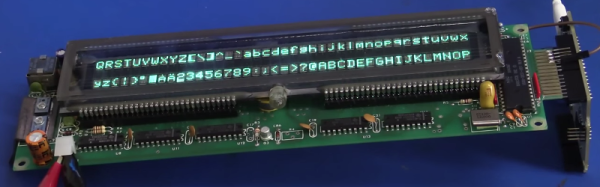
[Dave Jones] got his hands on a really wide, 2-row Vacuum Fluorescent Display. We’ve come across these units in old equipment before and you can get them from the usual sources, both new and used, but you need to know how to drive them. This recent installment of the EEVblog reverse engineers this VFD.
The function of these displays is pretty easy to understand, and [Dave] covers that early in the video after the break. There is a cathode wire and phosphorescent coated anodes. When current is applied the anodes glow. To add control of which anodes are glowing a mesh grid is placed between the anodes and the cathode wire. Applying negative potential to the grid prevents the electrons from traveling to the anode so that area will not be lit.
Now driving this low-level stuff is not easy, but rest assured that most VFDs you find are going to have a driver attached to them. The reverse engineering is to figure out the protocol used to control that driver. On this board there is a 2-pin connector with a big electrolytic filtering cap which is a dead giveaway for power rails. Looking at the on-board processor which connects directly he ascertains that the input will be 5V regulated since this is what that chip will expect. Connecting his bench supply yields a blinking cursor! [Dave] goes on to pump parallel data and test out the control pins all using an Arduino. He finds success, sharing many great reverse engineering tips along the way.
We often call this type of thing a dark art, but that’s really just because there aren’t a lot of people who feel totally comfortable giving it a try. We think that needs to change, so follow this example and also go look at [Ben Heckendorn’s] recent LCD reverse engineering, then grab some equipment and give it a try for yourself. We want to hear about your accomplishments!
When you think of satellites, you may think of the Space Shuttle extending its robot arm with a huge piece of high-tech equipment waiting to pirouette into orbit. This misconception is similar to picturing huge mainframes when thinking about computers. The future (and arguably even the present) reality of satellites is smaller, cheaper, and more prolific. This future is also an “open” one if the Libre Space Foundation has anything to say about it.
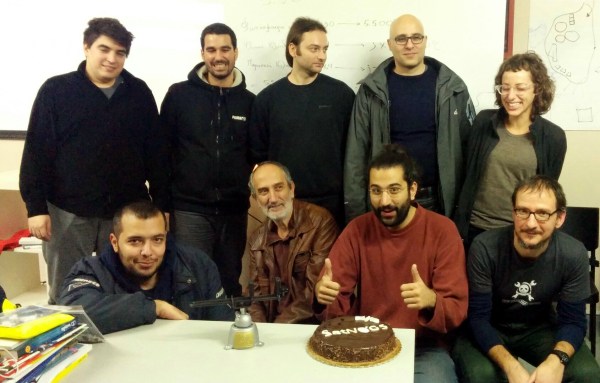
This group that plans to make satellite communications available to anyone started out as a build at a hackerspace. One good idea, a shared set of skills and experience, and a little bit of time led them to accomplish amazing things. We are, of course, talking about the Grand Prize winners of the 2014 Hackaday Prize. The SatNOGS team built a working satellite ground station and laid the foundation for a data-sharing network to connect to it. But even this description can be a bit daunting, so come with me to learn what this is all about, and how it matters to you.
It’s amazing how affordable PCB fabrication has become. It has long been economical (although not always simple) to fabricate your own singe and double-sided boards at home, the access to professional fabrication is becoming universal. The drive continues downward for both cost and turnaround time. But there is growing interest in the non-traditional.
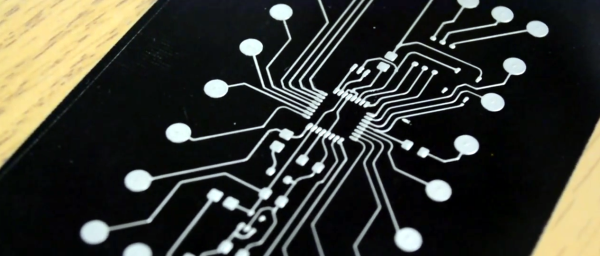
Over the last year we’ve seen a huge push for conductive-ink-based PCB techniques. These target small-run prototyping and utilize metals (usually silver) suspended in fluid (think glue) to draw traces rather than etching the traces out of a single thin layer of copper. Our question: do you think conductive in will become a viable prototyping option?
Voltera V-One Circuit Board Prototyping Machine
I recorded this interview at 2015 CES but was asked not to publish it until their crowd funding campaign went live. If you haven’t been paying attention, Voltera is at almost 400% of their $70k goal with 26 days remaining. This printer definitely works. You can print circuits, solder components or reflow them, and there’s even a second non-conductive ink that can be used to insulate between traces when they cross over one another. In the video [Alroy] suggests Voltera for small production runs of 10-20 boards. Would you see yourself using this for 10-20 boards?
Personally, I think I could solder point-to-point prototypes in less time. Consider this: the V-One will print your traces but you still must solder on the components yourself. If the board design reaches a high level of complexity, that timing may change, but how does the increased resistance of the ink compared to copper traces affect the viability of a board? I assume that something too complex to solder point-to-point would be delving into high-frequency communications (think parallel bus for LCD displays, etc.). Is my assumption correct? Do you think conductive ink will get to the point that this is both viable and desirable over etching your own prototypes and how long before we get there?
Now, I certainly do see some perfect use-cases for Voltera. For instance, introduction to circuit design classes. If you had one of these printers at the middle school or high school level it would jump-start interest in electronics engineering. Without the need for keeping chemical baths like Cuperic Chloride or Ferric Chloride on hand, you could walk students through simple board design and population, with the final product to take home with them. That’s a vision I can definitely get behind and one that I think will unlock the next generation of hardware hackers.
Correction: [Arachnidster] pointed out in the comments that Voltera is still working on being able to reflow boards printed by the V-One. On their Kickstarter page they mention: “(Reflow onto Voltera printed boards is currently under development)”
It hasn’t become a household term yet, but Software-Defined Radio (SDR) is a major player on the developing technology front. Whether you’re building products for mass consumption, or just playing around for fun, SDR is worth knowing something about and I’ll prove it to you.
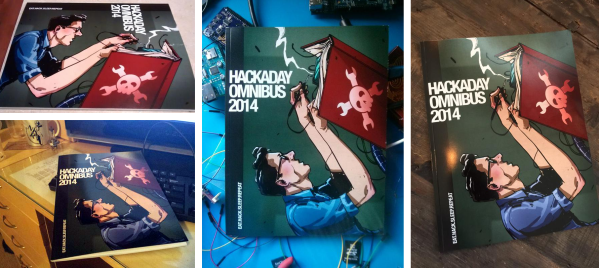
February 9th has come and gone and the Hackaday Omnibus 2014 is now shipping. If you were one of the early adopters who pre-ordered, thank you very much it should be in your hands shortly! If you missed out on the Pre-Order, don’t worry you can still get a copy of your very own but we only ordered a small over-run so don’t wait too long.
The Omnibus celebrates the best our writers and illustrators published in 2014 with an 80-page full color volume printed on premium paper. From tales of technology past, to current events, the Omnibus tells the story of what the high points in hardware were last year. We have fallen in love with having a physical version of this content since the proof copies hit our hands a month ago. We believe that this is a conversation waiting to happen — set it out and watch your friends gravitate toward it.
We’ve already seen them popping up on Twitter and we’d love to see more. Make sure to Tweet a picture of your copy to @Hackaday with hashtag #hadOmnibus. We’re happy to see any pictures shared, but if you’re one of the lucky souls who works with awesome hardware make sure to take some ‘extreme’ shots. For instance, reading while you wait for the cyclotron to warm up, the nuclear sub to surface, or your ride to pick you up from Amundsen-Scott.
This is our first ever print edition and we’ve gone to great lengths to make sure it’s something you’ll be proud to have on your coffee table, bookshelf, or anywhere for years to come.
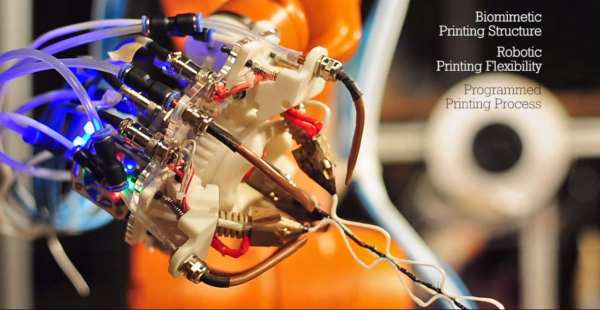
If you can get over how creepy spiders can be there’s a lot to learn from them. One of nature’s master-builders, they have long been studied for how they produce such strong silk. What we hadn’t realized is that it’s not strictly cylindrical in nature. The spider silk exhibits intermittent expansions to the diameter of the — for lack of a better word — extrusion. This project uses biomimickry to replicate the strength of that design.
The print head is actually four extruders in one. In the clip after the break you can see the black center filament’s rigidity is augmented with three white filaments positioned around it radially. The use of this knowledge? That’s for you to decide. As with some of the most satisfying engineering concepts, this is presented as an art installation. As if the rhythmic movements of that print head weren’t enough, they mounted it on a KUKA and plopped the entire thing down in the center of a room for all to see.
The demo isn’t the only awesome bit. You’ll want to click the link at the top to see the exploded-parts diagram porn found half-way down the page. All is beautiful!