Fail Of The Week: WS2811 Pixel Failure On FLED

This Fail of the Week project comes from one of Hackaday’s own. [Ben] took on the FLED data visualization project as a way to make the SupplyFrame decor a lot more fun. He had quite a bit of help soldering the 96 WS2811 pixels into their custom made 6’x4′ enclosure and the results are really awesome. In addition to showing server load and playing games, FLED has become something of a job interview. Sit the prospective employee down at a terminal and give them an hour to code the most interesting visualization they are capable of.

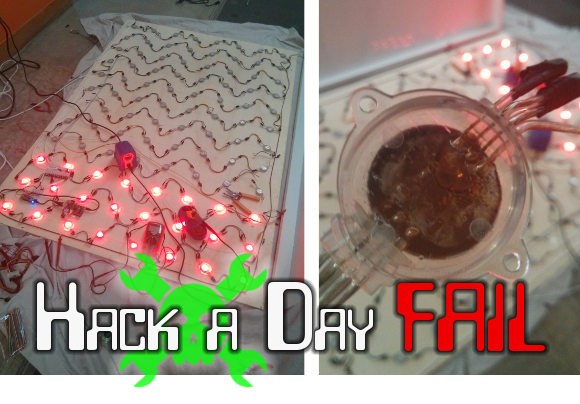
But two weeks ago [Ben] staggered into the office and found the display was dead. Did he try turning it off and back on again? Yes, but to no avail. The power supply wasn’t the issue and there was no option but to pull the display off the wall and crack it open for a look at all those pixels. Since every one of them had 4 solder joints on either side he figured the problem was with a broken connection. But not so. He resorted to a binary search for the offending pixel by  cutting the strand in half, and testing each portion. He tracked it down to the pixel whose underside was blackened as you can see above.

[Ben] thinks one of the capacitors inside the sealed enclosure blew, but isn’t certain. Feel free to tell us what you think failed in this component. But the thing we’d really like to know is if there is a more clever way to sniff out the offensive pixel without cutting the connections? Four hours on the floor with this thing (and no knee-pads) and [Ben] has sworn off sourcing pixels from random Chinese suppliers. He might go with pre-assembled strings next time. We chuckle; this is the high-tech equivalent of trying to get old strands of Christmas lights to work.

If you haven’t seen FLED in action, check it out after the break. It amazing how LED intensity and quality diffuser material can make a perfect grid of LEDs seem to dance in waves and color curves.

Continue reading “Fail Of The Week: WS2811 Pixel Failure On FLED”

Hackaday Scouts For Hacks At SXSW

It seems like everyone is going to South by Southwest this year. We even heard about it on The Today Show this week. But we still have hope that there’s awesomeness to be found. A few of our crew will be there this year and they’re on the lookout for something special. The festival starts on Friday and runs more than a week to the following Sunday but our guys will be on the ground Sunday, March 9th through Tuesday the 11th.

Sure, we’ll take a gander at the interactive hardware areas, but preliminary research tells us these may be watered down to the lowest common denominator. What we really want to see is if a Burning-Man-like culture is beginning to coalesce around SXSW. Are you carrying around your own hacked hardware at this year’s event? Do you roll up in a custom party-mobile and spend the week trying to keep the 24-hour tailgate alive with your fold out pig roaster and awning-based entertainment system? We’d like to check that out.

[Eren], [Alek], and [Ivan] are handling coverage of the event. They’ve been killing themselves making Hackaday Projects an awesome place to share and interact. What they wanted was a bit of down time, but handing out T-shirts and Stickers in exchange for a look at your hacks doesn’t get in the way of that. Connect with them on Twitter using the hash tag #HaD_SXSW. They’ll be using it to tweet their activities but of course it works both ways. Your best bet of just crashing into these guys is to check out [Alek’s] talk on StageTwo.

[Background Image Source]

Forget Stopping Bullets – Vest Warms You While Stopping Taser

[Bruce Wayne] [Shenzhen] wanted a garment that would protect him from a jolt, while keeping him toasty in the cold weather. Well that’s not it at all, these are merely two of his projects using the same material in different ways.

We’re going to start with the infrared image on the right. This is a vest with chest and back pieces made of carbon tape totaling two meters of the material swirled on each side. Hook it to a power source and the carbon tape warms the wearer. Portability is something of an issue as each “element” takes 36 W of power (3A at 12V). Click through for advice on how to interface the tape with the power source.

Onto the main event… avoiding electrical shock when you get all up in the grill of that mall cop you’re hated for years. [Shenzhen’s] jacket is really just an ordinary long-sleeved coat. But he separated the lining at the bottom seam and used fusible material to hold the carbon tape in place. The carbon tape provides a better conductor than your skin, preventing the shock from stunning you as it was intended. This really is the thing of superheroes, or former editors who should have known better.

Theta Junction to Case Tjc

Hot Or Not? Find Out How To Calculate Component Heat And Why You Should

How hot are your key components getting? There’s a good chance you’ve built a project and thought: “Well I guess I better slap a heat sink in there to be safe”. But when working on a more refined build you really need to calculate heat dissipation to ensure reliability. This is actually not tough at all. The numbers are right there in the datasheet. Yes, that datasheet packed with number, figures, tables, graphs, slogans, marketing statements, order numbers… you know right where to look, don’t you?

Hackaday has you covered on this one. In under 10 minutes [Bil Herd] will not only show how easy these calculations are, he’ll tell you where to look in the datasheets to get the info you need quickly.

Continue reading “Hot Or Not? Find Out How To Calculate Component Heat And Why You Should”

Fail Of The Week: Reset Issues With 595 And HD44780

fotw-reset-issues-595-character-lcd

We really like to see hardware hackers stepping out of the safe and polished boundaries of available Arduino libraries. One example of this is a project which [Matteo] thought worked: using a shift register to drive a character LCD. This can be a desirable way to do things, because it takes the GPIO usage down from six to just three connections. If you don’t remember seeing that one earlier this month take another look. The gist of it is that [Matteo] hacked one function in the LiquidCrystal library to make it happen.

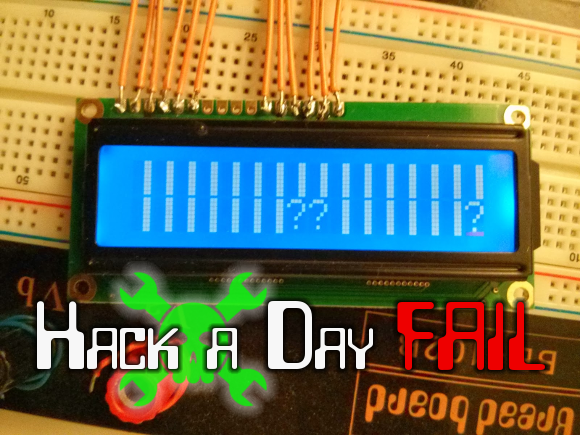
What makes this a truly great fail is that the problem was not immediately apparent, and is difficult to reliably reproduce. The LCD is unstable depending on how the Arduino board is reset. When connecting the Arduino to a computer the screen doesn’t work until you press the reset button. But press the reset button repeatedly and you get a non-functional screen plus the gibberish seen above.

There’s not much to go on here, but we think it’ll be a lot of fun to state your theory on the malfunction and suggesting for testing/fixing the issue. This could be a lot of things, the controller on the display getting mixed-up, the 595 missing an edge (or something along those lines). Do you fix this with hardware (ie: capacitor to avoid voltage dip), a software issue (need a longer delay after startup), or a combination of the two?


2013-09-05-Hackaday-Fail-tips-tileFail of the Week is a Hackaday column which runs every Wednesday. Help keep the fun rolling by writing about your past failures and sending us a link to the story — or sending in links to fail write ups you find in your Internet travels.

Hackaday Meetup With [Chris Gammell]

hackaday-meetup-with-chris-gammell

Update: We have it figured out. We’re bringing the awesome at The Blind Donkey in Pasadena, CA at 6pm this evening. Stop in with your hardware and your war stories. Chris Gammell, Mathieu Stephan, and I can’t wait to talk Arduino hardware hacking with you!

I’m getting to meet all kinds of cool people in person this year, and so can you! Well… if you happen to be in Pasadena, California on Wednesday after work and have nothing better to do. [Chris Gammell] — well-known for The Amp Hour and Contextual Electronics — and I are both going to be in town. We’re meeting up for a beer and thought we’d invite you along for the fun.

Details are scarce right now. I’m not sure of time or place (other than Pasadena area) so make sure you follow @Hackaday on Twitter and watch for the #HaD_meetup tag Wednesday afternoon for the details. We’ll also update the Hackaday Projects event page at the time. I’ll bring along some swag; you’d better cart along a piece of hardware to show off in return for a t-shirt or stickers. You’re on your own for food and beverages at this one.

Wondering what I meant about meeting lots of cool people? In addition to the nearly 500 awesome readers who showed up at The Gathering, I met [Brian] and [Eliot] for the first time.

Hackaday Links: February 23, 2014

hackaday-links-chain

You can pick up a tiny laser pointer on the cheap if you know where to look. But when it comes time to replace the multiple button cells that power it be prepared to clean our your wallet. [KB3WZZ] got around that with the cap from a ball-point pen. He drilled holes in the end plug of the pointer, and used wire and a plastic pen cap as a battery adapter. He’s powering it from USB, but now that you have wires exiting the case you can use any source you wish.

[Gerben] tipped us off about the trinket clone he built himself. It’s a tiny sliver of a PCB which he etched, populated with through-hole parts only, and finished off with some finger nail varnish to prevent shorting and corrosion. The solder-covered edge connector for USB was left unvarnished of course.

If you live in a college town you are probably quite used to seeing futon pads and frames on the curb waiting for the garbage collector. A little bit of ingenuity, and some added lumber, will turn a futon frame into a respectable shelving unit. [Thanks Martin]

Complicated bench equipment + good lighting + a great camera = an awesome teardown. This time around it’s the guts of a Keithly 2002 8.5 digit mulitimeter laid bare. [Thanks David]

Here’s a PCB laminator hack that is definitely worth a look. The original unit was acquired on eBay for about $25 and had a thermostat whose performance wasn’t optimal. A bit of alteration for the thickness of the substrate, and you’ll never hand iron a toner transfer board again! [Thanks William]

Last summer we heard about Scout, an ocean-going drone trying to cross the Atlantic. We just checked the live tracking and the craft is still at sea. But a much smaller 5ft vessel made it from New Jersey to Guernsey (an island between the UK and France) after traveling for about 14 months. [Thanks Rob]