EmuDroid 4: An Android Gaming Controller

snesdroid

[Carnivore] over at Droid Build is working on a very awesome Android Gaming Controller called the EmuDroid 4.

It’s a work in progress at the moment, but so far it looks utterly fantastic. He is combining an android tablet with a USB SNES controller, an OTG adapter, and an inductive charging unit. He’s cramming them all into a custom designed, 3D printed controller body, which is semi-reminiscent of an Xbox 360 controller — minus the joysticks.

The forum posts go over his current progress and outline the ups and downs of 3D printing a project as precise as this. There is everything from designing it in segments to suit the small build volume of his UP 3D printer, to dealing with issues like delamination from the print bed, and seamlessly bonding the parts together. It’s a great learning experience, and we love to see projects in progress like this. Best of all, he’s planning on giving it away for FREE when it’s complete!

We’ve seen lots of modified controllers used with Android before, but we think this integrated solution really takes the cake, at least for now anyway!

[Thanks Tony!]
Pedaling At 128km/h

[Donhou] had a dream. To create a road bike capable of reaching 100mph (160km/h).

He damn well near did it too. The goal of this project wasn’t to set a land speed record, but more of an experiment in design, and building a really fast bike that still looks like a bicycle. In case you’re wondering though, the land speed record is currently set at 167mph by [Fred Rompelberg] who was drafting behind a dragster on the Salt Flats of Bonneville.

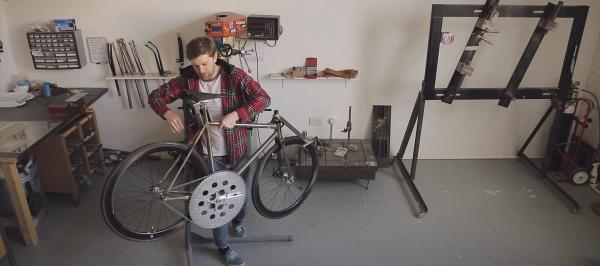
The bike features custom everything; a welded lightweight frame using Columbus Max tubing (to help with speed wobbles), super low handlebars for aerodynamics, and a massive 104 tooth chainring which almost scrapes the ground as you pedal. Even the rims and tires are unique — regular bicycle wheels just aren’t designed to go that fast.

We aren’t even bike nuts, but we thoroughly enjoyed the awesome 9-minute documentary on this project. Check it out after the break.

Continue reading “Pedaling At 128km/h”

ATMega16 Hard Disk Clock

Hard-Disk-Clock-by-Martin-Stromer_3338278

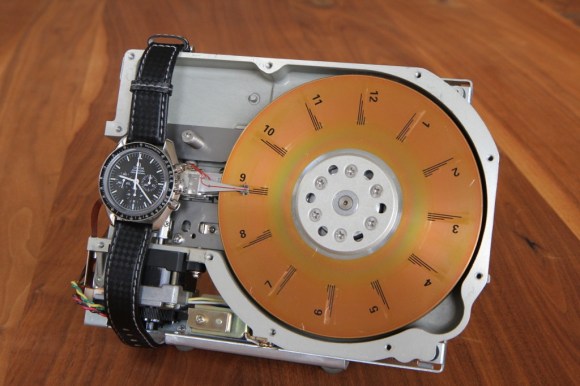
[Martin Stromer] made this great looking Hard Disk Clock about 12 years ago, and finally decided to share it with the world. It’s been “ticking” ever since.

It’s a beautiful clock, and if you think the drive might look a bit odd, that’s probably because its well over 20 years old! We’re not too sure the capacity, but it couldn’t have been more than a few dozen megabytes.

To read the time, the platter rotates 30 degrees at once, per hour. The read-write head inches across the disc to display the minutes. Each of the black lines represents a quarter hour. The whole thing is controlled by an ATMega16, which maintains almost all of the original hardware. The blog post has a great write-up on how it all works.

Did we mention it’s also easy to set the time? Simply rotate the disc by hand and slide the read-write head into place, then press the reset button. Check out the clock in action after the break.

Continue reading “ATMega16 Hard Disk Clock”

Wireless MIDI Floor Piano!

123

[Jianan Li] just finished documenting one of his most recent projects, a wireless MIDI floor piano that he and a small group made for Duke University’s Hackathon!

He was inspired to do this project after reading our recent coverage on a DIY Pressure Plate. Having only 24 hours to compete in the Hackathon, they had to choose something that was fairly easy to build out of cheap materials, and quick to assemble. This was just the ticket.

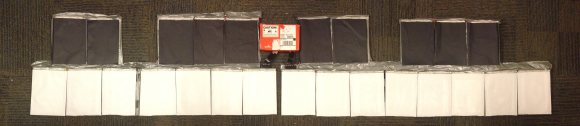
The piano features 25 of the aluminum foil pressure plates, whose state are read by the Arduino Mega. This is then transmitted by an XBee radio to an Arduino Uno, which acts as the receiver for the laptop that processes the signals. They even added a remote control using an ATtiny85 to allow for octave and instrument changes — it also uses an XBee to communicate back to the Uno. For a 24 hour build, the quality is quite impressive, and it doesn’t sound half bad either — Take a listen after the break!

Continue reading “Wireless MIDI Floor Piano!”

Pong Playing T-Shirt

pong playing tshirt

One of our younger hackers just finished off this awesome Instructable on his flexible 14 x 15 pixel, pong playing t-shirt!

[GenAap] has been working on this on and off for the past year, and finally debuted it at a few Halloween parties last month — it was a hit. He’s made the screen out of RGB LED strips, cleverly soldered together into a large flexible panel of 14 by 15 full colour pixels.

An Arduino Mega takes care of the logic to run the game, which [GenAap] wrote all himself! There’s also a cleverly designed controller using a slide-potentiometer and single button. To play back, the computer AI uses about 15 lines of code, which for pong, is more than enough. He’s also made the whole thing removable so you can still wash the shirt. Finally, the batteries and the “Magic Box” go into a pocket for simplicity’s sake.

If you’re interested in making your own, he also has a Github repository of everything you needStick around after the break to see a demonstration of the shirt by [GenAap] himself!

Continue reading “Pong Playing T-Shirt”

Raspberry Pi Smart TV

[Tony] decided his “smart” LED TV wasn’t quite smart enough. So he stuffed a Raspberry Pi in it.

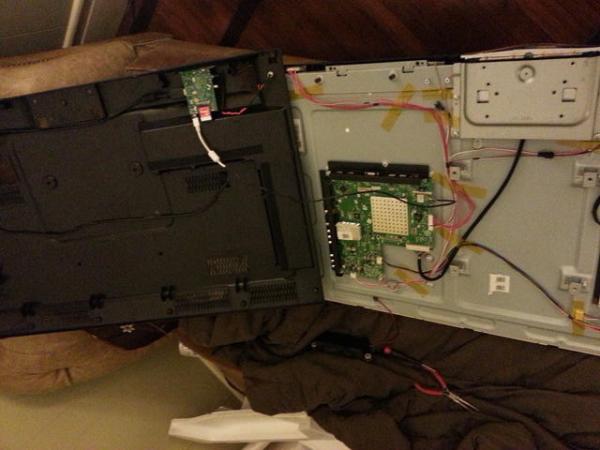
Upon opening the case of his 40″ Hisense Smart LED TV, he discovered that the logic board actually had two unused USB pads — what luck! He tapped off of them to get 5V @ 500mA to power the Pi… Later on he realized this wasn’t the ideal solution — when the TV turned off, it cut the Pi’s power too. So he pulled out his multimeter and probed the board, this time finding a 5V source that remained on while the unit was plugged in.

Next up was the placement of the Raspberry Pi. The included speakers on this particular TV weren’t that good, and since [Tony] uses a surround sound system anyway, he decided to make use of their space better. Cutting out the grill and removing the whole assembly left him with more than enough room to store the Pi and mount a 3D printed LAN and USB port cover!

He’s running Raspbmc which lends the TV tons of functionality. If you don’t mind voiding your warranty, this is a great hack!

Da Vinci’s Viola Organista

hurdy gurdy

Leonardo Da Vinci had many unfinished projects, not unlike many hackers here. Lucky for us though, he was a bit better at writing down his ideas than we are. This is his Viola Organista, as recreated by [Slawomir Zubrzycki] — a mechanical work of art, that sounds good too!

If you’re familiar with a Hurdy gurdy, this is basically the same thing — but on a much bigger scale. It is the combination of an organ, a harp, and a viola. Instead of a hammer hitting the 61 steel-strings, spinning wheels of horse-hair (similar to a bow) caress each string via input from the keyboard and the pedal powered crankshaft. The result is a very unique sound, which is reminiscent to each of the instruments it combines.

The designs for the instrument were found in Da Vinci’s Codex Atlanticus, a 12-volume collection of many of his manuscripts and designs, documenting everything from his flying machines to weaponry. [Slawomir] spent three years and over 5000 hours perfecting his version of it.

Stick around after the break to hear it in action! Don’t forget to turn on the subtitles though, unless you’re fluent in Polish!

Continue reading “Da Vinci’s Viola Organista”