Holiday Jukebox Gets ESP32, Home Assistant Support

If we’ve learned anything over the years, it’s that the only thing hardware hackers love more than a device festooned with buttons is one that’s covered in LEDs — so it’s no surprise that this “Mr Christmas” jukebox caught the eye of [Roberts Retro]. But while the holiday gadget might have been mildly entertaining in its stock configuration, he quickly realized that what it really needed was an ESP32 retrofit. After all, what good are all those buttons and LEDs if you can’t bend them to your will?

For the first half of the video, [Robert] treats us to a detailed teardown of the device, which as you might imagine, is largely hollow inside. This gave him plenty of room to graft in new hardware, which is really the best gift any of us could hope to find under the tree. In addition to the ESP32 development board, the jukebox also received a number of WS2812B addressable RGB LEDs, and a DFPlayer module to handle music playback.

With all the buttons wired up to inputs on the ESP32, [Robert] can reconfigure the jukebox to do pretty much whatever he wants with just changes to the software. In the video, he demonstrates how the buttons can be used to trigger the playback of individual songs stored on the DFPlayer’s SD card, which essentially replicates it’s stock functionality. A few lines of changed code later, those same buttons can be used to control devices via Home Assistant.

To get into the holiday spirit, [Roberts Retro] shows off the completed jukebox controlling his ESP-enabled LEGO train set — another of his festive upgrades that we covered back in 2022.

Continue reading “Holiday Jukebox Gets ESP32, Home Assistant Support”

Custom Firmware For Even Cheaper Bluetooth Thermometers

Readers may recall when we first covered the $5 Xiaomi LYWSD03MMC temperature and humidity sensor back in 2020. Prolific hacker [Aaron Christophel] wrote a custom firmware for the affordable gadget that was so capable and well implemented that it kicked off a whole new community.

It’s recently been brought to our attention that the Xiaomi thermometer has become so popular that clones have started popping up. Often sold under the Tuya brand, these versions look very similar to Xiaomi’s offering but can be had for as little as $1 each from the usual Chinese importers. Even better, they’ve got their very own open-source custom firmware.

The firmware comes from [pvvx], who also helms the most active fork of [Aaron]’s original firmware for the Xiaomi thermometer. Doing a bit of spot-checking between the repositories, it’s not immediately clear that any meaningful code is shared between the two projects. However, once installed, they offer similar capabilities to the user, such as integration with Home Assistant. Perhaps the most significant difference between the two projects is that, at least for the initial flash, you need to hook the Tuya units up to your computer with a USB serial adapter. Considering that one of the highlights of the Xiaomi custom firmware was its exceptionally easy wireless installation, this is a considerable step backward.

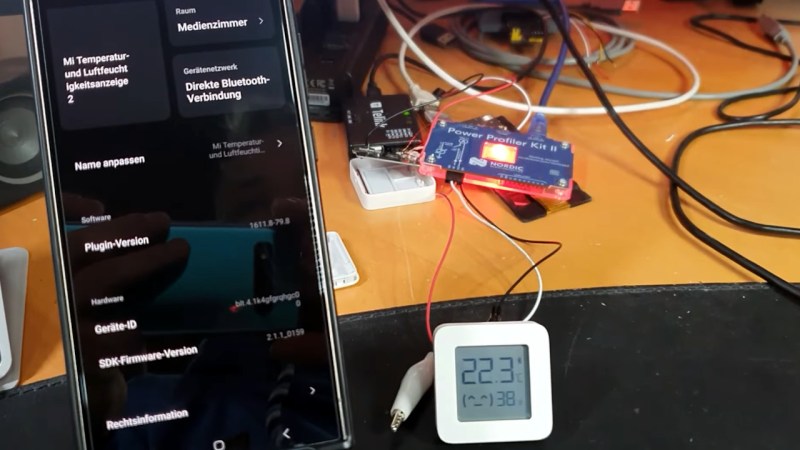
Below is a video from a few months back that [Maker’s Fun Duck] put together, where he takes apart one of these clones and shows the installation process for the custom firmware. Our overall impression is that it’s probably worth the few extra dollars to get the original Xiaomi hardware, although the display on the clone seems much brighter. In any event, we’re always happy to see the community coming up with free and open-source firmware for an otherwise locked-down gadget.

Continue reading “Custom Firmware For Even Cheaper Bluetooth Thermometers”

Building The Spectacular Fibonacci128 Simple Add-On

This year, we not only challenged Supercon attendees to come up with their own Simple Add-Ons (SAOs) for the badge, but to push the envelope on how the modular bits of flair work. Historically, most SAOs were little more than artistically arranged LEDs, but we wanted to see what folks could do if they embraced the largely unused I2C capability of the spec.

[Squidgeefish] clearly understood the assignment. This first-time attendee arrived in Pasadena with an SAO that was hard to miss…literally. Looking directly at the shockingly bright 128 RGB LED array packed onto the one-inch diameter PCB was an experience that would stay with you for quite some time (ask us how we know). With the “artistically arranged LEDs” aspect of the nominal SAO handled nicely, the extra work was put into the design so that the CPU could control the LED array via simple I2C commands.

Continue reading “Building The Spectacular Fibonacci128 Simple Add-On”

ESP8266 Keeps Tabs On Wood Stove Temperature

Wood heat offers unique advantages compared to more modern heating systems, especially in remote areas. But it also comes with its own challenges, namely, keeping the fire going at the optimum temperature. If it’s too cold you risk buildup in the chimney, but if you’ve got it stoked up more than necessary, you’ll end up burning through your wood faster.

To keep the fire in that sweet spot, [Jay] decided to put an ESP8266 and a thermocouple to work. Now, this might seem like an easy enough job at first, but things are complicated by the fact that the flue temperature above the stove lags considerably behind the temperature inside the stove. There’s also the fact that the top of the chimney will end up being much colder than the bottom.

Mounting the thermocouple in the flue pipe.

In an effort to get a more complete view of what’s happening, [Jay] plans on putting at least two thermocouples in the chimney. But as getting on the roof in December isn’t his idea of fun, for now, he’s starting with the lower one that’s mounted right above the stove. He popped a hole in the pipe to screw in a standard K-type probe, and tapped it a few times with the welder to make sure it wasn’t going anywhere.

From there, the thermocople connects to a MAX6675 amplifier, and then to the WeMos D1 Mini development board that’s been flashed with ESPHome. [Jay] provides the configuration file that will get the flue temperature into Home Assistant, as well as set up notifications for various temperature events. The whole thing goes into a 3D printed box, and gets mounted behind the stove.

This project is a great example on how you can get some real-world data into Home Assistant quickly and easily. In the future, [Jay] not only wants to add that second thermocouple, but also look into manipulating the stove’s air controls with a linear actuator. Here’s hoping we get an update as his woodstove learns some new tricks.

Tldr-pages Keeps It Short, Wherever You Need It

Let’s face it, even the most accomplished console cowboy can’t keep everything memorized. Sure, you might know all the important arguments for a daily-use tool like tar or ls, but what about the commands you don’t use that often? For that matter, even if you do use tar every day, we bet you don’t know all of the options it supports.

Built-in documentation or the man pages are of course a huge help, but they are dense resources. Sometimes what you really need is to see just a few key examples. When that happens, check out the tldr-pages project and its array of front-ends. Whether you’re working remotely on an embedded gadget, or have the luxury of a full desktop OS and browser, the project offers a way to get the help you need as quickly as possible.

Continue reading “Tldr-pages Keeps It Short, Wherever You Need It”

Hackaday Podcast Episode 299: Beaming Consciousness, Understanding Holograms, And Dogfooding IPv6

On this episode of the Hackaday Podcast, Editors Elliot Williams and Tom Nardi talk about the optical witchcraft behind holograms, the finer points of designing 3D printable threads, and the challenges of switching your local network over to IPv6. They’ll also cover how a clever software patch improves the graphics in a flight simulator from the 1990s, and why spacecraft flying into orbit powered by the SABRE engine is going to remain a dream for now.

From there you’ll hear about a reproduction VW gas gauge that works better than the real thing, custom ball screws, and the latest and greatest in homebrew battery charging. Finally, they’ll cap the episode off by exploring the conundrum that’s heating up London’s Underground, and diving into the (mostly) fictional history of teleportation.

Check out the links below if you want to follow along, and as always, tell us what you think about this episode in the comments!

Direct Download Link

Continue reading “Hackaday Podcast Episode 299: Beaming Consciousness, Understanding Holograms, And Dogfooding IPv6”

Cranking Up The Detail In A Flight Simulator From 1992

Nostalgia is a funny thing. If you experienced the early days of video games in the 1980s and 90s, there’s a good chance you remember those games looking a whole lot better than they actually did. But in reality, the difference between 2023’s Tears of the Kingdom and the original Legend of Zelda is so vast that it can be hard to reconcile the fact that they’re both in the same medium. Of course, that doesn’t mean change the way playing those old games actually makes you feel. If only there was some way to wave a magic wand and improve the graphics of those old titles…

Well, if you consider Ghidra and a hex editor to be magic wands in our community, making that wish come true might be more realistic than you think. As [Alberto Marnetto] explains in a recent blog post, decompiling Stunt Island and poking around at the code allows one to improve the graphical detail level in the flight simulator by approximately 800%. In fact, it’s possible to go even higher, though at some point the game simply becomes unplayable.

Continue reading “Cranking Up The Detail In A Flight Simulator From 1992”