The 13.5 Million Core Computer

Having a dual- or quad-core CPU is not very exotic these days and CPUs with 12 or even 16 cores aren’t that rare. The Andromeda from Cerebras is a supercomputer with 13.5 million cores. The company claims it is one of the largest AI supercomputers ever built (but not the largest) and can perform 120 Petaflops of “dense compute.”

We aren’t sure about the methodology, but they also claim more than one exaflop of “AI computing.” The computer has a fabric backplane that can handle 96.8 terabits per second between nodes. According to a post on Extreme Tech, the core technology is a 3-plane wafer processor, WSE-2. One plane is for communications, one holds 40 GB of static RAM, and the math plane has 850,000 independent cores and 3.4 million floating point units.

The data is sent to the cores and collected by a bank of 64-core AMD EPYC 3 processors. Andromeda is optimized to handle sparse matrix computations. The company claims that the performance scales “almost linearly.” That is, as you double the number of cores used, you roughly half the total run time.

The machine is available for remote use and cost about $35 million to build. Since it uses 500 kW at peak run times, it isn’t free to operate, either. Extreme Tech notes that the Frontier computer at Oak Ridge National Labs is both larger and more precise, but it cost $600 million, so you’d expect it to be more capable.

Most homebrew “supercomputers” we see are more for learning how to work with clusters than trying to hit this sort of performance. Of course, if you have a modern graphics card, OpenCL and CUDA will let you do some of this, too, but at a much lesser scale.

Fuel Cell Catalyst: Less Is More

A fuel cell is almost like a battery that has replenishable fuel. Instead of charging a battery with an electric current, you recharge a fuel cell with something like hydrogen or you simply consume it from a tank much as an internal combustion engine consumes gasoline. However, fuel cells usually use a catalyst — it isn’t consumed in the reaction, but it is necessary and many fuel cells use platinum as a catalyst which is expensive. But what if you could use less catalyst and get a better result? That’s what researchers in Canada and the US are claiming in a recent paper. The key isn’t how much catalyst they are using, but rather the shape of the catalyst.

Of course, everyone wants to use less of the expensive catalyst but polymer electrolyte fuel cells have had a particular problem where reducing the amount of catalyst used causes a disproportionate drop in cell performance. This new approach uses spherical catalyst support that improves the distribution and utilization of the catalyst.

Continue reading “Fuel Cell Catalyst: Less Is More”

New Metric Prefixes Get Bigger And Smaller

It always fascinates us that every single thing that is made had to be designed by someone. Even something as simple as a bag and box that holds cereal. Someone had to work out the dimensions, the materials, the printing on it, and assign it a UPC code. Those people aren’t always engineers, but someone has to think it out no matter how mundane it is before it can be made. But what about the terms we use to express things? Someone has to work those out, too. In the case of metric prefixes like kilo, mega, and pico, it is apparently the General Conference on Weights and Measures that recently had its 27th session. As a result of that, we have four more metric prefixes to learn: ronna, quetta, ronto, and quecto.

Apparently, the new prefixes are to accommodate “big data” which is rapidly producing more data than there are atoms in the Universe. There were actually proposed earlier in a slightly different form but accepted at the conference. Apparently quecca is too close to a Portuguese swear word. So what do these actually mean? A QB (quettabyte) would be 1030 bytes while an RB (ronnabyte) is only 1027.  So 1 QB would be 1,000,000 yottabytes (YB) the previous top of the scale.

Continue reading “New Metric Prefixes Get Bigger And Smaller”

How To Repair? The Death Of Schematics

There was a time when, if you were handy with a soldering iron, you could pretty easily open up a radio or TV repair business. You might not get rich, but you could make a good living. And if you had enough business savvy to do sales too, you could do well. These days there aren’t many repair shops and it isn’t any wonder. The price of labor is up and the price of things like TVs drops every day. What’s worse is today’s TV is not only cheaper than last year’s model, but probably also better. Besides that, TVs are full of custom parts you can’t get and jam-packed into smaller and smaller cases.

Case in point, I saw a “black Friday” ad for a 40-inch 1080p flatscreen with a streaming controller for $98. Granted, that’s not huge by today’s standards and I’m sure it isn’t a perfect picture. But for $98? Even a giant high-quality TV these days might cost a bit more than $1,000 and you can get something pretty great for well under $500.

Looking back, a Sears ad showed a great deal on a 19″ color TV in 1980. The price? $399. That doesn’t sound too bad until you realize that today that would be about $1,400. So with a ratio of about 3.5 to 1, a $30/hour service call would be, today, $105. So for an hour’s service call with no parts, I could just buy that 40″ TV. Add even one simple part or another hour and I’m getting close to the big league TVs.

Did you ever wonder how TV repair technicians knew what to do? Well, for one thing, most of the time you didn’t have to. A surprising number of calls would be something simple like a frayed line cord or a dirty tuner. Antenna wires destroyed by critters was common enough. In the tube days, you could pretty easily swap tubes to fix the bulk of actual problems.

Continue reading “How To Repair? The Death Of Schematics”

At A Loss For Words? Try A Teleprompter

With everyone doing videos these days, you might want to up your narration game with a teleprompter. [Modern Hobbyist] can help. Since he does videos — like the one about the teleprompter below — we assume he built it out of his own need for the device. Actually, this is his second teleprompter. The first one was larger and not battery-powered, so this new version offers more portability. The camera shoots through the teleprompter screen so you can look right at the camera and still stay on script.

The project reuses some of the original teleprompter code, showing a text file via a Raspberry Pi. There’s also a control keyboard that lets you remotely control the scrolling speed. The real key to this project though is the 3D printed housing. Well, that and the reflective glass screen. Given that, you could do the actual text display in a number of ways.

Apparently, the portability of the build is limited somewhat by the weight of the camera. You could, of course, use something lighter or perhaps add some weight opposite to at least balance it a bit. The 3D printing files are on Thingiverse and the rest is on GitHub, so you can easily make changes if you want.

You would think we would see more teleprompter projects, and we do see some. We’ve also seen a hack to let you look through your laptop screen on video conferences.

Continue reading “At A Loss For Words? Try A Teleprompter”

Logic Via DNA

We often say you can make logic gates out of nearly anything. [Steve Mould] would agree as he just finished playing naughts and crosses (tic tac toe if you are an American) with a tray full of DNA. You can see the resulting game and how it works in the video below.

The use of DNA isn’t really significant as it simply implements a logic equation for each of the nine cells. So, for example, each cell is taken by an X (the DNA) only when certain other squares have been taken by O or not taken by O. So you essentially create an AND/OR gate using the state of each cell and its inverse.

Continue reading “Logic Via DNA”

Madness Or Genius? FDM Printing With Resin

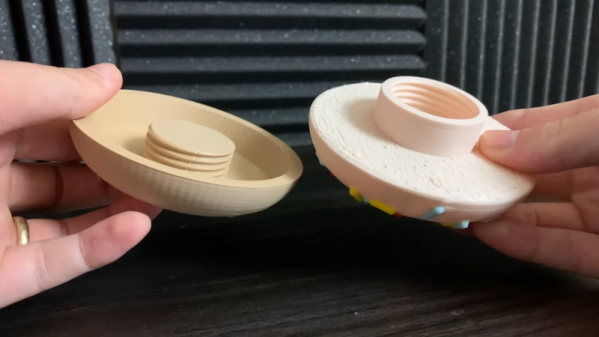
We aren’t sure what made him think of it, but [Proper Printing] decided to make an FDM printer lay down resin instead of filament. Why? We still aren’t sure, but we admire the effort nonetheless. In principle, extruding resin shouldn’t be much different than other liquid things you print like icing or concrete. Then you’d need to UV-cure the viscous liquid quickly. In fact, they wound up making up a paste-like resin using several chemicals and a filler.

Armed with the paste, it would seem like the big obstacles would be over. Instead of part cooling fans, the printer now has two laser heads focused on the print area. Printing in vase mode avoids some problems, but the first few attempts were not very successful.

With a bit of perseverance, the setup did work — for a while. More fine tuning got acceptable results. However, he eventually changed the filler material and got a passable Benchy to print. Nothing to be proud of, but recognizable. Honestly, we were surprised that the laser’s didn’t cure the material still inside the nozzle and cause terrible clogs.

Why put this much effort into doing this? We have no idea. Should you try it? Probably not. Of course, being able to print a paste has its own value. Perhaps delivering glue or solder paste, for example. But you generally won’t need to make tall prints with that kind of material. Then again, we’ve never been opposed to doing something “just because.”

After all, why make a musical instrument out of a Game Boy? Why make a modem with tin cans? You might as well extrude resin.

Continue reading “Madness Or Genius? FDM Printing With Resin”