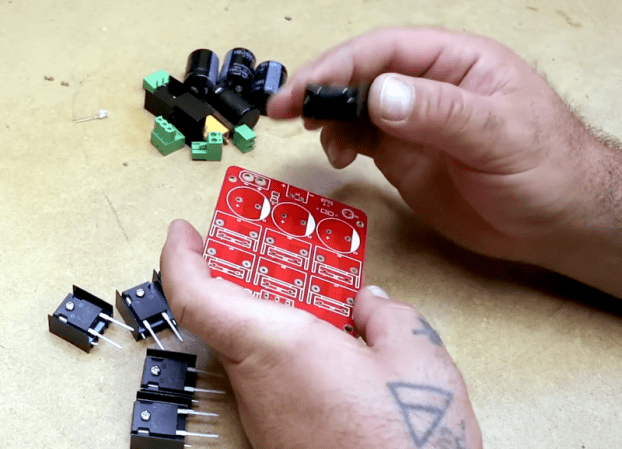
[Electronoobs] is using some brushless motors to make a DIY wind turbine. His recent video isn’t about the turbine itself, but a crucial electronic part: the three-phase rectifier. The reason it is so important is due to the use of brushless motors. Normal motors are not ideal for generating power for several reasons, as explained in the video below.
The brushless motors have three windings and generate three outputs, each out of phase with the others. You can’t just join them together because they are 120 degrees out of phase. But a special rectifier can merge the inputs efficiently and output a low-ripple DC voltage.
I know many computer languages, but I’ve struggled all my life to learn a second human language. One of my problems is that I can’t stop trying to translate in my head. Just like Morse code, you need to understand things directly, not translate. But you have to start somewhere. One of the reasons metric never caught on in the United States is that it is hard to do exact translations while you are developing intuition about just how hot is 35 °C or how long 8 cm is.
If you travel, temperature is especially annoying. When the local news tells you the temperature is going to be 28, it is hard to do the math in your head to decide if you need a coat or shorts.
Ok, you are a math whiz. And you have a phone with a calculator and, probably, a voice assistant. So you can do the right math, which is (9/5) x °C + 32. But for those of us who can’t do that in our heads, there is an easier way.
No one likes cleaning out water spouts. [NeedItMakeIt] wanted to collect rainwater and was interested in using a Coanda filter that those used on hydroelectric plants to separate out debris. Ultimately, he decided to design his own and 3D print it.
The design uses a sloping surface with teeth on it to coax water to go in one direction and debris to go in another. It fits into a typical spout, and seems like it works well enough. Some commenters note that varying volumes of rain and different types of debris behave differently, which is probably true. However, there are similar commercial products, so you’d guess there would be some value to using the technique.
The water pushes the debris off the slope, so you end up losing a little water with the debris. So as always, there’s a trade-off. You can see in the video that if the water flow isn’t substantial, the debris tends to stall on the slope. Could the filter be improved? That was the point in trying a second design.
It wasn’t a big improvement. That’s where there’s a plot twist. Well, actually, a literal twist. Instead of making a flat slope, the new design is a conic shape with a spiral channel. That improved flow quite a bit. We weren’t clear from the video of exactly where the debris was going with the last version.
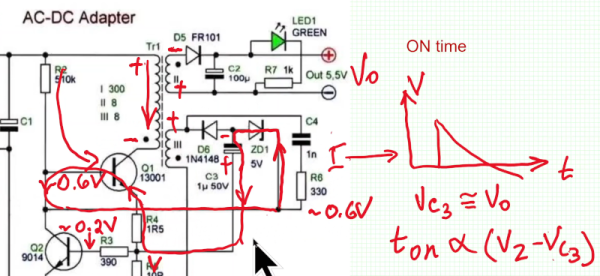
As [Sam Ben-Yaakov] points out in a recent video, you don’t often see flyback converters these days. That’s because there are smarter ways to get the same effect, which is to convert between two voltages. If you work on old gear, you’ll see plenty of these, and going through the analysis is educational, even if you’ll never actually work with the circuit. That’s what the video below shows: [Sam’s] analysis of why this circuit works.
The circuit in question uses a bridge rectifier to get a high-voltage DC voltage directly from the wall. Of course, you could just use a transformer to convert the AC to a lower AC voltage first, but then you probably need a regulator afterwards to get a stable voltage.
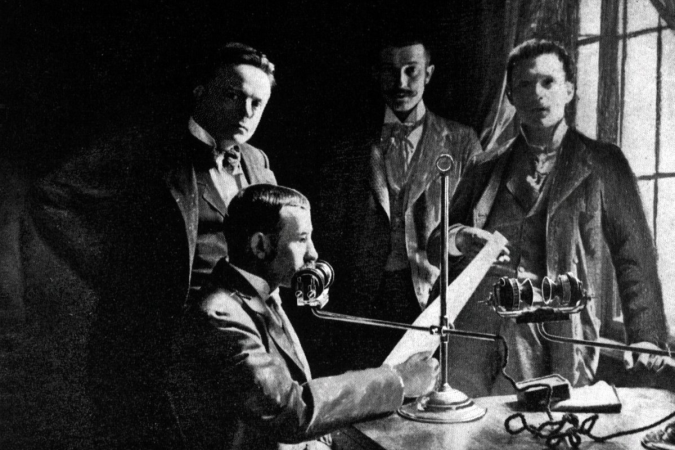
When do you think the first podcast occurred? Did you guess in the 1890s? That’s not a typo. Telefonhírmondó was possibly the world’s first true “telephone newspaper.” People in Budapest could dial a phone number and listen to what we would think of now as radio content. Surprisingly, the service lasted until 1944, although after 1925, it was rebroadcasting a radio station’s programming.
Tivadar Puskás, the founder of Budapest’s “Telephone Newspaper” (public domain)
The whole thing was the brainchild of Tivadar Puskás, an engineer who had worked with Thomas Edison. At first, the service had about 60 subscribers, but Puskás envisioned the service one day spanning the globe. Of course, he wasn’t wrong. There was a market for worldwide audio programs, but they were not going to travel over phone lines to the customer.
The Hungarian government kept tight control over newspapers in those days. However, as we see in modern times, new media often slips through the cracks. After two weeks of proving the concept out, Puskás asked for formal approval and for a 50-year exclusive franchise for the city of Budapest. They would eventually approve the former, but not the latter.
Unfortunately, a month into the new venture, Puskás died. His brother Albert took over and continued talks with the government. The phone company wanted a piece of the action, as did the government. Before anything was settled, Albert sold the company to István Popper. He finalized the deal, which included rules requiring signed copies of the news reports to be sent to the police three times a day. The affair must have been lucrative. The company would eventually construct its own telephone network independent of the normal phone system. By 1907, they boasted 15,000 subscribers, including notable politicians and businesses, including hotels. Continue reading “The World’s First Podcaster?”→
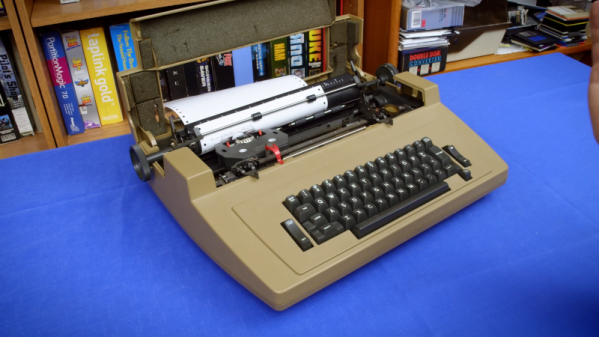
If you learned to type anytime in the mid-part of the 20th century, you probably either had or wanted an IBM Selectric. These were workhorses and changed typing by moving from typebars to a replaceable element. They were expensive, though worth it since many of them still work (including mine). But few of us could afford the $1,000 or more that these machines cost back in the day, especially when you consider that $1,000 was enough to buy a nice car for most of that time. [Tech Tangents] looks at something different: a clone Selectric from the sewing machine and printer company Juki.
The typewriter was the brainchild of [Thomas O’Reilly]. He sold typewriters and knew that a $500 compatible machine would sell. He took the prototype to Juki, which was manufacturing typewriters for Olivetti at the time.
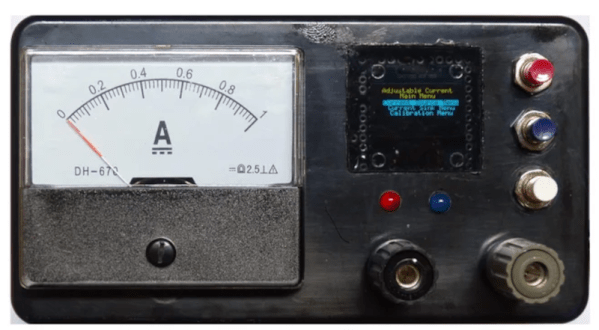
At first glance, [RobBest]’s constant current source looks old school. The box is somewhat old-fashioned, featuring switches and binding posts. Most importantly, there’s a large analog meter dominating the front panel. Then you notice the OLED display, and you know something’s up.
The device can source or sink a constant current. In addition, it features a timer that calculates milliamp-hours and automatically turns off when not in use. The brain is a PIC 16F1765, which controls the screen, the buttons, and a few relays. While that might seem an odd choice for the processor, it is actually smart. The device has both a DAC and an ADC, plus an internal op amp. The analog output and a single pass transistor control the current flow, while the two relays flip it between a source and a sink.
Without that op amp, the DAC can’t produce much current. However, by passing it through the onboard amplifier, the output can drive about 100 mA, which is sufficient for this project.
This is a classic circuit, but the addition of a CPU and a display gives it capabilities that would have been very difficult to build back in the day. Want to dive into the theory behind constant current sources? Or just the practical use of a voltage regulator to make one?