The Nuclear War You Didn’t Notice

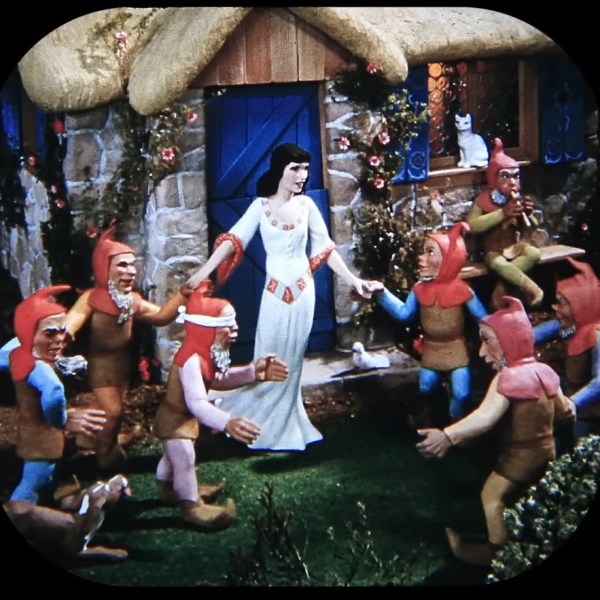
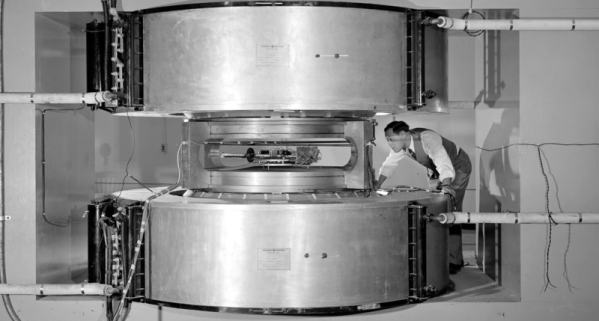
We always enjoy [The History Guy], and we wish he’d do more history of science and technology. But when he does, he always delivers! His latest video, which you can see below, focuses on the Cold War pursuit of creating transfermium elements. That is, the discovery of elements that appear above fermium using advanced techniques like cyclotrons.

There was a brief history of scientists producing unnatural elements. The two leaders in this work were a Soviet lab, the Joint Institute of Nuclear Research, and a US lab at Berkeley.
Continue reading “The Nuclear War You Didn’t Notice”

Inside A Selective Voltmeter

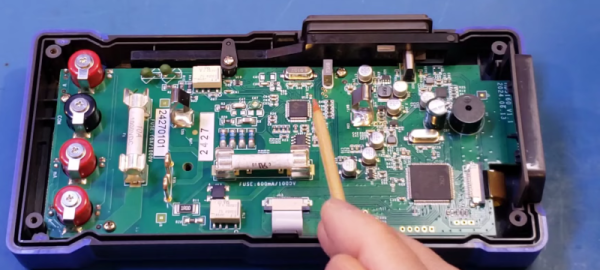
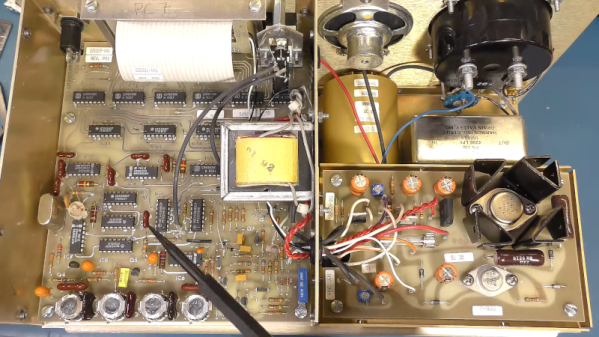
[Martin Lorton] has a vintage Harmon 4200B selective voltmeter that needed repair. He picked it up on eBay, and he knew it wasn’t working, but it was in good condition, especially for the price. He’s posted four videos about what’s inside and how he’s fixing it. You can see the first installment below.

The 4200B is an RMS voltmeter and is selective because it has a tuned circuit to adjust to a particular frequency. The unit uses discrete components and has an analog meter along with an LCD counter.

Continue reading “Inside A Selective Voltmeter”

Oscilloscope Digital Storage, 1990s Style

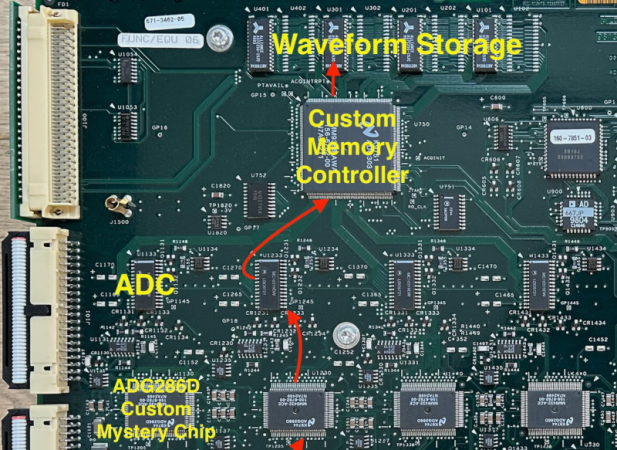
You’re designing an oscilloscope with modest storage — only 15,000 samples per channel. However, the sample rate is at 5 Gs/s, and you have to store all four channels at that speed and depth. While there is a bit of a challenge implied, this is quite doable using today’s technology. But what about in the 1990s when the Tektronix TDS 684B appeared on the market? [Tom Verbure] wondered how it was able to do such a thing. He found out, and since he wrote it up, now you can find out, too.

Inside the scope, there are two PCBs. There’s a CPU board, of course. But there’s not enough memory there to account for the scope’s capability. That much high-speed memory would have been tough in those days, anyway. The memory is actually on the analog board along with the inputs and digitizers. That should be a clue.

Continue reading “Oscilloscope Digital Storage, 1990s Style”

Scan Your Caliper For Physical Part Copies

We’ve certainly seen people take a photo of a part, bring it into CAD, and then scale it until some dimension on the screen is the same as a known dimension of the part. We like what [Scale Addition] shows in the video below. In addition to a picture of the part, he also takes a picture of a vernier caliper gripping the part. Now your scale is built into the picture, and you can edit out the caliper later.

He uses SketchUp, but this would work on any software that can import an image. Given the image with the correct scale, it is usually trivial to sketch over the image or even use an automatic tracing function. You still need some measurements, of course. The part in question has a vertical portion that doesn’t show up in a flat photograph. We’ve had good luck using a flatbed scanner before, and there’s no reason you couldn’t scan a part with a caliper for scale.

This is one case where a digital caliper probably isn’t as handy as an old-school one. But it would be possible to do the same trick with any measurement device. You could even take your picture on a grid of known dimensions. This would also allow you to check that the distances at the top and bottom are the same as the distances on the right and left.

Of course, you can get 3D scanners, but they have their own challenges.

Continue reading “Scan Your Caliper For Physical Part Copies”

Understanding Linear Regression

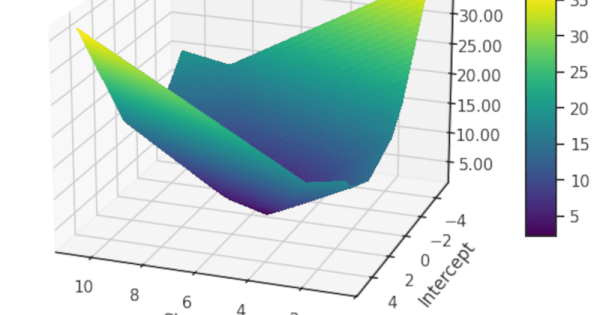
Although [Vitor Fróis] is explaining linear regression because it relates to machine learning, the post and, indeed, the topic have wide applications in many things that we do with electronics and computers. It is one way to use independent variables to predict dependent variables, and, in its simplest form, it is based on nothing more than a straight line.

You might remember from school that a straight line can be described by: y=mx+b. Here, m is the slope of the line and b is the y-intercept. Another way to think about it is that m is how fast the line goes up (or down, if m is negative), and b is where the line “starts” at x=0.

[Vitor] starts out with a great example: home prices (the dependent variable) and area (the independent variable). As you would guess, bigger houses tend to sell for more than smaller houses. But it isn’t an exact formula, because there are a lot of reasons a house might sell for more or less. If you plot it, you don’t get a nice line; you get a cloud of points that sort of group around some imaginary line.

Continue reading “Understanding Linear Regression”

Edison Phonograph Plays The Cylinders

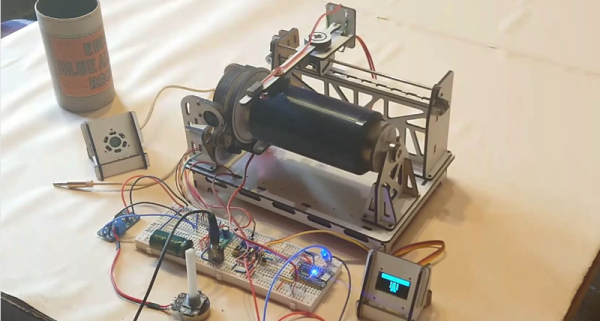
You might be old enough to remember record platters, but you probably aren’t old enough to remember when records were cylinders. The Edison Blue Amberol records came out in 1912 and were far superior to the earlier wax cylinders. If you had one today, how could you play it? Easy. Just build [Palingenesis’] record player. You can even hear it do its thing in the video below.

The cylinders are made of plaster with a celluloid wrapper tinted with the namesake blue color. They were more durable than the old wax records and could hold well over four minutes of sound.

Continue reading “Edison Phonograph Plays The Cylinders”

The Owon HDS160 Reviewed

These days, if you are in the market for a capable digital voltmeter, you might as well consider getting one with an oscilloscope built-in. One choice is the Owon HDS160, which [Kerry Wong] covers in the video below. The model is very similar to the HDS120, but the multimeter in the HDS160 has more counts–60,000 vs 20,000 as you might expect from the model number.

The internal chip is an HY3131, which is rated at 50,000 counts which is odd since the meter is 60,000 counts, but presumably the meter uses some capability of the chip, possibly putting it out of spec. The oscilloscope is the same between the two models. Almost everything else works the same, other than the capacitance measuring feature, as the video shows.

The difference in cost between the two units isn’t much, so if you are shopping, the small extra cost is probably worth it. Not that a 20,000 count meter isn’t perfectly fine for most normal uses.

[Kerry] really likes scopemeters. He gets excited about bench scopes, too.

Continue reading “The Owon HDS160 Reviewed”