DIY Lock Nuts

If you have a metal lathe just looking for some work, why not make your own lock nuts? That’s what [my mechanics insight] did when faced with a peculiar lock nut that needed replacing in a car. We can’t decide what we enjoyed more in the video you can watch below: the cross-section cut of a lock nut or the oddly calming videos of the new nut being turned on a lathe.

The mystery of the lock nut, though, isn’t how it works. The nylon insert is just a little too small for the bolt, and the bolt, being harder than nylon, taps a very close-fitting hole in the nylon as you tighten it. The real mystery is how that nylon got in there to start with.

Continue reading “DIY Lock Nuts”

Reviewing The World’s 2nd Smallest Thermal Camera

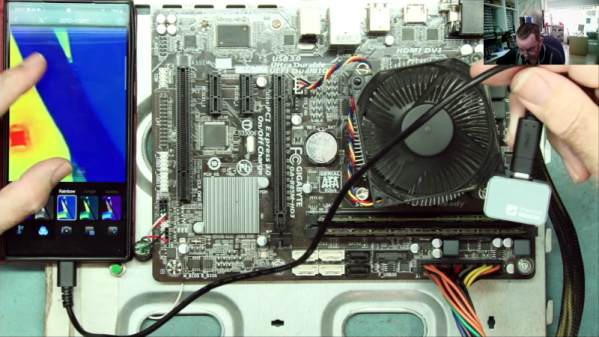
A thermal camera is a very handy tool to have, and [Learn Electronics Repair] wanted to try out the Thermal Master P2 for electronic repair, especially since it claims to have a 15 X digital zoom and 1.5 degree accuracy. The package proudly states the device is the “World 2nd Smallest Thermal Camera” — when only the second best will do.

The camera is tiny and connects to a PC or directly to a tablet or phone via USB C. However, it did look easier to use on the end of a cable for probing things like a PC motherboard. The focus was fairly long, so you couldn’t get extremely close to components with the camera. The zoom somewhat makes up for that, but of course, as you might expect, zooming in doesn’t give you any additional resolution.

He also compares the output with that of a multimeter he uses that includes an IR camera (added to our holiday gift list). That multimeter/camera combo focuses quite closely, which is handy when picking out a specific component. It also has a macro lens, which can zoom up even more.

We’ve looked at — or, more accurately, through — IR cameras in the past. If you are on a tight budget and you have a 3D printer, you might try this method for thermal imaging, but it doesn’t use the printer the way you probably think.

Continue reading “Reviewing The World’s 2nd Smallest Thermal Camera”

Check Your Clip Leads

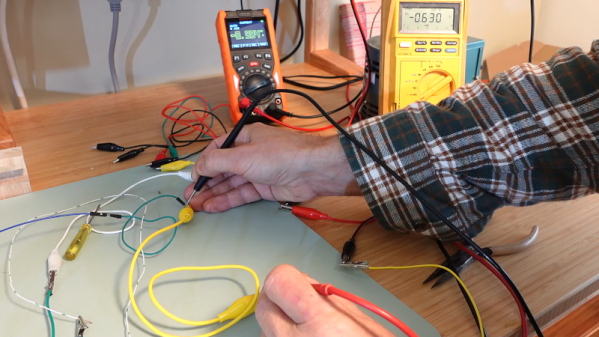
[Matthias] bought cheap clip leads online and, wisely, decided to check them. We’ve had the same experience that he’s had. Sometimes, these cheap leads are crimped and don’t make good contact. However, you can usually solder them and completely fix them. Not this time, however, as you can see in the video below.

The resistance for the leads was a bit on the high side, which is usually a sure sign of this problem. But soldering didn’t really make a big difference. A homemade clip lead, for example, read under 20 milliohms, but a test lead from the new batch read about 260 milliohms even after being soldered.

Continue reading “Check Your Clip Leads”

Random Wire Antenna Uses No Wire

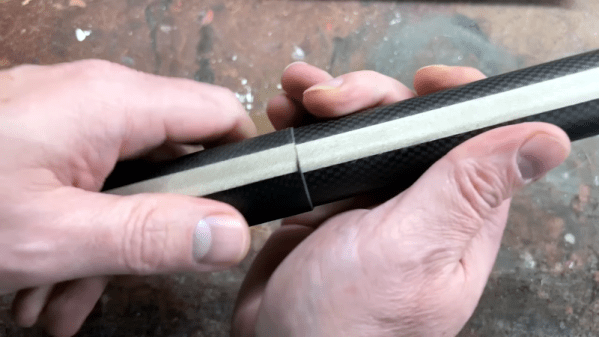
Ideally, if you are going to transmit, you want a properly-tuned resonant antenna. But, sometimes, it isn’t practical. [Ham Radio Rookie] knew about random wire antennas but didn’t want a wire antenna. So, he took carbon fiber extension poles and Faraday tape and made a “random stick” antenna. You can check it out in the video below.

We aren’t sure what normal people are doing with 7-meter-long telescoping poles, but — as you might expect — the carbon fiber is not particularly conductive. That’s where the tape comes in. Each section gets some tape, and when you stretch it out, the tape lines up.

Continue reading “Random Wire Antenna Uses No Wire”

Ham Radio In The Internet Age

Even if you are relatively young, you can probably think back on what TV was like when you were a kid and then realize that TV today is completely different. Most people watch on-demand. Saturday morning cartoons are gone, and high-definition digital signals are the norm. Many of those changes are a direct result of the Internet, which, of course, changed just about everything. Ham radio is no different. The ham radio of today has only a hazy resemblance to the ham radio of the past. I should know. I’ve been a ham for 47 years.

You know the meme about “what people think I do?” You could easily do that for ham radio operators. (Oh wait, of course, someone has done it.) The perception that hams are using antique equipment and talking about their health problems all day is a stereotype. There are many hams, and while some of them use old gear and some of them might be a little obsessed with their doctor visits, that’s true for any group. It turns out there is no “typical” ham, but modern tech, globalization, and the Internet have all changed the hobby no matter what part of it you enjoy.

Radios

One of the biggest changes in the hobby has been in the radio end. Hams tend to use two kinds of gear: HF and VHF/UHF (that’s high frequency, very high frequency, and ultra-high frequency). HF gear is made to talk over long distances, while VHF/UHF gear is for talking around town. It used to be that a new radio was a luxury that many hams couldn’t afford. You made do with surplus gear or used equipment.

Globalization has made radios much less expensive, while technological advances have made them vastly more capable. It wasn’t long ago that a handy-talkie (what normal folks would call a walkie-talkie) would be a large purchase and not have many features. Import radios are now sophisticated, often using SDR technology, and so cheap that they are practically disposable. They are so cheap now that many hams have multiples that they issue to other hams during public service events.

Continue reading “Ham Radio In The Internet Age”

Silent Antenna Tuning

If you want to deliver the maximum power to a load — say from a transmitter to an antenna — then both the source and the load need to have the same impedance. In much of the radio communication world, that impedance happens to be 50Ω. But in the real world, your antenna may not give you quite the match you hoped for. For that reason, many hams use antenna tuners. This is especially important for modern radios that tend to fold their power output back if the mismatch is too great to protect their circuitry from high voltage spikes. But a tuner has to be adjusted, and often, you have to put a signal out over the air to make the adjustments to match your antenna to your transmitter.

There are several common designs of antenna tuners, but they all rely on some set of adjustable capacitors and inductors. The operator keys the transmitter and adjusts the knobs looking for a dip in the SWR reading. Once you know the settings for a particular frequency, you can probably just dial it back in later, but if you change frequency by too much or your antenna changes, you may have to retune.

It is polite to turn down the power as much as possible, but to make the measurements, you have to send some signal out the antenna. Or do you?

Several methods have been used in the past to adjust antennas, ranging from grid dip meters to antenna analyzers. Of course, these instruments also send a signal to the antenna, but usually, they are tiny signals, unlike the main transmitter, which may have trouble going below a watt or even five watts.

New Gear

However, a recent piece of gear can make this task almost trivial: the vector network analyzer (VNA). Ok, so the VNA isn’t really that new, but until recently, they were quite expensive and unusual. Now, you can pick one up for nearly nothing in the form of the NanoVNA.

The VNA is, of course, a little transmitter that typically has a wide range coupled with a power detector. The transmitter can sweep a band, and the device can determine how much power goes forward and backward into the device under test. That allows it to calculate the SWR easily, among other parameters.

Continue reading “Silent Antenna Tuning”

Classic Heathkit OL-1 Scope Gets Some TLC

These days, not only are oscilloscopes very common, but even a cheap instrument today would have been the envy of the world’s greatest labs not that long ago. But back in the day, the home experimenter basically had two choices: buy a surplus scope that a big company was getting rid of or build a Heathkit. [Radiotvphononut] bought an old Heathkit OL-1 scope at an estate sale and set about putting it back in service.

If you are used to a modern scope, you’ll be amazed at how simple a scope like this can be. A handful of tubes and a CRT is the bulk of it. Of course, the OL-1 is an analog scope with a 400 kHz bandwidth. It did, however, have two channels, which was a rarity at the time.

The OL-1 was sold for a few years up to 1956 and cost about $30 as a kit. There was a version with a larger screen (five whole inches) that cost an extra $40, so you can bet there were more OL-1s sold since $40 was a big ask in 1956. While they don’t seem like much today, you were probably the envy of the ham club in 1956 when you lugged this in for show and tell.

This is a long video, but it pays off at the end. Overall, this was a more capable scope than the $66 scope from 10 years earlier we looked at. Did you ever wonder how people visualized signals before the CRT? Funny, we did too.

Continue reading “Classic Heathkit OL-1 Scope Gets Some TLC”