Rideable Hexawalker Is Chibikart’s Kin

[youtube=http://www.youtube.com/watch?v=hnG96qDibo0&w=470]

The folks from MIT made their way to the NYC Maker Faire, and of course brought a pair of Chibikarts. [Nancy Ouyang] wouldn’t allow those portable go karts take center stage at the MIT booth though; her Hexarideablepod (yes, that’s what she calls it) saw much more action from the kids clamoring to take something for a drive.

From the video above, [Nancy] shows off her six-legged, tennis ball-footed creation. The entire machine is powered by car batteries and is controlled via two joysticks in something resembling driving a tank Nope, it’s powered by A123 lipos and controlled with triggers taken from an electric drill.

As per [Nancy]’s wishes, I must mention that this project was for MITERS, a.k.a. the people from MIT that came down to Maker Faire.

Proper video after the break. The Internet at Maker Faire is horrible, give me a break.

Continue reading “Rideable Hexawalker Is Chibikart’s Kin”

Putting A Workshop On Your Bike Rack

As a member of the Repair Cafe in Maastricht, [Bertoa] sometimes needs to take a few tools out into the field to repair mechanical and electronic devices. His previous solution to the problem was a toolbox in the trunk of his car, but he knew he could come up with a more environmentally friendly solution. He created a portable workbench that fits right on his bike rack that is able to transport all the tools needed for light repairs using only a bike.

[Bertoa]’s portable workbench is made up of two parts; each side has one small slide drawer perfect for storing screwdrivers and wrenches, as well as a second tilting drawer able to hold heavier items such as an electric drill.

The work surface joins the two sides of the workbench together and is able to fold out with the help of a piano hinge and a few brackets. The workbench is removable from the bike rack and is able to stand on its own (stowable) legs made of aluminum tubes.

Even though the portable workbench only weighs about 10kg, it’s able to support [Bertoa]’s full body weight; a wonderful addition to any maker’s bicycle and a great solution to working on projects in the field.

Tiny OLED O-scope Fits On A Breadboard

[youtube=http://www.youtube.com/watch?v=UfAkdd9kXNY&w=470]

With a surplus of 3D printers at this year’s Maker Faire, it’s really surprising to see the most talked about tool among the makers is a simple oscilloscope.

[Gabriel Anzziani]’s Xprotolab is an extremely small oscilloscope, function generator, logic analyzer, and general 128×64 OLED display is the perfect addition to your next prototyping project. With its breadboard friendly format and USB output, it will dutifully serve as a 200kbps oscilloscope, 8 channel logic analyzer, or as seen in the video above, the perfect interface for a Wii Nunchuck or just a simple digital Etch-a-sketch.

In the video above the fold [Gabriel] shows off the functions of his tiny, if somewhat limited, OLED oscilloscope.

Giving Graphing Calculators A New Life

[youtube=http://www.youtube.com/watch?v=Um0IeGGdIRY&w=470]

[Christopher] at Cemetech, ever frequent HaD feature for his hacked up graphing calculators, made it to the NYC Maker Faire.

He already posted on his blog he was making the trip up to Maker Faire, but we were lucky enough to catch up with him. Two things: the name of his blog isn’t ‘cement tech’, but ‘chem tech.’ Apparently he hates it when it’s mispronounced.

Secondly, he’s been turning in the TI-83s for a Casio Prizm graphing calculator. In the video above he tells us he’s gotten a few homebrew games running on the Prizm, a Lua interpreter, and is currently working on digging around the operating system.

New And Improved DIWire Bender

[youtube=http://www.youtube.com/watch?v=xrr4peibbNI&w=470]

The DIWire bender we saw last summer made its way to Maker Faire this year with a new and improved version that is now able to bend steel even more accurately than the previous aluminum-bending version.

I chatted up [Marco Perry] (above, obviously), and he explained a new feature of the DIWire bender that makes soldering or welding creations made out of CNC bent wire even easier. The new machine features a sharpie that precisely marks where the wire should be welded.

The folks behind the DIWire – Pensa – have a ton of really cool wire sculptures at their booth at Maker Faire, quite incidentally within spitting distance of Hackaday’s Red Bull booth. Be sure to check them out if you’ve got a chance.

Fitting A CNC Machine, 3D Printer, And Vinyl Cutter In A Suitcase

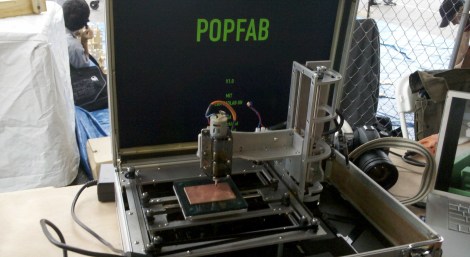
Maker Faire NY is awash with new and interesting computer controlled tools, but the most unusual so far appears to be Popfab, a combination router, 3D printer, and vinyl cutter able to collapse down into a suitcase.

Popfab is the brainchild of [Nadya Peek] and [Ilan Moyer] of the MIT CADLAB. With interchangeable heads for routing PCBs, 3D printing, and vinyl cutting. A conventional machine of this capabilities would have motors all over the place, but [Ilan] used a CoreXY system to make the stepper motors stationary relative to the frame of the machine.

The electronics are standard Printrboard and Pronterface fare, but it’s still a remarkable build that also fits into a suitcase.

Pictures of the machine, the XY system (good luck wrapping your head around that, but I can tell you it relies on the differential movement of the two motors) and the lovely [Nadya] holding up the plastic extrusion head. We’ll get a video up tomorrow. after the break

Continue reading “Fitting A CNC Machine, 3D Printer, And Vinyl Cutter In A Suitcase”

Janus: The Gatekeeper

janus-001

[Piet] wrote in to tell us about his hack that allows for his front gate to be opened without a key. Unlike this hack that we featured in August, you don’t need a subway pass, just a good memory. As explained in his article (and the video after the break) if the proper sequence of doorbell rings is input, the gate unlocks itself.

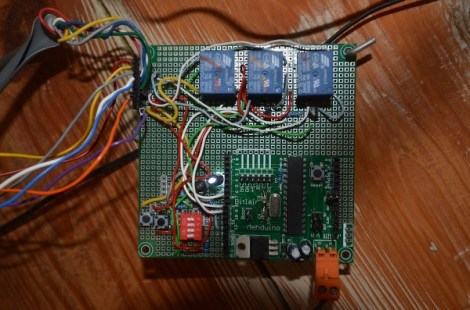
For hardware a [mehduino] is used to take the doorbell input and decide whether or not the “secret knock” has been achieved. The door can be unlocked remotely via a button on the processor. Reprogramming the code is achieved by simply holding the program button while the code is entered on the “remote ringer” button.

Be sure to check out the video after the break to see this lock in action. The housing application may not be exactly what you expect. Also of interest, is that in true hacker fashion, the bare processor is hanging by a hook on his wall! Continue reading “Janus: The Gatekeeper”