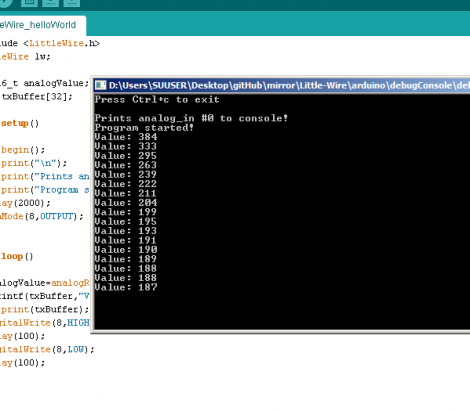
First off, if you’re looking at that title and thinking it’s flame-bait, please hold off. What [Ihsan Kehribar] is working with is another way to get some feedback for what’s going on with your Arduino project. Or really any AVR project that uses an ISP connection. He’s added text output for AVR programs similar to the printf function used for a lot of non-embedded C development.
So, we’d bet you’re asking yourself why he’s not just using outright debugging? The AVR line supports many different types of it. But that can be complicated, and usually requires a proper programmer. If you just want to watch to see what values are changing, and when functions are being executed, this isn’t a bad solution. He uses the computer to continually poll the chip. Whenever the sketch calls the his print library it answers back with the payload to be displayed in the terminal. The overhead shouldn’t be too high, and if you’re smart about it this can be flagged as a debug option at the top of the program file.
This weekend, June 16th, the North Carolina Maker Faire will be happening. This is the 3rd year for this event and from what we’ve seen in the past, it should be pretty good.
We realize that every site has its niche of event coverage that they should deliver. Engadget/Gizmodo need to show new phones and got to big apple announcements. Joystiq needs to be at E3. We feel like we should be where people are hacking/building things. In an effort to reach those places, Maker Faire pops into mind pretty quickly. [Jeremy Cook] will be at this one walking around and doing interviews as well as having a booth for his personal site jcopro.net . If you see him, don’t hesitate to go up and say hi, maybe he’ll have a custom cut vinyl hackaday sticker left to give out.
We plan on hitting as many other similar events as we can swing (sorry, looks like no one can make it to toorcamp this year). Our writers are located all over the country so if you hear of an event you think we would enjoy, shoot us an email. Maybe we can attend!
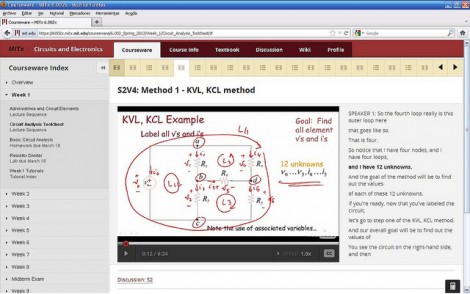
[Jorge] just finished MITx 6.002x with the fine score of 99.1%. Congratulations! We just finished reading through this review of his experience (translate) with the 14-week class and it sounds like the program is extremely well executed. For those that don’t remember, this is an intro to circuits and electronics course offered at the Massachusetts Institute of Technology. Except 6.002x is free to all as an online course (but if you actually want a certificate a fee may be involved).
Above is one of the many screenshots which [Jorge] took of the student web interface. It looks great, and offers pretty much everything you need to complete the class. The textbook, which runs at least $65 for a paper copy, is available through the web interface as part of the course. The labs even include web demos you can use to simulate circuits and probe and measure the resulting signals and wave forms. If you have questions there is access to the teachers, but also a set of forums where you can work with other students.
Perhaps most interesting is [Jorge’s] assessment of the time you will spend working on the class. He thinks that if you’re already familiar with electronics the work can be complete in about one afternoon per week. Scheduling is flexible — tests are available for one week, but once you start taking one it must be completed in 24 hours.
He believes this will be offered again in the fall so keep a look out for registration to begin.
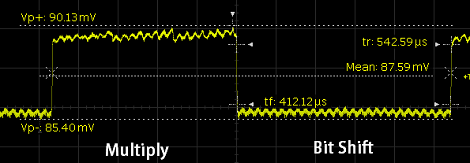
Of course putting a microcontroller into sleep mode or changing the clock rate has an effect on the power consumption of the chip, but what about different bits of code? Is multiplying two numbers more efficient than adding them, and does ORing two values consume more power than NOPping? [jcw] wanted to compare the power draw of a microcontroller running different loops, so he threw some code on a JeeNode and hooked it up to an oscilloscope.
For his test, [jcw] tested two instructions: multiply and shift left. These loops run 50,000 and 5,000 times, respectively (bit shifting is really slow on ATMegas, apparently) and looked at the oscilloscope as the JeeNode was doing its work.
Surprisingly, there is a difference in power consumption between the multiply and shift loops. The shift loop draws 8.4 mA, while the multiply loop draws 8.8 mA. Not much, but clearly visible and measurable. While you’re probably not going to optimize the power draw of a project by only using low-power instructions, it’s still very interesting to watch a microcontroller do its thing.
Have you heard of the Raspberry Pi? Surprisingly enough, they’re starting to trickle into the hands of thousands of hackers, and we were fortunate to get our hands on one (second-hand since we didn’t jump in time for the initial preorder). We’ve longed for a tiny embedded option for running XBMC and this is one of the best opportunities we’ve seen yet. The Raspbmc project, created by [Sam Nazarko], is tailored to getting XBMC on the Raspberry Pi just a few minutes after it arrives in the mail. And that’s exactly what we did.
If you’re familiar with writing an image to an SD card (or any device for that matter) this is a simple process. Raspbmc is distributed as a single image file which starts up the RPi hardware, then copies itself to RAM while it downloads and installs the filesystem for the distribution. Once the card is flashed just pop it in, power up, and wait about 20 minutes until XBMC shows up on the screen. After that it’s a quick boot each time.
The good news is that its works. XBMC runs pretty fast, with just a hint of lag when loading some menus. We felt at home using the confluence skin we’re familiar with, and had no trouble setting up our samba shares to the video library. The one problem is that it won’t play any of the video files we have on hand. None of them. So we downloaded the Big Buck Bunny trailer. It wouldn’t play that either. This is all a codec issue. Although the chip used on the RPi is capable of hardware decoding MPEG2 video, the foundation didn’t license that ability. So it can’t play that format, period. With the movie trailer we tried the OGG format and that’s not currently supported, but the MOV version did play, in full 1080p without trouble.
So the verdict is, if you’re looking to get an RPi just to run XBMC you should wait. So far the package is promising. But we record ATSC video, all of which is MPEG2. If you use MakeMKV to store your DVDs on a server, that also uses MPEG2. Of course there is the option of transcoding everything. But you’ll want to be careful if you have other XBMC frontends which may not be able to play alternative encodings.
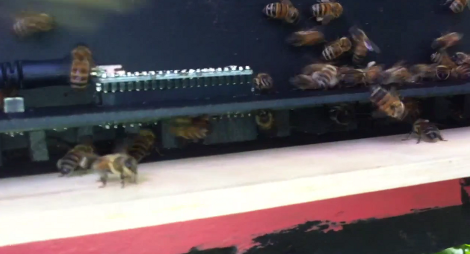
This is the bee counter which [Hydronics] designed. It’s made to attach to the opening for a hive, and will count the number of bees entering and exiting. We’re not experienced bee keepers ourselves (in fact we’re more of the mind of getting rid of stinging beasties) but we understand their important role in agriculture and ecosystem so we’re glad someone’s making a nice home for them.
Most of the apparatus is a circuit board lined with reflective sensors. There is a double-row of pin sockets on the top of the board which accepts the Teensy+ which monitors those sensors. The bees must pass below this PCB every time they enter or leave the hive, thereby tripping a sensor. In the video after the break [Hydronics] shows off the system with a netbook used to monitor the output. But it sounds like he has plans for an integrated display system in future versions of the bee counter.
So you’ve mastered your PCB layout software, and it’s time to make the board. But if you don’t want to etch your own you’ve got to decided where to have it fabricated. There’s a slew of services out there, most of which you cannot afford, but the short list of those you can is still pretty long. We think this set of PCB fabrication house reviews will help you make your choice.
[Ladyada] — aka [Limor Fried] — knows what she’s talking about. She owns Adafruit Industries and has done the lion’s share of designing the many kits and items they sell. If you’re going to charge money for something it better work right, and that involves lots of prototypes. But even if you don’t need a quick turn-around or numerous testing boards the post is helpful as she also covers some of the batch producers we’re already familiar with. These include DorkBot PDX and BatchPCB to name a couple.