posted Feb 23rd 2012 12:02pm by
Jeremy Cook
filed under:
contests,
misc hacks,
toy hacks

Although some might note that [Jamie]‘s creation could mistaken for a Velociraptor or even Allosaurus, his giant T-Rex costume/model is quite a feat of artistry. It stands at over 14 feet tall and 10 feet long. For comparison, the room that you see in the picture above measures 25 x 25 feet. If you happen to live in the Atlanta area, or are willing to travel, this costume is expected to make an appearance at Dragon*Con in 2012, so be sure to look for it there.
The whole thing is made from poly foam plank cut with a CNC router. It also has a metallic support structure. As noted in the article, you could, in theory, cut all these parts out by hand. Persistence would be required though, since there are over 140 parts!
[Jamie]‘s making capabilities are obviously quite advanced at this point, but he’s trying to expand them by winning a router in the Instructables Shopbot contest. If you like his creation, be sure to vote for him! Check out the video of this costume in action after the break. Read the rest of this entry »
posted Feb 21st 2012 8:01am by
Jeremy Cook
filed under:
tool hacks

Hardware hackers and makers like us may not be well known for our excellent hygiene habits, but after [Dan]‘s creation, no one can claim he doesn’t know how to use one! Either out of a total disdain for tooth care, or hopefully, after using one properly for many months, [Dan] decided to turn his electric toothbrush into an engraving tool!
At around $4 and meant for cleaning plaque off teeth, this tool isn’t the most powerful engraver on the block, but is capable of good work on softer material such as acrylic. Be sure to check out the heart that was made with this improvised tool that introduced us to [Dan]‘s work.
This is really a clever use of your resources, and the article gives a nice account of how the toothbrush was modified with pictorial directions. Besides it’s use as an engraving tool, this might give someone other ideas for alternate toothbrush uses. For another neat alternate home-item use, why not check out how to repurpose an air freshener as a camera trigger?
posted Feb 16th 2012 7:01am by
Jeremy Cook
filed under:
Holiday Hacks

Although [Danman] was right on time with his home-hacked Valentines day gift, this article comes to you a little late. With the message on the heart changed, however, it could be a perfect “Sorry I forgot Valentines Day again” gift, so it may still be useful.
The concept isn’t that complicated, simply a strip of LED lights around a piece of acrylic. A battery holder and switch rounds out this build. It’s a neat way to light things up, but what we thought was especially interesting was the way it was engraved and cut out with a minimum of traditional tools.
Sure, [Danman] had access to a bandsaw, but as for actually engraving the outline he used a modified electric toothbrush! We’d love to see that build written up. If that wasn’t enough, the lettering was “ghetto blasted”, as he puts it, using a compressed air nozzle, a pen tube, and a styrofoam cup full of ceramic dust! Macgyver would be proud!
posted Feb 11th 2012 9:01am by
Jeremy Cook
filed under:
cnc hacks,
digital cameras hacks

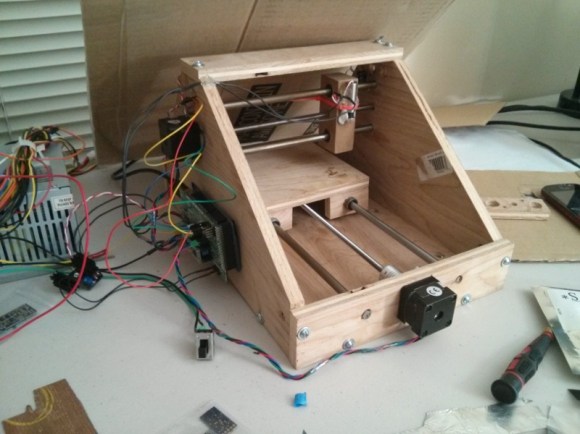
Light painting is a technique where a shape is drawn with a light source while a camera is taking a very long exposure shot of it. To do this well by hand would take a lot of skill, so I naturally decided to make my “light art” with a CNC router.
Using this technique, the LED light is treated just like an engraving bit would be under normal circumstances. The difference is that the Y axis is swapped with the Z axis allowing for easy movement in the plane that you see displayed in the picture above. This allows the old Y axis to switch the light on and off in the same way that an engraving bit is lifted to stop engraving and lowered to start (explained here). Instead of a bit though, it’s a switch.
Be sure to check out the video of the router in action (with the lights on) after the break: Read the rest of this entry »
posted Feb 9th 2012 6:01am by
Jeremy Cook
filed under:
green hacks

Although there are several vertical axis wind turbines listed on greenterrafirma’s page, the one built with 55 gallon drums was especially interesting to us. Although the spouse approval factor of any of these designs is debatable, at $100, the 55 gallon drum design could provide a very good return on investment. The tools required to make one of these are relatively simple, so this could make this experiment accessible to those without a vast arsenal of equipment.
If large blue barrels aren’t your thing, the post also features several other turbine designs, including one made with wood and aluminium foil, and one constructed out of PVC pipe. The video after the break does a good job of explaining the “blue barrel” construction process, but if you’d rather just see this [VAWT] in action, fast forward to 5:25.
Read the rest of this entry »
posted Feb 4th 2012 12:01pm by
Jeremy Cook
filed under:
home hacks

[Arpad] has spent quite a bit of time reverse-engineering a home automation system, and, as he is quick to point out, presents the information learned for informational purposes only. He’s really done his homework (and documented it well), looking into the US patent application, and figuring out how the protocol works.
If you’re wondering how someone is able to send a signal over an AC sine wave, at least one technique is the proprietary [Universal Powerline Bus]. This works by sending precisely times pulses in conjunction with the wave that would exist normally. Given the correct software on the other end, this can then be decoded and used for whatever data transfer is necessary.
Although as engineers and technologists, we certainly don’t condone stealing patents, part of point of one is that others are allowed to learn your secrets in exchange for some legal protection. [Arpad]‘s motivation in doing this is that the technology is only widely available in the US with our puny 120 VAC 60Hz power. With this knowledge, he’s been able to transfer it to work with European 230 VAC 50Hz.
Read the rest of this entry »
posted Feb 1st 2012 6:01am by
Jeremy Cook
filed under:
cooking hacks

[Joel] of [Helion Microsystems] is at it again with his USB controlled solder reflow oven. You may remember him from his crazy twitter-enabled Ewok model. Although these two projects are quite different, they both use the HU-320 USB breakout board that he’s in the process of getting funding for via [Pozible], or Australian Kickstarter for Yanks.
The reflow oven works using a thermocouple-enabled RS-232 voltmeter to output the temperature to the HU-320 board. [Joel] has been nice enough to provide us with the C# code to interface with many multimeters if you want to implement a similar project. Temperature is controlled with a mechanical relay for what would appear to be a poor man’s PID controller.
Sadly, Fluke meters don’t seem to be listed, but your place of work probably wants their meter back anyway! For another toaster reflow oven implementation, check out this [HAD] article. Be sure to check out the video after the break for a video of the setup! (heat treat engineers may find the “recipe” format humorous).
Read the rest of this entry »
posted Jan 28th 2012 2:40pm by
Jeremy Cook
filed under:
repair hacks,
robots hacks

After the terrible tragedy in Fukushima, the cleanup and damage assessment has begun. A robot operator, known only as [S.H.] has decided to write a blog about their efforts. As pictured above, they are using [iRobot] models, including the [510 Packbot], and the [710 Warrior].
Since cleanup efforts started, [S.H.] was posting on his or her blog daily. After word of this blog started getting out via various social media outlets, the blog was mysteriously taken down. The blog was at times critical of elements of the cleanup effort, but it’s unknown why the disappearance happened. Efforts to reach [S.H.] were unsuccessfull according to [IEEE].
Fortunately, before the takedown, [IEEE]‘s [Erico Guizzo] decided to make a copy of the posts. These have been translated into English and portions are now available at the link listed above. Be sure to check out robot training video after the break. Read the rest of this entry »