You Probably Do Not Have Time To Build This Incredible Dead Space Costume.

What happens when an unemployed sailor has a ton of time on his hands? Well, evidently they become an extremely skilled prop builder. Then again our only reference point is [Throssoli]’s excellent Dead Space suit build.

[Throssoli] started this ambitious project by setting a months deadline for the helmet. Although he did not meet the dead line the results were fantastic and very true to the game models.  Noting the reaction people had to the helmet out in the wild, and giving in to the fact that he really wanted the full engineering suit as seen in game, [Throssoli] set off to reproduce the entire RIG down to the illuminated face mask and back mounted spine-like health and stasis indicators.  All it really needs are lead weights in the boots to give it that signature stompy Isaac feel. The build incorporates a lot of techniques we typically see in other game related prop builds, such as the black-washing and weathering effects seen in the wheatley puppet and mold making as seen in this Portal Turret build and even daft punk helmets. Keep in mind [Throssoli] is no stranger to prop or suit building, his portfolio of finished projects include halo armor and props, various Star Wars costumes, Mass Effect stuff, a Predator outfit you name it. We could easily loose half a day just perusing all the builds at the site so check it out for yourself!

[via Reddit]

Hackaday Links: October 28th, 2011

An accidental radial engine

Hack A Day’s very own [Jeremy Cook] was trying to figure out how to push four ‘arms’ out one at a time. What he came up with is a very nice model of a radial engine. Everything was cut on a CNC router and a motor from an air freshener provides the power.

Using a candle to produce light

[Chris] sent in his Candela Amplifier. It’s a Pentium 4 heat sink with a very bright Cree Xlamp LED attached to the base. A bunch of Peltier thermoelectric units are attached to the underside of the heat sink. Put the whole thing on top of a candle, and you can light a room. With a candle. Oh, he’s selling these, by the way.

Objectification and video games?!

We really feel sorry for our lady readers. Guys have so many choices for Halloween costumes, but just about every costume available for women can be reduced to, “Sexy [noun].” Whelp, here’s the Sexy Game Boy, just in time for Halloween. [kazmataz] gets a few bonus points because she went with the DMG-01. It’s better than Sexy Chewbacca, so she’s got that going.

Prototypable 32-bit uCs

[Ng Yong Han] wrote in to tell us about some newish 32-bit PICs that are floating around. The datasheet for the PIC32MX1xx/2xx chips is pretty interesting – USB support and an audio and graphics interface. Oh, they come in PDIPs for ease of prototyping as well. We haven’t seen much from the PIC microcontroller faction recently (Atmel is winning the holy war, it seems). Anybody feel like building something with these?

Makerbot dual extruder


[Lomo] at TU-Berlin is taking a class in rapid prototyping. He built a second print head for his department’s Makerbot Cupcake with a few other students. The result are pretty impressive, although from what we’ve seen, it’s generating the G-code that’s a pain in the butt.

Pololu Compatible Relay Driver

[Bart] built a couple dozen Pololu compatible relay drivers.

If you have a Reprap, you’re probably familiar with the Pololu stepper motor driver. These tiny pieces of kit provide stepper motor control for Gen 6, RAMPS, or Sanguinololu Reprap electronics. There’s a small problem with all these boards, though; there’s no way to control any high-power devices from these boards except for stepper motors. Controlling a spindle for a home-built CNC router would be great, but apart from attaching a Dremel to your x-axis, you’re just about out of luck.

[Bart]’s relay driver takes the step and direction inputs from the stock Pololu stepper driver and connects each of those to a MOSFET. From there, a relay can be hooked up to the driver to control the spindle for a router, or a whole bunch of fans for a homebrew laser cutter.

The schematic and Gerber files are up on [Bart]’s webzone. The part count is very low, and the entire board could easily be built on a piece of perfboard. Check out the demo on the other side of the jump.

Continue reading “Pololu Compatible Relay Driver”

Crawling Zombie Is Shockingly Creepy

When [Mark] sent in the tip about this crawling zombie prop he said that it didn’t sound scary but warned us that it is terrifying when you see it. He’s absolutely right, the video after the break shows some remarkably undead movement from the thing.

This crawler is actually radio controlled. Details are brief, but there’s plenty of pictures and the start of a build tutorial for the hardware. A wood frame serves as collar-bone and spine for the zombie. Attached to the spine are two  motors which allow independent shoulder operation. We’d wager that the realistic movements are due to a talented operator at the controls, but it can’t be too hard to master if you play around with it for a while. It looks like the initial build was headless, but we think the addition of the zombie head really makes finishes out the project!

Continue reading “Crawling Zombie Is Shockingly Creepy”

DIY Thermostat Keeps The Harsh Winter Cold At Bay

diy_attiny_thermostat

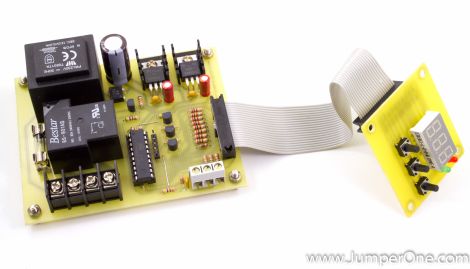
[Phil’s] parents grow their own organic food, but the harsh Ukraine winters make storing it a difficult proposition. Since it can drop to -30°C on occasion, they asked him to find a way to keep their storeroom at around 5-7°C above zero. He decided to construct his own programmable thermostat to keep things in check, and has been documenting the process as he goes along.

The thermostat uses a DS18B20 temperature sensor to monitor the room, and the logic is handled by an ATtiny2313. When the temperature dips low enough, the ATtiny triggers the room’s heater via a standard 240v relay. He can check the current temperature via a small 7-segment display mounted on the control board, which also contains three microswitches for controlling the heater.

It looks like a pretty solid build so far, and while he hasn’t finished coding the thermostat just yet, [Phil] says that those details are forthcoming. He has published a schematic however, so you can get a jump start on building your own if you’re looking to warm things up this winter.

Continue reading to see a video overview of the thermostat’s design.

Continue reading “DIY Thermostat Keeps The Harsh Winter Cold At Bay”

3D Printed Electromechanical Computer

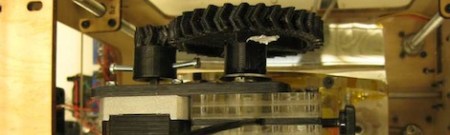
A few nights ago, [Chris Fenton] was hanging out at NYC Resistor putting in some time on his electromechanical computer project. You might remember [Chris] from his tiny Cray that he’s putting an OS on. It seems [Chris] is going back in time about 150 years and has set his sights on a 3D printed version of [Babbage]’s Analytical Engine.

The Analytical Engine was is a remarkable feat of engineering and machining. It was the first programmable computer. Shame, then, that it was never built in the 1800s. [Chris] isn’t building a glorified calculator like [Babbage]’s polynomial-computing Difference Engine – he’s going all out and building something with conditional looping.

[Chris] calls his device an electromechanical computer, so we’re assuming it won’t be crank driven like the version in the British Science Museum. Right now, he’s constructed the decade-counting gears that are vitally important for the ALU of his design. All the parts were printed on a Thingomatic, so we’re betting [Chris] is going to be relying heavily on the MakerBot automated build platform for the thousands of parts he’ll have to fabricate.

Check out the video from NYC Resistor after the break.
Continue reading “3D Printed Electromechanical Computer”

[Vigo’s] Stare Follows You Wherever You Go

To decorate the office for Halloween [Eric] decided to make [Vigo the Carpathian] stare at passersby. We hope that readers recognize this image, but for those younger hackers who don’t, this painting of [Vigo] played an important part in the classic film Ghostbusters II.

In the movie, his eyes appeared to be following anyone looking at the painting. [Eric] grabbed a Kinect and used Processing to recreate the effect in real life. The image is displayed on an LCD screen. A bit of work with Photoshop allowed him to cut out the eyes from the image, then create sprites which are moved by the Processing sketch. It’s reading data from the Kinect (so it knows where to ‘look’) which you can see perched on the top of the cubicle wall. The illusion is delightful, see for yourself in the clip after the break. We’ve already watched it a half-dozen times, and it looks like it was a real hit with the guests at the open house.

Can you believe they threw this together in just one day?

Continue reading “[Vigo’s] Stare Follows You Wherever You Go”