Control Android With A Projector And Kinect

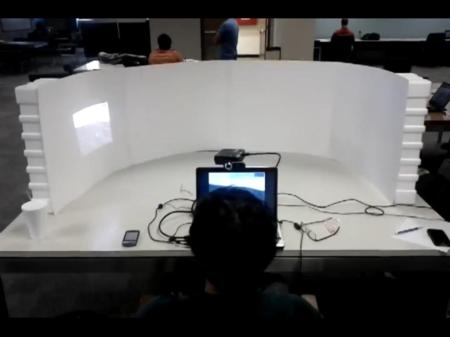
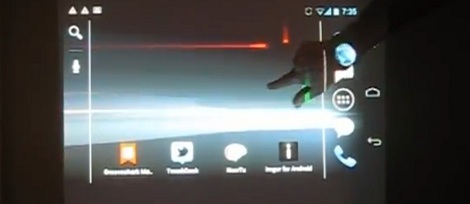
If you’re going to build a giant touch screen, why not use an OS that is designed for touch interfaces, like Android? [Colin] had the same idea, so he connected his phone to a projector and a Kinect.

Video is carried from [Colin]’s Galaxy Nexus to the projector via an MHL connection. Getting the Kinect to work was a little more challenging, though. The Kinect is connected to a PC running Simple Kinect Touch. The PC converts the data from the Kinect into TUIO commands that are received using TUIO for Android.

In order for the TUIO commands to be recognized as user input, [Colin] had to compile his own version of Android. It was a lot of work, but using an OS designed for touch interface seems much better than all the other touch screen hacks that start from the ground up.

You can check out [Colin]’s demo after the break. Sadly, there are no Angry Birds.

Continue reading “Control Android With A Projector And Kinect”
Projector Project Bears No Fruit But It Was A Fun Ride

No matter how good the intentions or how strong your hack-fu may be, sometimes you just can’t cross the finish line with every project. Here’s one that we hate to see go unfinished, but it’s obvious that a ton of work already went into reclaiming these smart white-board projectors and it’s time to cut the losses.

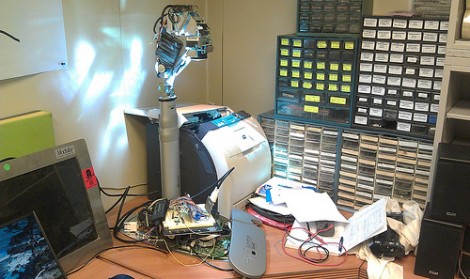
The hardware is a Smartboard Unifi 35″ computer with a projector mounted on a telescoping rod. It was manufactured for use with a touch-sensitive white board which the guys at the Milwaukee Makerspace don’t have. The projector works, but all it will display is a message instructing the user to connect the computer to the white board. Since they’ve got a couple of these projectors, it would be nice to salvage the functionality.

The first attempt was to replace the video signal to the projector. A few test boards were etched to experiment with DVI input. This included several logic sniffing runs to see what the computer is pushing to get the warning message to display. Alas, the group was not able to get the device to respond. But this opens up a great opportunity for you to play Monday morning hacker. Take a look at the data they’ve posted in the link above and let us know how you would’ve done it in the comments.

RGB Laser Projector Is A Jaw-dropping Build

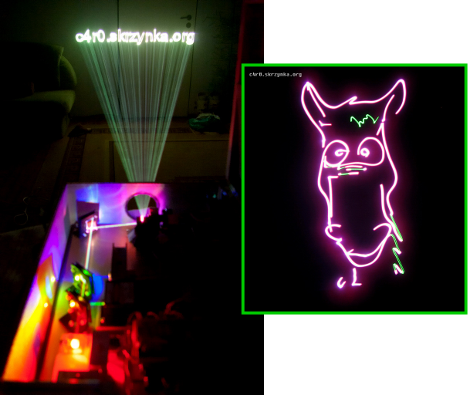
We can think of no better way to describe this laser projector project than Epic. [C4r0] is a student at Gdansk University of Technology and he’s been working on this projector for at least a couple of years. It uses several different laser diodes pulled out of DVD burners, Blu-Ray drives, and entertainment equipment (the green diode is from a disco laser).

In order to direct the beams he built a series of brackets that hold dichroic filters which reflect some wavelengths of light while allowing others to pass straight through. Each diode also needs a driver, most of which he built from scratch. And once the hardware has been designed and tested, what does one do with it? If you’re [C4r0] you build it into a money case with professional-looking results.

Don’t miss the video demo after the break. And make sure you have a rag ready to wipe up the drool before you look at his forum post linked above.

Continue reading “RGB Laser Projector Is A Jaw-dropping Build”

Old-school Projector Turned Digital

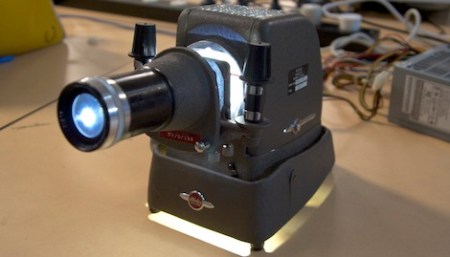
Who hasn’t thought about turning a 1950s slide projector into a digital projector? [Matt] did, but unlike most of us, he actually did it.

[Matt]’s friend [Angus] found an old, single-slide, sans-carousel slide projector in the trash. It’s a wonderful piece of ancient technology with a fabric insulated power cord and bakelite lamp socket. This projector was upcycled to the 21st century by adding a 10 Watt LED and a Nokia 1200 LCD.

For the electronics, [Matt] used an ATmega88 microcontroller. There’s an infrared receiver so the remote from an in-car CD player can be used to advance the slides and turn the projector on and off. The LCD is controlled by a bit of bit-banging from the Mega88, using hard-coded images of Che Guevara, Hendrix, Space Invaders and some old-school Macintosh/Lisa icons. Unlike the screen printed t-shirts at American Apparel, Che is the only authentic image in this project; this projector might have been made after Guevara came to prominence.

With a 10 Watt LED, it’s not the brightest projector on the planet and the picture is a little washed out in a bright room. With dim lighting, it’s a very good project even if the images are static.

Cookie Projector Uses That Dusty Film Camera Of Yours

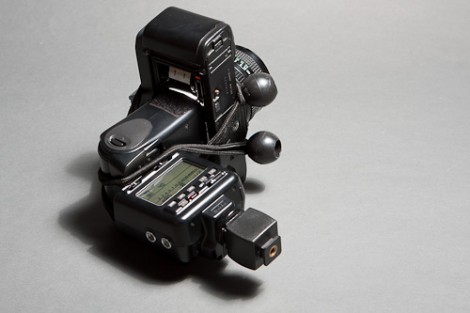
This hack is not for photographers with weak hearts. We’re going to be talking about destroying the body of a Single-Lens Reflex camera. But out of destruction comes something new. A broken camera paired with a flash and functional optics can be used to project light patterns for picture backgrounds.

The hardware is often referred to as a cookie projector, and a commercial unit can cost several hundred dollars. But if you or someone you know has a non-functional film SLR you’re already half way to making your own. Just snap off the back cover, yank out the mirror and shutter, and the bloody part is over. Slap on a lens with a large aperture, create your own slide with the pattern you’d like to see in your images, and affix a flash to the gaping hole on the back of the camera body. The video after the break shows the diy cookie projector hanging out on the flash stand, synchronized with your DSLR flash to add some pizzazz to the photo shoot.

Continue reading “Cookie Projector Uses That Dusty Film Camera Of Yours”

Virtual Reality With A Pico Projector

Although virtual reality was the wave of the future in the early 90’s, it hasn’t really taken off the way we would have liked. Sometimes a great idea just takes time for the technology to catch up to it (Aeolipile anyone?). Now that tiny projectors, realistic FPS games, and eye tracking systems have come down in price, this head-tracking projection system engineered by students at University of Texas at Austin could be the start of something really neat.

Although we’ve seen some cool FPS/pico projector hacks before, most of them use the “gun” as the controller. This approach offers a a different experience as one isn’t required to carry a “gun” around. It simply tracks one’s eye movement and moves the projector automatically. Check out the video after the break to see this device in action. Continue reading “Virtual Reality With A Pico Projector”

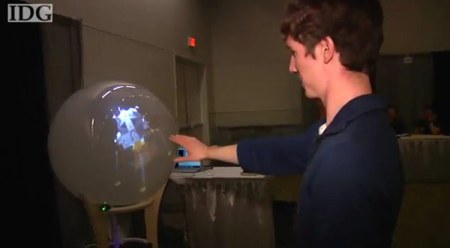
Two Kinects Plus One HD Projector Makes The Coolest “Snowglobe” Ever

Looking for something to replace the flat screen display that was amazing in your house ten years ago?  How about a circular display similar to a snowglobe (crystal ball?) that will display the image you are watching correctly no matter at what angle you view it.

This amazing student project from Queens University combines elements that many hackers are familiar with, including: Kinect sensors, a 3-D projector, and a giant acrylic sphere.  Actually, most people have never worked with a giant acrylic sphere, but they look like fun.  Check out the video after the break. Continue reading “Two Kinects Plus One HD Projector Makes The Coolest “Snowglobe” Ever”