Converting A Mill To CNC

traces

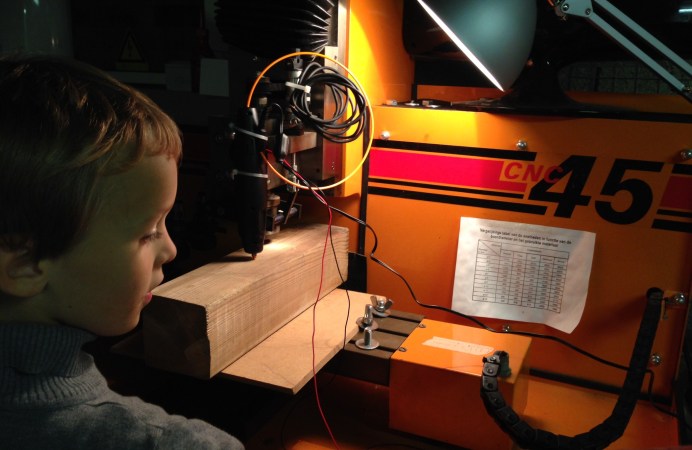
Have a mill that you’d like to automate? Perhaps you can gets some ideas from the work [James] recently finished. Using familiar NEMA 23 stepper motors (the same motors used in the RepRap), he hacked his Proxxon MF-70 mill for CNC control. Adding a Sanguino and the stepper controllers from other projects, [James] got a working machine for minimal investment. You can tell that [James] is a fan of Polymorph, because he uses it liberally for most of the project, even using it to create some Oldham couplings (Google cache).

After completing the build initially, he managed to burn out the spindle motor by milling steel too quickly. We found it interesting that he was able to use a TURNIGY 2217 860kv 22A Outrunner (for R/C airplanes) as a new spindle motor. Not only is it a low-cost solution, but pairing it with a traditional brushless ESC can give your CNC software direct control over the motor speed.

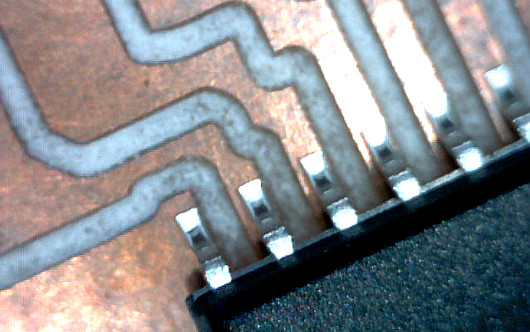
The image above is an example of what [James’] machine is capable of. Overall, it’s a very accessible project for most of us. Not every mill needs to be capable of 10 mil traces. If you’ve got the urge, you can probably put one together yourself. Of course, if you do, please let us know!

3D Printering: A Call For An Open Source Automated Build Platform

I’ve said this before, and I’ll say it again: if you’re using a 3D printer to make a few hundred identical plastic parts, you’re doing it wrong. That’s the place for traditional manufacturing methods such as injection molding or resin casting. If, however, you’re looking at printing a few dozen identical plastic parts, or even running a script to optimize your machine time, the current open source 3D printer world leaves one thing to be desired.

An Automated Build Platform

An Automated Build Platform is a fairly simple idea: put a conveyor belt on your heated bed, and when the print is done, send a command to drive a motor, dumping the newly printed part into a bin, The printer then begins the next part with a clean bed, and the days of doting over a 3D printer soon fade into the past.

For such a simple and useful idea, it’s surprising there hasn’t been much done with this idea in open source circles. There are, of course, problems both technical and legal, but hopefully nothing that should indefinitely derail anyone who would want to create the first open source automated build platform.

Continue reading “3D Printering: A Call For An Open Source Automated Build Platform”

3D Printed Cutaway Jet Engine Sounds Great

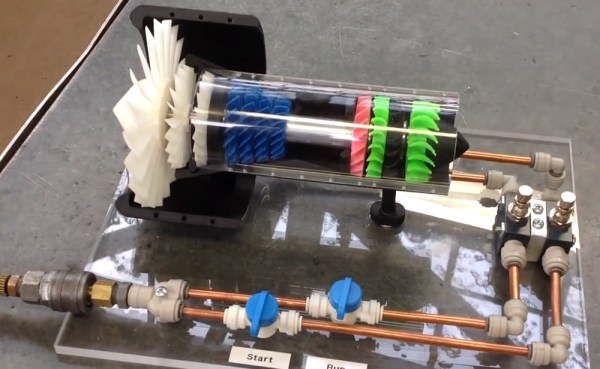
Thanks to the wonders of 3D printing, you can now have a 3D printed a jet engine of your very own. Unlike jet engines we’ve seen before, this one comes with no chance of the operator getting burned to a crisp. [Gerry] is a self-proclaimed “broken down motor mechanic” from New Zealand. He’s designed a rather awesome jet engine in 3D Software, and printed it on his UP Plus printer. The engine itself is a cutaway model of a high-bypass turbofan engine. While we’re not sure which make and model of jet engine this cutaway represents, we’re still very impressed.

This isn’t just a static display model – the engine will actually spin up with the help of compressed air.  Separate start and run tubes send air to the turbine and main fain respectively. It even has that distinctive turbofan “buzz saw” sound. While this model is relatively safe, [Gerry] does warn to keep the pressure down, or it could come apart. To that end we’d recommend adding a regulator before the quick disconnect.

The Thingiverse project is a bit light on instructions.  However this situation is remedied by [hacksaw], who posted a pictorial and build log up on pp3d. [Hacksaw] did run into a few problems with the build, but nothing a little bit of superglue couldn’t fix. It may have fewer moving parts, but this definitely puts our old Visible V8 Engine kit to shame.

Continue reading “3D Printed Cutaway Jet Engine Sounds Great”

3Doodler In The Wild

Remember the Kickstarter for the 3Doodler? Well they have just started shipping, and a hackerspace called Open Garage in Belgium just got theirs! Like any good hackerspace after playing with it they took it apart and posted pictures.

This is great because in our original coverage on the 3Doodler, we wondered what it looked on the inside, and whether it could be adapted to use with a CNC machine to make a giant 3D printer. Garage Lab delivered on both.

Stick around after the break to see the innards, and the first test print using a CNC mill!

Continue reading “3Doodler In The Wild”

Blender CAM – Open Source CAM Software

[Vilem] sent in a tip about a plugin he’s been working on for Blender, called Blender CAM. It allows for exporting directly from Blender to a G-code file. He has been working on it for several months, and releasing regular updates with various tweaks and improvements. While the project isn’t complete, [Vilem] has made some very impressive progress. It currently supports 2D and 3D strategies, various cutter types, simulation of 3D operations, and even automatic bridges.

The image above was made using the plugin, and it shows the level of detail possible. We can’t wait to see the 4 and 5-axis support that he is planning on adding.

A basic tutorial video is embedded after the break. As with anything Blender-related, it isn’t incredibly automatic, but another free tool is definitely a good thing. It looks like [Vilem] is looking for some other developers who could help out. If you have the knowledge, you might consider contributing.

Continue reading “Blender CAM – Open Source CAM Software”

3D Printering: Pastestruders

printering

While bits of plastic are the usual material for 3D printers, there are hundreds of other materials that are equally well suited for 3D printing. One of the most famous is chocolate, a material so popular and easy to manipulate inside an extruder there are even Kickstarters for 3D printed chocolate bars.

teapotThere are many more materials deserving of being 3D printed, though: wax for lost wax castings, other foodstuffs for improbably shaped edibles, and ceramics so I can finally print a life-sized, functional version of the Utah Teapot.
Unfortunately, for all the progress of plastic extrusion, little has been done about extruding pastes, foods, and clay with a 3D printer. The RepRap paste extrusion working group is fairly close to being dead, so let this volume of 3D Printering explore what has been done in the world of paste printing.

Continue reading “3D Printering: Pastestruders”

6-axis 3D Printer

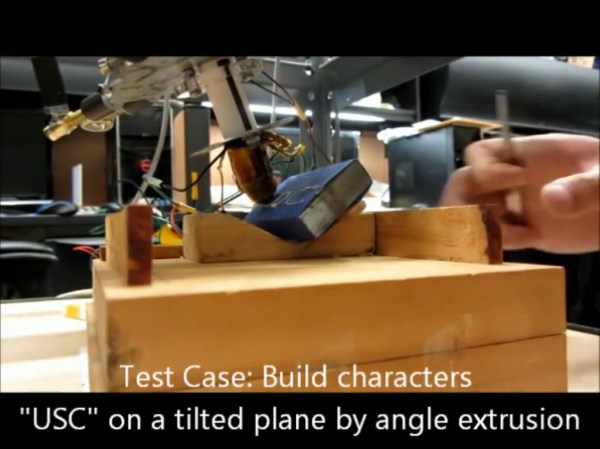
We just stumbled upon this video by Professor [Yong Chen] and his students [Xuan Song] and [Yayue Pan] on a 6-axis 3D printer. The group is from the University of Southern California and their project is called the “Development of a Low-cost Parallel Kinematic Machine for Multi-direction Additive Manufacturing”.

That’s right. 6-axes of 3D printing. It uses six linear actuators to move the tool head in almost any direction. The whole thing is powered by a KFLOP board by Dynomotion, a company dedicated to premium motion control for CNC manufacturing and robotics and automation.

In the video they give examples of printing on angled surfaces and cylindrical surfaces — but that’s just the tip of the iceberg. With 6-axes, parts could be designed with completely different characteristics, you could build up the base of a part, and then build off of it in different angles, no more horizontal layers throughout!

Unfortunately we haven’t been able to find any published information on their research, only this video — so stick around after the break and watch it in awe!

Continue reading “6-axis 3D Printer”