Midwest RepRap Festival

midwest-reprap-meetup

Midwesterner’s should take note — here’s an event that’s happening somewhere other than New York or California! We jest, of course there are great events in the Midwestern states every year, like the Kanasas City or Detroit Maker Faires. This event puts focus on 3D printing. The Midwest RepRap Festival will be held in Elkhart, Indian March 15-17, 2013. Despite the name, the event is meant to encompass all things involved with any brand, make, or variety of 3D printing.

The owners of a local business called The Royal Phoenix have opened their doors for the weekend. Organizers have arranged for [Josef Prusa] and [Johnny R] to speak. There will also be build events (one session will show the build process of the MendelMax 2.0) so feel free to bring your own equipment for help with construction or getting it dialed in.

There is no registration fee, or tickets. But it would be best if you did fill out the questionnaire so they have some semblance of how many people might be coming.
Help Hackaday Buy Our Own 3D Printer UPDATED!

beggars

UPDATE: We’re getting a LulzBot thanks to [Jeff Moe].

ALL DONATIONS ARE BEING REFUNDED. YOU WILL STILL RECEIVE YOUR STICKERS.

We’ve held out for far too long. Hackaday now needs a 3D printer.   We get emails all the time asking why we don’t have a donate button. Well, we’re kind of stubborn and would rather just do with what we have. Unfortunately this hasn’t gotten us very far in the 3d printer department.

We have a few projects in mind that could really utilize a 3d printer, namely building custom game controllers for children with special physical needs.

If you have any interest in helping us get a 3D printer for Hackaday, read on. Otherwise, carry on with your day.

Continue reading “Help Hackaday Buy Our Own 3D Printer UPDATED!”

Ceramic Hot-end Mount Seeks To Improve Extrude Performace

ceramic-hot-end-mount

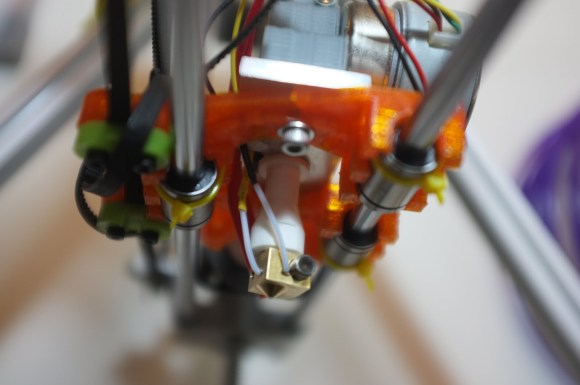
Take a gander at the part of this extruder head which looks like a chess pawn. It’s the mounting bracket for the hot end and it’s made out of ceramic. [Ed] came up with the idea to use ceramic to mount the hot end when trying to improve the design while keeping it rather simple and easy to assemble. The concept uses the thermal properties of the ceramic to insulate well enough to operate the extruder at higher temperatures without causing other problems.

Where does one get a custom ceramic part anyway? Turns out you can get low volume runs from China much like PCBs. The minimum order was ten units, which was still a leap of faith since he had no way of testing the design in advance. The first run with the new part went quite well, but only for the first layer and then the filament jammed. He’s still not sure why, but overcame the issue by lining the inside of the ceramic with a PTFE tube. This means he now has to use a smaller filament to fit through it. But the quality of the prints he’s getting with 1.75mm stock and the ceramic head are superb.

It may even be possible to print this ceramic part some day. We remember seeing another extruder that can deposit ceramic clay.

Print Your Own 30 Round AR15 Magazine

AR

Here’s a 30 round magazine for an AR15, made just in time to add to the national conversation over things that look scary.

This magazine is the product of Defense Distributed who have previously graced the front page of Hackaday with their 3D printed scary bang bang machine. While continuing to work on their WikiWeapon – a gun printable on a home-built 3D printer – the team decided they could subvert more obtuse gun laws by making their own high-capacity magazine.

The magazine is printed on an extremely expensive commercial 3D printer, but the team is working to make it printable on more affordable models. The prototype magazine survived unloading a full 30 rounds. Video demo of that after the break.

Also on Defense Distributed’s DEFCAD is a sound moderator for paintball and air guns. While the design isn’t yet finalized for those big scary assault weapons, it should be possible to modify it for the big guns.  One of their next projects is a stock, hopefully one that includes a hinge.

Continue reading “Print Your Own 30 Round AR15 Magazine”

3D Printing Vacuum Tube Sockets

tubes

With the popularity of 3D printers and the current cult of vacuum tubes, it’s shocking we haven’t seen someone do this before.

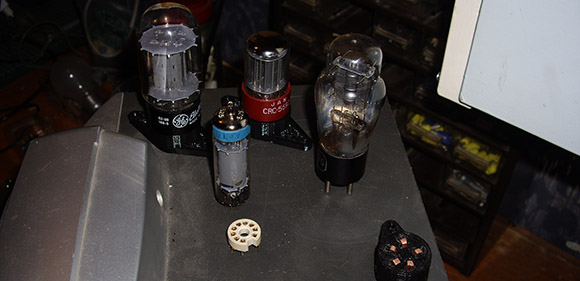
[Peter] printed his own sockets for a few vacuum tubes he had lying around. After designing them on his computer, [Peter] printed them out on his local hackerspace’s 3D printer.

After printing out the plastic parts, [Peter] needed to add a few strips of metal for a conductor. He used a few pieces of an ATX power supply; a little difficult to fit, but something that works all the same.

So far, [Peter] has whipped up a few sockets for UX5 and VT76 tubes, UX6, B7G (7 pin mini), and B9D  Magnoval tubes. No Nixie sockets yet, but it’s enough diversity to build your own tube amp using the most common designs. Now if we could only make our own transformers with laser cutters and 3D printers…

Signing Your 3D Prints

print

For all the 3D models out on the Internet, including the STL files on Thingiverse that are copied by other makers every day, there hasn’t been a good way to put your John Hancock on a three-dimensional piece of plastic you’ve designed. [Chris] has been thinking about the fact that an STL file released on the Internet is completely out of the creator’s hands for a while now, and he finally came up with a good solution to signing 3D prints.

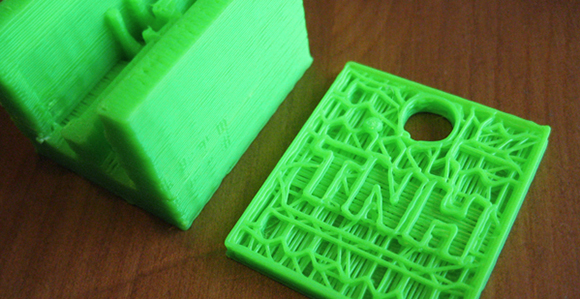
[Chris] had been looking into ‘stamping’ a maker’s mark on the first few layers of a print, but this wasn’t always practical. Sometimes the bottom of a print needs to be a smooth surface, so [Chris] moved his initials up a few layers into the main body of the print.

By subtracting a 1.0 mm-thick version of his initials from the interior of a print, [Chris] is able to put his maker’s mark on the inside of a 3D object, visible only for a short time during the production process.

The signature isn’t impossible to remove, but it does give a little bit of credit to the original designer, all without some strange DRM scheme or metadata attached to an STL file.

You can check out [Chris]’ printer laying down a few layers of his logo after the break.

Continue reading “Signing Your 3D Prints”

Touchscreen Control For A Reprap

display

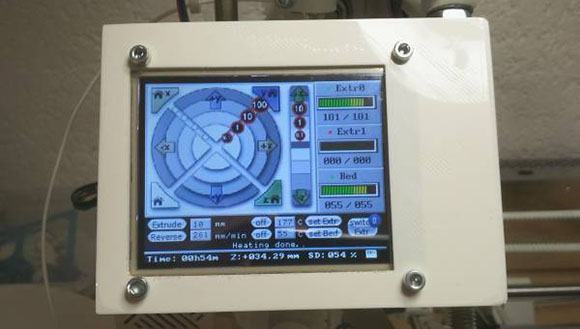
After you’ve got your Reprap running smoothly with acceptable resolution and good quality prints, the next order of business for any 3D printer hobbyist is headless printing. While the greatest and newest 3D printers come with controls to allow jogging, homing, temperature control, and printing from an SD card, the home-built versions will require an add-on attached to the electronics board. [Marco] has been spending his time improving the character LCD control panel projects we’ve seen for Repraps with an awesome graphical version that emulates the control interface found in the Pronterface control software.

The biggest problem with adding a control interface to a Reprap is the number of pins available on the electronics board. While an electronics board like RAMPS has enough spare I/O pins to drive a display, other boards such as the Sanguinololu and the Melzi are extremely limited in their expansibility. To get around this limitation, [Marco] used a 4D Systems serial touchscreen display.

This display only requires two pins to fully interact with a printer running the Marlin firmware; the graphical processing, communication, and SD card access is handled by the on-board PICASO micocontroller, leaving the ATMega on the electronics board free for important things like printing stuff out of plastic.

[Marco] has a git full of modified Marlin firmware and firmware for the 4D Systems display. There’s also a neat printed case for the display, making a very professional-looking standalone controller a weekend project instead of a months-long ordeal.

Thanks [Antonio] for sending this one in.