PCBs Straight From The Magazine

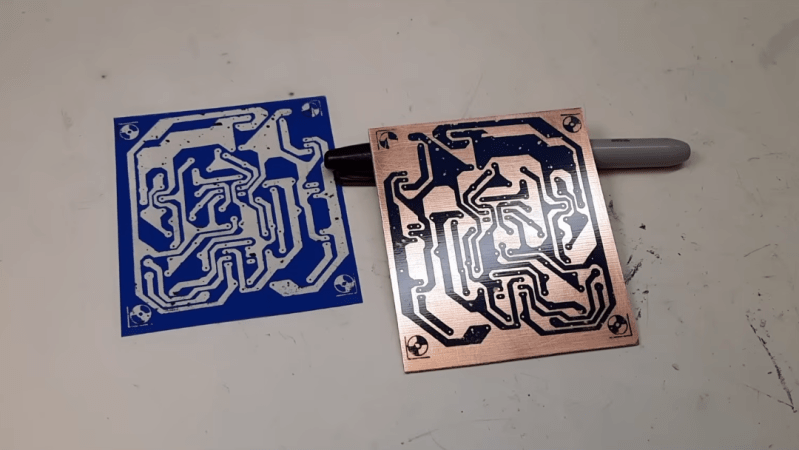
It’s never been easier to get a printed circuit board made. In fact, almost every electronics video out on the internet will incessantly remind you of this fact now. But making a custom PCB wasn’t always as straightforward as sending a KiCad file to a board house. Many DIY methods involve harsh chemicals and tedious processes, but did have the potential benefit of taking much less time than waiting on boards to arrive in the mail. [Bettina Neumryr] is demonstrating one of these older methods, called the toner transfer method, using a circuit that was printed directly in an old magazine.

The first part of the toner transfer method is to create an image that can be printed. Since this circuit came from a magazine, it is first scanned in to a computer and imported into GIMP, where it can be scaled to match the size of the components and then sharpened to make a crisp print. With the image ready, it’s time to print the image onto some toner transfer paper, ensuring that the printer in question is a laser printer which actually uses toner. From there, a sheet of blank copper PCB is prepared and then the toner is transferred by heating, in this case using a laminator. After that its etched, removing all of the copper not protected by the toner, and then the toner itself can be removed which leaves behind the copper traces.

For those of you who were around when toner transfer was in vogue, this video might not have much value. But for anyone who can’t use a board manufacturer for whatever reason or is looking for alternatives, a modern video showing the method could be much more useful and have better context for beginners than videos made a decade or more ago now. Some of those older methods include similar processes using inkjet printers instead, but there are more modern DIY methods as well using lasers or CNC machines too.
Continue reading “PCBs Straight From The Magazine”

DIY Test Gear From 1981

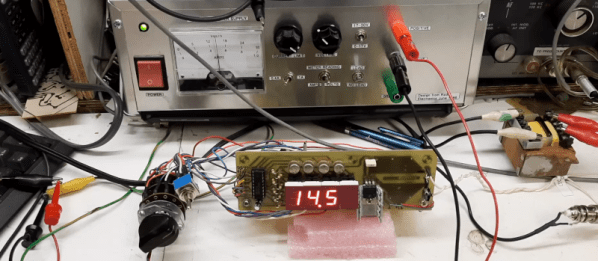
We can’t get enough of [Bettina Neumryn’s] videos. If you haven’t seen her, she takes old electronics magazines, finds interesting projects, and builds them. If you remember these old projects, it is nostalgic, and if you don’t remember them, you can learn a lot about basic electronics and construction techniques. This installment (see below) is an Elektor digital voltmeter and frequency counter from late 1981.

As was common in those days, you could find the PCB layouts in the magazine. In this case, there were two boards. The schematic shows that a counter and display driver chip — a 74C928 — does most of the heavy lifting for the display and the counter.

Continue reading “DIY Test Gear From 1981”

Magazine Transistor Tester Lives Again

One of the lost pleasures of our modern world is the experience of going shopping at a grocery store, a mall, or a drugstore, and finding this month’s electronics magazine festooned with projects that you might like to build. Sure, you can find anything on the Internet, but there’s something to be said about the element of surprise. Can any of those old projects still be of interest?

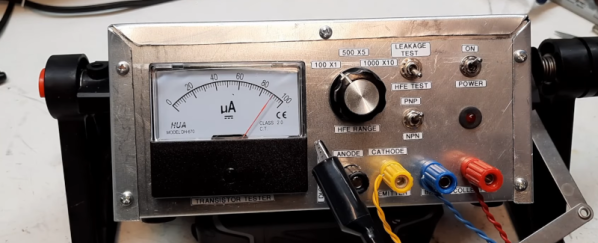
[Bettina Neumryr] thinks so. She has a hobby of finding old magazine projects and building them. Her most recent installment is a transistor tester from the June 1983 issue of Everyday Electronics.

The tester was quite a neat job for 1983, with a neat case and a PC board. It measures beta and leakage. There’s an analog meter that can measure the collector current for a fixed base current (beta or hfe). Leakage is how much current flows between emitter and collector with the base turned off.

In 1983, we’d have loved to have a laser printer to do toner transfer for the PC board, but of course, that was unheard of in hobby circles of the day. The tester seemed to work right off the bat, although there was a small adjustment necessary to calibrate the device. All that was left was to put it in a period-appropriate box with some printed labels.

We loved the old electronics and computer magazines. Usually, when we see someone working on an old magazine project, it is probably not quite a literal copy of it. But either way is cool.

Continue reading “Magazine Transistor Tester Lives Again”

A Function Generator From The Past

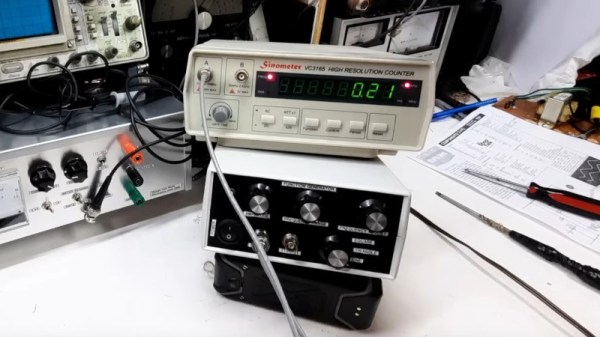
It’s always a pleasure to find a hardware hacker who you haven’t seen before, and page back through their work. [Bettina Neumryr]’s niche comes in building projects from old electronics magazines, and her latest, a function generator from the British Everyday Electronics magazine in April 1983, is a typical build.

The project uses the XR2206 function generator chip, a favourite of the time. It contains a current controlled oscillator and waveform shaper, and can easily produce square, triangle, and sine waves. It was always a puzzle back in the day why this chip existed as surely the global market for function generators can’t have been that large, however a little bit of background reading for this write-up reveals that its intended application was for producing frequency-shift-keyed sinusoidal tones.

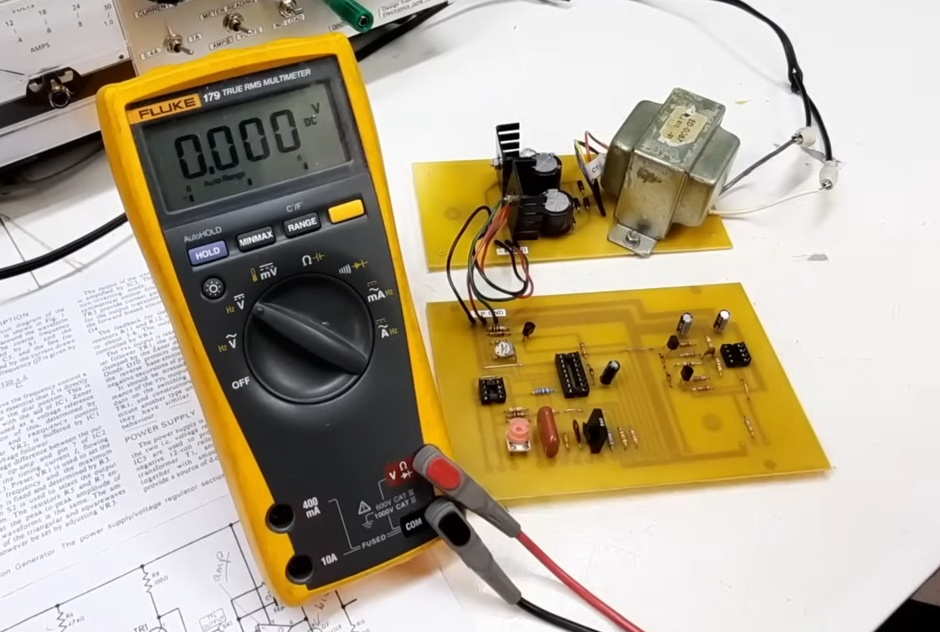
The two PCBs on the bench, with a multimeter
Yellow-stained boards for the win!

TheĀ EE project pairs the XR2206 with an op-amp current generator to control the frequency, and another op-amp as an amplifier and signal conditioner. The power supply is typical of the time too, a mains transformer, rectifier, and linear regulators. There are a pair of very period PCBs supplied as print-outs in the magazine for home etching. This she duly does, though with toner transfer which would have been unheard of in 1983. After a few issues with faulty pots and a miswired switch, she has a working function generator which she puts in a very period project box.

It’s interesting to look at this and muse on what’s changed in electronic construction at our level in the last four decades. The PCB is single sided and has that characteristic yellow of ferric chloride etching, it takes up several times the space achievable with the same parts on the professionally-made dual-sided board designed using a modern PCB CAD package we’d use today. A modern take on the same project would probably use a microcontroller and a DAC, and a small switch-mode supply for less money than that transformer would provide the power. But we like the 1983 approach, and we commend [Bettina] for taking it on. The full video is below the break.

Continue reading “A Function Generator From The Past”

Hackaday Links Column Banner

Hackaday Links: August 10, 2025

We lost a true legend this week with the passing of NASA astronaut Jim Lovell at the ripe old age of 97. Lovell commanded the ill-fated Apollo 13 mission back in 1970, and along with crewmates Jack Swigert and Fred Haise — along with just about every person working at or for NASA — he managed to guide the mortally wounded Odyssey command module safely back home. While he’s rightly remembered for the heroics on 13, it was far from his first space rodeo. Lovell already had two Gemini missions under his belt before Apollo came along, including the grueling Gemini 7, where he and Frank Borman undertook the first long-duration space mission, proving that two men stuffed into a Volkswagen-sized cockpit could avoid killing each other for at least two weeks.

Continue reading “Hackaday Links: August 10, 2025”

Early “Computer Kit” Really Just A Fancy Calculator

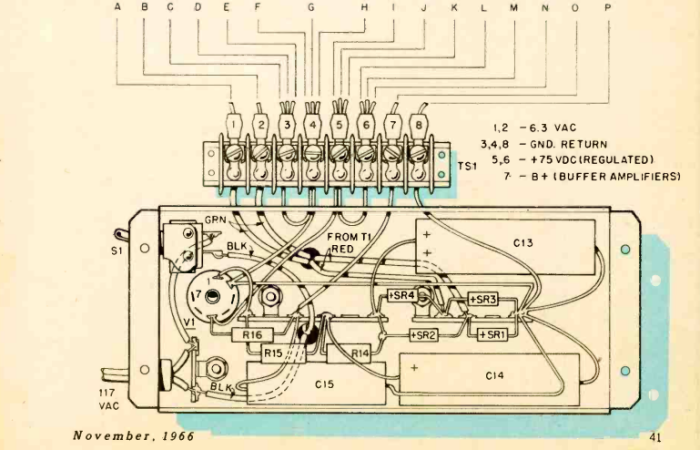
We’re big fans of calculators, computers and vintage magazines, so when we see something at the intersection of all three we always take a look. Back in 1966, Electronics Illustrated included instructions in their November issue on building, in their words, a “Space-Age Decimal Computer!” using neon lamps, a couple of tubes, and lots of soldering. The article starts on page 39 and it’s made fairly clear that it will be an expensive and complicated project, but you will be paid back many times over by the use and experience you will get!

Our modern idea of a computer differs greatly from the definitions used in the past. As many readers likely know, “Computer” was actually a job title for a long time. The job of a computer was to sit with pen, paper, and later on electromechanical devices, and compute and tabulate long lists of numbers. Imagine doing payroll for large companies completely by hand, every month. The opportunity for errors was large and was just part of doing business. As analog and later transistor-based computers started to be developed, they replaced the jobs of human computers in calculating and tabulating numbers. This is why IBM was originally called the Computing, Recording and Tabulating Company!

Continue reading “Early “Computer Kit” Really Just A Fancy Calculator”

End Of An Era: Popular Science Shutters Magazine

Just three years after the iconic magazine abandoned its print version and went all-digital, Popular Science is now halting its subscription service entirely. The brand itself will live on — their site will still run tech stories and news articles, and they have two podcasts that will keep getting new episodes — but no more quarterly releases. While you can’t complain too much about a 151 year run, it’s still sad to see what was once such an influential publication slowly become just another cog in the content mill.

Started as a monthly magazine all the way back in 1872, Popular Science offered a hopeful vision of what was over the horizon. It didn’t present a fanciful version of what the next 100 years would look like, but rather, tried to read the tea leaves of cutting edge technology to offer a glimpse of what the next decade or so might hold. Flip through a few issues from the 1950s and 60s, and you won’t see pulpy stories about humanity conquering the stars or building a time machine. Instead the editors got readers ready for a day when they’d drive cars with warbird-derived turbochargers, and enjoy more powerful tools once transistor technology allowed for widespread use of small brushless motors. It wasn’t just armchair engineering either, issues would often include articles written by the engineers and researchers that were on the front lines. Continue reading “End Of An Era: Popular Science Shutters Magazine”