3D Printed Circuit Boards Using Conductive Ink

The thought of using a 3D printer to fabricate PCBs is tantalizing and the good news is that it’s a reality. This project shows that it’s possible to use a special printer head to apply traces to an extruded substrate.

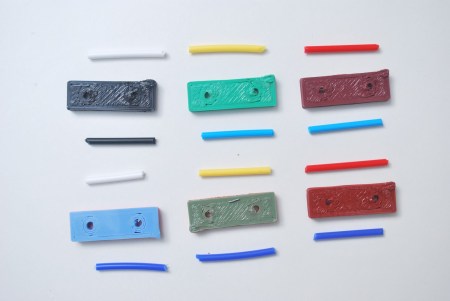
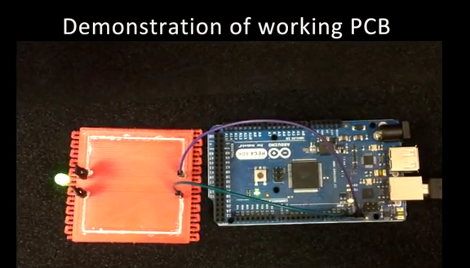
This is similar to the point-to-point 3D printer circuits with one big upgrade. Now the traces can be printed directly onto the ABS using conductive ink. The process starts with the design files, which are used to model a substrate that has a trench for each trace. A Makerbot then prints out this model. Once complete, the ABS extruder head is swapped for a special ink head. Each trace is then filled with the conductive fluid, which is kept in place by the trench walls until it can dry. We think this improves on the trace printing techniques we’ve seen before because it doesn’t require your printer heat to use molten metals.

The circuit above uses printed traces for the high and low side of an LED circuit. It’s a bit rough at the edges, but it shows a lot of promise. Don’t miss the demo video embedded after the jump.

Continue reading “3D Printed Circuit Boards Using Conductive Ink”
3D Printing With Nylon For A More Useful Objects

[taulman] over on Instructables has been working on his own version of a 3D printer. Unlike the usual PLA or ABS filament all the RepRaps and Makerbots use, this printer uses nylon to make parts with very interesting properties.

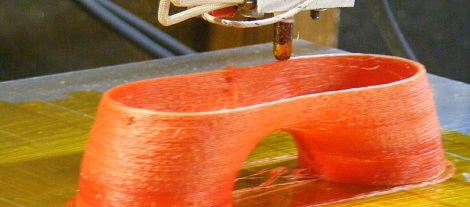
Most extrusion printers are designed to print with ABS (a very hard plastic that melts around 220-230° C) or PLA (a somewhat softer plastic that melts at about 180° C). [taulman] is using Nylon 6, a very slippery and bendable plastic that melts around 320° C (about 600 degrees Fahrenheit). He’s doing this with a hot end of his own design and a ‘spiky’ extruder bolt that allows high-temperature thermoplastics to be extruded into any shape imaginable.

For the longest time, the 3D printer community has been using low-temperature thermoplastics such as PLA and ABS. There are obvious benefits to these materials: it’s pretty easy to source a spool of filament, and the low melting point of these plastics makes building a printer easier and safer. Now that [taulman] has the high-temperature plastic nut cracked, he’s moving on to easily-machiniable Delrin and transparent Polycarbonate. Very cool, and hopefully in a year’s time we’ll have a choice of what material to run in our printers.

After the break, there are a few videos [taulman] put up showing his printer at work and the properties of his 3D printed objects. It looks like [taulman] can print objects that are impossible on any other 3D printer we’ve seen; the flexible iPhone case probably couldn’t be made on any other DIY machine.

Continue reading “3D Printing With Nylon For A More Useful Objects”

3d Printing A Mini Lathe

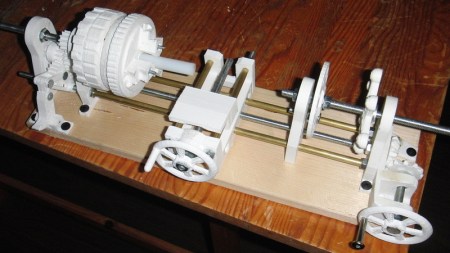
While browsing on one of our regularly visited sites, RobotsDreams, we found this interesting little video. Here, [Sublime] is showing off his 3d printed mini lathe. In the video he mentions that all the files are available for download so you could make one for yourself, but there were unfortunately no links. A quick bit of googling and we found some more information.  We found the project on Thiniverse, though reading through the comments it seems that [Sublime] no longer uses Thingiverse. You can now find the files on his GitHub account to make your own.

The design seems very solid and looks like it could handle some basic jobs. As [Sublime] points out in the video below, you already know what parts are going to wear out fast and can simply print a few extras to have on hand.  While that may seem somewhat wasteful, he also points out that he’s using PLA which is compostable and much easier to recycle.

Continue reading “3d Printing A Mini Lathe”

Mixing Colors On The Reprap

3d printing has come huge strides in ability to construct detailed objects. Unfortunately, color is still a considerable limitation. Here, some people at the Reprap blog are having fun coming up with an extruder head that actually mixes two colors as it deposits them. Don’t confuse this with the dual head that Makerbot is touting that allows you to switch colors on the fly, this is a single head that actually has a cavity where the material is melted, then stirred to create a combination of the two. It is an interesting method of overcoming a limited supply of colors.

Having this extra stirring chamber means that there would be a small amount of material wasted any time that you wanted to make a change to the color, as it would have to be purged. There are some interesting thoughts in their comments on how to use this extra material most efficiently.

Solidoodle, A $500 3d Printer

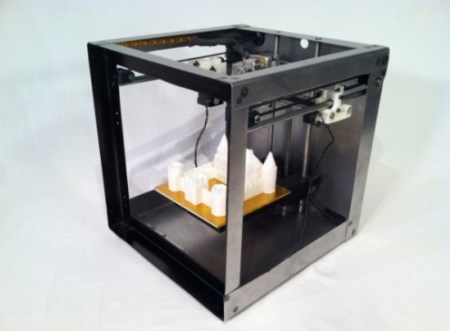
3D printers are very popular right now. We’ve seen them go from an interesting project to multiple commercial entities. Makerbot seems to be the poster child for the commercial side of things, at least they were. Their former COO [Samuel Cervantes] is now in charge of a new company called Solidoodle. Their main product is a complete 3d printing kit for $499. You supply power and a computer.

The Solidoodle is capable of building things 6″x6″x6″. The quality seems to be comparable to most of the others we’ve seen. They tout a .1mm layer thickness in HD mode (makerbot shows .2-.3mm). Not bad considering it is less than 1/3 the price of the makerbot replicator with a single extruder. The video after the shows it in action, as well as both with the optional case and door and without.

3d Printing Saves The Day For Time-lapse Photography

Several of us here at Hackaday have discussed how much we’d like to have some tools, like a 3d printer, but just can’t justify the cost. What would we make? Why do we really need one? Why don’t we just bother [Brian Benchoff] who already has one to make us parts instead. That’s usually how the conversation goes.

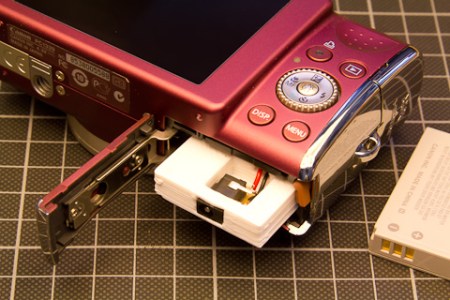
[Alexander Weber] gave us another little reason to drop in our “list of reasons we need a 3d printer” list with this little hack. He wanted to play with CHDK but found the camera’s battery unable to stay alive for longer than 2 hours. There is a commercially available adapter to allow you to plug into the wall, but the cost was outrageous. At least it is outrageous to someone who already owns a 3d printer. We just need a few hundred more dollars worth of reasons to justify that sweet 3d printer we’ve been pining over.

[via Adafruit]

Mapping The Surface Of A Video Game Moon

Writing for Hackaday isn’t all fun and games; occasionally I need to actually write posts and reply to emails from builders around the globe. Usually, though, I’m knee-deep in a personal project, or just hanging out playing a few video games. Recently I’ve gone off the deep end with Kerbal Space Program, an awesome little space flight simulator set in an alternate reality where everyone is just slightly incompetent.

As it turns out, there’s actually a lot of fairly technical objectives in this game, from performing orbital rendezvous to mapping the surface of another planet. It didn’t take long for me to go off the deep end and start mapping the Kerbal moon and turning it into a 3D object. Check out how I did this after the break.

Continue reading “Mapping The Surface Of A Video Game Moon”