The Keypad Contest

Keypad

What can you do with ten buttons and ten lights? A lot.

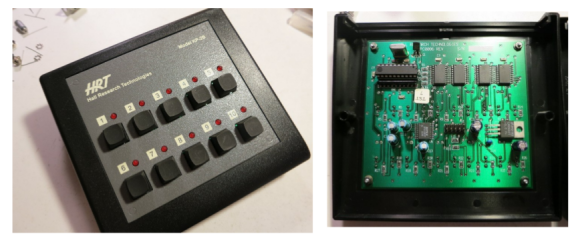
[Andrew] and [Nathan] found a collection of Hale Research keypads being thrown out, and decided to host the Keypad Contest. The goal of the contest was to create something nifty using the ten buttons and ten lights on the keypad, and an ATtiny2313 that replaced the original 8051-compatible microcontroller in the device.

[Andrew] wanted to try making PCBs with his home-built CNC machine, so he milled out USBtinyISP programmers for the ATtiny2313. Then he gave out eleven development kits to a group, and explained how to develop on the hardware.

After a month of hacking, seven people completed projects. The winner was an internet radio controller, which had the keypad sending serial data to a TP-Link WR703N router. The router used a USB sound card and OpenWRT firmware to stream music. The runner up was a timing game called “Capture”.

The contest write up has details on all seven projects. [Andrew] and [Nathan] were successful in getting software engineers to try hardware with this contest, resulting in some neat hacks. After the break, check out a video demo of the internet radio controller.

Continue reading “The Keypad Contest”

Write Code, Fix The Space Station, Win $10,000

ISS

If you want something great to add to your astronaut application, this is your chance. If you can figure out a way to optimize the position of the solar panels for the International Space Station, you’ll win $10,000 from this TopCoder competition.

Positioning the solar arrays on the ISS is an incredibly complex task; if parts of the arrays are in the shadow of other parts, they’ll bend due to the temperature difference and eventually break. NASA would like more power to run science experiments and other cool stuff, so they’re turning to hackers so they can optimize the amount of power generated on the ISS.

Your goal, as a contestant in this completion, is to define the angular position and velocity for each of the joints that connect the solar panels to the station for every point in a 92-minute orbit. Limitations on any solution  include making sure the masts for each panel aren’t in a shadow more than they need to be, making sure the cycle can be repeated each orbit, and making sure the most power is generated on board.

The completion is open, so if you haven’t done enough matrix algebra this weekend feel free to sign up. In any event, you’ll get a cool CAD model of the ISS.


Building An Automatic Bicycle Transmission In A Week

1

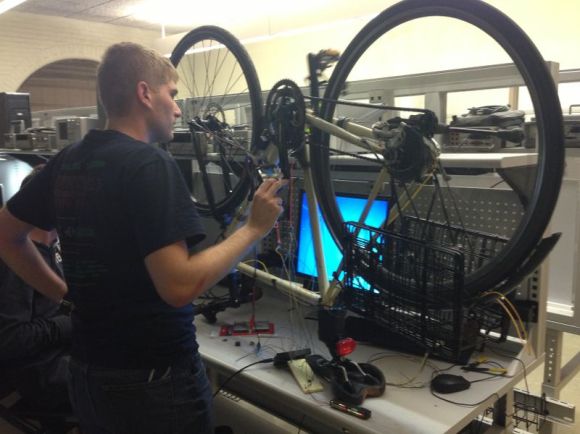
Every year, the ECE department of Carnigie Mellon University hosts Build18, an engineering festival intended to get students out of the classroom and into the workshop. [Andrew Toth] along with team members [Jenna MacCarley], [Peter McHale], and [Nicolas Mellis] have been busy this last week putting together an automatic bicycle transmission.

Most cyclists agree that a cadence of 80 RPM is just about right for most cycling. The team’s transmission uses Hall effect sensors to sense the cadence of the rider and will change to a higher gear if the cadence drops below 60 RPM and a lower gear if the cadence is above 100 RPM.

One of the requirements of the Build18 festival is the completed project must cost less than $250. By using an Arduino Mega and a servo to change gears, the team has a fairly low cost solution to automatically changing bicycle gears.

It’s a very cool project, and hopefully we’ll see a video once the competition is over at noon, EST today.

Engadget Trying Out Some Crowd-funding

eng-insert-coin-logo-article-1356645135

Engadget has decided to give this whole crowd-funding thing a try with a competition called Insert Coin. This is part of an upcoming event called Expand that is supposed to let us get inside information on gadget construction and conception. This actually sounds refreshing compared to the giant commercial that other tech conferences can be (This is why Hackaday has never returned to CES).

Insert Coin is a contest that has hardware at the forefront. If you qualify, you could win $25,000 for your device as well as $1,000 to come show it off at their event.

Continue reading “Engadget Trying Out Some Crowd-funding”

7400 Logic Competition Winners Announced

The 7400 Logic Competition has drawn to a close. The winners were announced and there are quite a few of them. There were fifteen first place winners named, nine second place, and nineteen third place projects. The bounty of quality entries is a testament to the popularity of the contest. It helps to have a wide range of prizes and the post linked above lists all of the sponsors who donated goodies as an incentive.

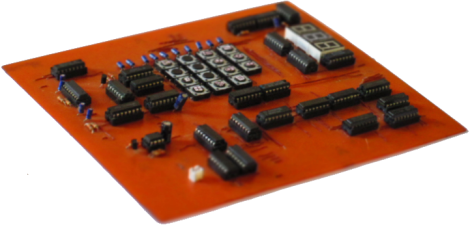
The board seen above was awarded the reader’s choice, to which the grand prize was awarded. It is a 7400 series calculator. [Umair Mukati] and [Naveed Ahmed] — both are students at the Institute of Industrial Electronics Engineering in Karachi, Pakistan — developed the device as part of a class project. It is capable of adding or subtracting two digit numbers. This includes support for negative numbers as results. We’ve embedded a video demo of the calculator in action after the break.

Continue reading “7400 Logic Competition Winners Announced”

DSO Quad Contest Has A Quartet Of Cash Prizes

Seeed Studios has launched a contest centered around the DSO Quad. In case you’re unfamiliar with the hardware, the DSO Quad is a low-cost standalone oscilloscope. It’s got four channels, two of which are analog, and includes an ARM Cortex-M3 processor as well as an FPGA. Why are we recapping the hardware with the contest announcement? Because the contest rules state that you are allowed to alter the hardware despite the fact that this is more of a software-focused event.

But what you really should know about are the cash prizes going to the winners. Rank in the top four and you’ll claim $3000, $1500, $800, and $300 in cold hard cash. But even if you don’t take one of the top spots everyone still wins. That’s because all entries are open source and will be found in Seeed’s DSO Quad forums.

If judging people is more your thing Seeed needs some help with that too. They’re looking for qualified judges and application details are includes at the bottom of the contest page.

[Thanks Petteri]

Find A Way To Stop Robocalls To Grab This $50k Prize

Here’s a challenge tailored to our community if we’ve ever seen one. You know those delightful unsolicited prerecorded calls you get from time to time? They might be political, but they also come from companies trying to sell you vinyl siding, or promising improvements in your business. Well they’re against the law in many cases, and complaints to the Federal Trade Commission have been piling up. So now the FTC is offering a $50,000 bounty to anyone who can find a way to block the calls.

It’s called the Robocall Challenge and you’ve got until January 17th, 2013 to get your entry submitted. The great thing is, this doesn’t need to be a fully working solution. Your entry may be: “proposed technical solutions or functional solutions and proofs of concept “. Even better, you retain ownership of the solution even if you win. This type of recognition will surely have telco related companies beating a path to your door.

Of course if you do have a solution, we’d love to hear about it too!

[Thanks Filespace via WCPO]