Win Free Stuff By Uploading A Pic Of Your Fritzing Circuit

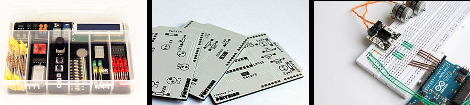
Pull out your old Fritzing designs, or churn out a new one, and you might be able to win one of these prizes. Fritzing is looking for the top three designs which will receive these prizes. On the left is a Fritzing super upgrade kit with goodies like a Character LCD, DC motor and driver IC, shift register, LEDs, and buttons. In the middle is a free PCB from your design (they’ve started their own service to us Fritzing for board layout). Third prize is a motor driver breakout module for breadboard use.

You can get an idea of what others are submitting by poking around their project pages. You’ve got a bit more than a week to get your designs in for consideration. Their deadline is on Sunday, December 18th, 2011.

If this stuff doesn’t interest you, don’t forget to try your luck with 2012 Free Day!

Toy Car Fitted With Lights And Sirens Is A Children’s Delight

police_car_lights_and_sirens

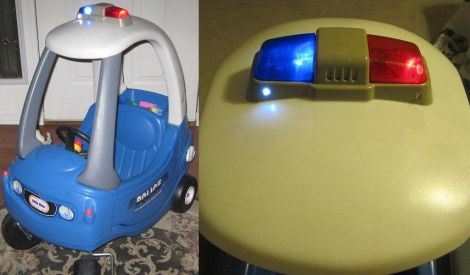
[Nathan], a member of the DangerousPrototypes forums, was looking for a project he could use to enter the 7400 logic competition they are holding. His kids had a small ride on police car, but the light bar on top contained no lights, and the car made no sounds when his children were in pursuit of baddies around the house. [Nathan] had all the inspiration he needed, and took to his workshop in order to fix this glaring oversight by the toys’ creators.

He designed a circuit based loosely around a Cylon-style light that he saw a while back at the Evil Mad Scientist Labs, which employed an oscillator and a 4107 decade counter to control the lights. His design uses a 74HC04 hex inverter as the oscillator, while the decade counter is used to modulate the siren’s frequency and control the rotating LED beacons.

The final result is great if you ask us. An “unnamed adult female” in the house was not nearly as impressed by the additions based upon how much time [Nathan] spent on the project, but his children were absolutely thrilled.

Continue reading to see a quick video of the revamped police car in action.

Continue reading “Toy Car Fitted With Lights And Sirens Is A Children’s Delight”

Halloween Hacks: Flickering Jack-o’-lantern

The dollar store is always a great place to find some weird stuff, so when [jethomson] found a flickering Jack-o’-lantern, he thought it would make a great project for the 74xx logic competition.

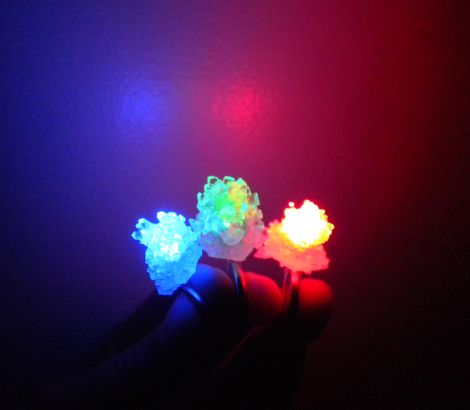
Instead of using the flickering incandescent lightbulb that came with the blinking pumpkin, [jethomson] decided to rebuild a blinking circuit around a 74HC14 Hex inverting Schmitt trigger IC. The chip was used as a relaxation oscillator by adding a resistor and cap from the input to the ground. After a bit of component selection and some calculation, he had a red and blue LED blinking at 2,6,9, and 15 Hz.

The result is a seemingly random pattern of light that looks like a ghostly blue after image of the handheld Jack-o’-lantern. While it may not be one of the most complex builds for the 74xx competition, it gets points in our book for originality.

Although [jethomson] says his camera doesn’t pick up his project very well, he did post a video of the Jack-o’-Lantern in action. Check it out after the break.

Continue reading “Halloween Hacks: Flickering Jack-o’-lantern”

Hackers Age 14-18 Can Compete To Put Their Project Into Space

If you’re between the ages of 14 and 18, or have a child who is, here’s a chance to put a project into space. NASA is partnering with YouTube, Lenovo, and a few other entities for a contest that challenges participants to dream up low-gravity experiments. You can enter as an individual or in teams of up to three people, and may put forth up to three experiment ideas for judging. Getting in on the first round is as easy as recording and uploading a video. You’ll need to state a scientific question or principle you want to test, a hypothesis of what can be learned, and a method for testing it.

As with most of the projects we encounter, the seminal idea is always the toughest part. And since the folks here at Hackaday are too old to enter, we thought we’d propose throwing around some ideas in the comments to get the ball rolling (the contest FAQ says it’s okay to get help from others so we’re not ruining it for everyone). We’ll go first.

It looks like experiments can be Biology or Physics related, and can’t use hazardous chemicals, weapons, or anything sharp. We’d love to see some tests that measure how well electronic sensors work in the microgravity. For instance, can you use a gyroscope sensor reliably in micro-gravity? What about an electronic compass; does it always point toward earth? What about robotic propulsion? We’d love to see a minature ROV swimming through the air like a water-bourne vessel would on earth.

Your turn. Leave a comment to let us know what you’d do if you could enter. Oh, and we’ve also embedded the contest promo video after the break.

Continue reading “Hackers Age 14-18 Can Compete To Put Their Project Into Space”

Candied LEDs Are A Light, Tasty Treat

rock_candy_diffused_leds

[Emily Daniels] recently snagged a free iPad in the Instructables “Play with your food challenge” with an interesting way to work with LEDs. Growing up, most kids attempted to make, or at least have seen rock candy be produced. [Emily] thought it would be interesting to mix LEDs with the stuff to see what she could come up with, and her candied LEDs are the result.

The process is pretty straightforward, and involves mixing up a batch of supersaturated sugar syrup in which LEDs are suspended. The LEDs act as a nucleation point for the crystal formation, growing a nice solid coating of sugar after a couple weeks’ time. After some cleaning up, the LEDs can be connected to a coin cell battery or similar, as you would normally do. The sugar acts as a diffusing medium for the LEDs, giving them a nice soft beam pattern.

Obviously you likely wouldn’t want to use these for any long-term electronics project, but it’s a fun activity for the kids, and it could be a good way to incorporate electronics into baked goods.

Win A Laser Cutter By Playing With Light

Buildlounge and Full Spectrum Laser have decided to give away a laser cutter to whoever comes up with the best project involving light.

The contest is in part sponsored by  adafruit industries. The focus of the contest is light – just design something around light, submit it, and you’re in the drawing for your own laser cutter. A solar oven, photophone, solar fiber-optic lighting and hacking apart an old overhead projector are suggested on the contest page, but the winning project will probably be much cooler.

Entries are due by January 1st. First prize is Full Spectrum Laser’s 40 Watt laser cutter, second is an awesome green laser pointer from Wicked Lasers, and third prize is an EL wire starter kit from Adafruit. Entries are due by January 1st, so we expect to see a lot of awesome submissions on the Hack A Day tip line between now and New Years.

Hackerspace Competition Combines Drinking And Lock Picking – Need We Say More?

rumble_challenge_lockpicking_contest

The guys from Bloomington’s Fraternal Order of Lock Sport (FOOLS) sure know how to throw a party! At this year’s DerbyCon event down in Louisville, the group put on an awesome event that combined lockpicking and drinking – what could be better?

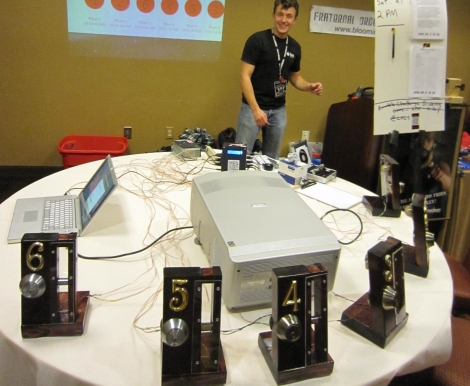
The Rumble Challenge is lock picking game where six people compete head to head for the best time. Whenever a competitor masters his lock, the competition is paused so that each player has a chance to take a shot from their air-powered shot dispensing machine. Once everyone has imbibed, the next round starts with the competitors picking up where they left off, in an effort to be the next to successfully open his lock.

The game is controlled by an Arduino, which both times the competition and senses when the locks have been opened. The Arduino relays this data to a computer, which uses a projector to display the contestant’s scores on a big screen. As an added bonus, FOOLS member [dosman] added loud rumble motors to the locking mechanisms in order to throw competitors off their game.

The contest sounds like a ton of fun – we’re bummed that we missed it. If you want to see how the game was put together, check out [dosman’s] build log over at the Bloominglabs wiki.