Kickstarter Incurs The Wrath Of Arduino Creator

[Massimo], one of the creators of the Arduino, is a little perturbed over what passes for the truth over on Kickstarter.

While [Massimo] does recognize that Kickstarter can be a force of good launching garage-designed projects into the hands of willing consumers, he noticed something was a little fishy with the recent smARtDUINO kickstarter (notice the capital letters, by the way). Right near the top of the smARtDUINO’s kickstarter page is the phrase, “For years we manufactured the ARDUINO in Italy. Now we created a new Open System: modular, scalable, the world’s cheapest and smallest!”

Being at the top of the Arduino organization, you’d think [Massimo] would have heard of these former Arduino manufacturers. The name didn’t ring a bell to him, so he called up the factory. No one at the factory had heard of them, and after a long search it was finally revealed the head of the smARtDUINO project hired two factory workers who worked for a supplier the official Arduino manufacturer uses.

[Massimo] makes the comparison of, “if he hires two factory workers from Ford he can claim he used to manufacture Ford cars.” We’re thinking that’s a little generous. It’s more like hiring two people who used to restock the vending machines in a Foxconn plant and claiming you used to build Apple computers.

With a simple trademark infringement on his hands, [Massimo] contacted Kickstarter to see what could be done. Kickstarter replied:

Thanks for writing in and bringing this to our attention. This is a matter that must be taken up directly with the project creator. You can contact them by clicking “Contact me” on the project page.
Best,
Kickstarter

For [Massimo], and us, that’s just not a sufficient answer. We’re thinking Kickstarter has an obligation to vet their projects and make sure the creators of these projects are who they say they are.

But enough about what we think. What do you, the Hackaday reader, think about this situation?
Bora Board Teaches Binary Hardware

If you’re just starting out in your quest to build really cool electronic devices, you’ll find a ton of options ready for the beginner. The Arduino makes toggling pins dead simple, and the Raspi brings the wonders of blinking a LED from the command line down from the gods and into the hands of the common man. These are all software platforms, though, and if you want to learn digital logic with hardware the best option is still a drawer full of 7400-series logic chips.

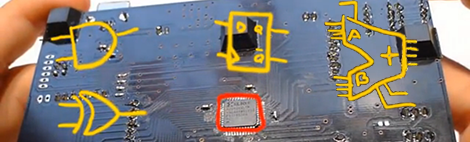
[Colin O’Flynn] hopes to change this with a beginners board for digital logic hardware design. It’s called the BORA, or Binary explORer boArd, and brings digital logic to a convenient package that is far less frustrating than a breadboard full of logic chips.

The BORA is based around a CPLD – a cousin of the FPGA-powered devices we see from time to time – that allows any student of digital logic to program the device and fill macrocells with NANDs, NORs, and ANDs.

The Xilinx device used in the BORA has about 1600 gates that can be programmed; more than enough to complete all the projects in the online lectures [Colin] has put together. You can check out the documentation for the BORA over on the official site, and the demo video after the break.

Continue reading “Bora Board Teaches Binary Hardware” →

Tiny OLED Oscilloscope Gets A Fancy Case

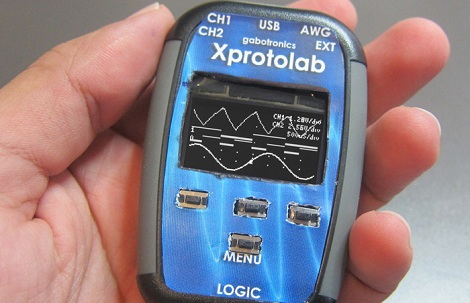
[Gabriel Anzziani] has just unleashed a newer, more convenient version of his Xprotolab portable oscilloscope, logic analyzer, and function generator. It’s up on Kickstarter, and the price is actually very nice for a tool of this caliber.

We first saw the Xprotolab early last year and ran into [Gabriel] at this year’s World Maker Faire in New York. On both occasions we were impressed with the size and capability of this very, very small OLED-display oscilloscope and general breadboarding Swiss army knife.

The Xprotolab features a two-channel, 200 kHz oscilloscope, 8-input logic analyzer, and an arbitrary waveform generator that should be good enough for all your breadboarding adventures. On top of that, the Xprotolab can sniff SPI, I2C, and UART protocols, and even has a small spectrum analyzer tucked away in a device small enough to lose in your pocket.

The updated-for-Kickstarter Xprotolab features an enclosure with a LiPo battery good for 12 hours of use per charge. Sure, it’s not a bench full of old HP and Tektronix gear, but for the budding maker, this seems like a very useful tool indeed.

FreeSoC, For When You Need 68 I/O Pins

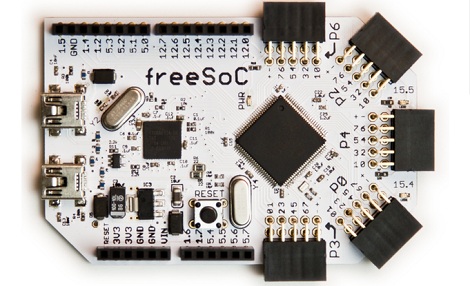
Like many of us, [Jon] began his journey through the magical world of microcontrollers with an Arduino. For a beginner, the Arduino is a wonderful tool, but [Jon] quickly found himself limited by the platform. There are too few pins on the Arduino, and and the platform doesn’t really lend itself to extremely complex projects. To this end, [Jon] designed freeSoC, an Arduino-compatible platform based on the Cypress Semiconductor PSoC 5.

The Cypress PSoC 5 is an extremely capable microcontroller with 60 general purpose I/O pins and 8 special purpose, high current outputs. Every pin on [Jon]’s freeSoC is completely configurable; if you want 24 SPI ports and a dozen 20-bit ADCs, just launch Cypress’ design software and configure the chip graphically. With this many I/O ports, the PSoC 5 is as useful as an FPGA, without all the hassle of actually being and FPGA.

A really neat feature of the freeSoC is its ability to be programmed graphically. Using Cypress’ PSoC Creator IDE, the multitude of I/O pins can be configured to just about anything very easily. Because the PSoC 5 is based on an ARM Cortex-M3, programming the freeSoC is as easy as any one of many ARM dev boards that were recently released.

[Jon] came up with a very, very neat project here, and it’s something we can definitely see the utility of.

Thanks [Dale] for sending this one in.

Massively Parallel Computer Costs $99

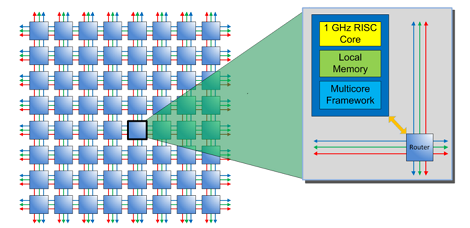
Even though dual, quad, and octo-core CPUs have been around for a while, it’s a far cry from truly massive parallel computing platforms. The chip manufacturer Adapteva is looking to put dozens of CPUs in a small package with their Parallella project. As a bonus, they’re looking for funding on Kickstarter, and plan to open source their 16 and 64-core CPUs after funding is complete.

The Parallella computer is based on the ARM architecture, and will be able to run Ubuntu with 1 Gig of RAM, a dual-core ARM A9 CPU, Ethernet, USB, and HDMI output. What makes the Parallella special is it’s Epiphany Multicore Accelerator – a coprocessor containing up to 64 parallel cores.

Adapteva is turning to Kickstarter for their Parallella computer to get the funding to take their Epiphany multicore daughterboard and shrink it down into a single chip. Once that’s complete, Adapteva will start shipping an ARM-powered Linux supercomputer that’s about the size of a credit card, or a Raspberry Pi under the new system of dev board measurements.

With any luck, the Parallella multicore computer will be available for $99, much less than a comparable x86 multicore computer. It’ll certainly be interesting to see what the Parallella can do in the future.

Kickstarter Isn’t A Store Anymore

Over the past few months, we’ve seen an increasing amount of Kickstarter projects making it into the Hackaday tip line. We don’t mind all these emails from people trying to get their Kickstarter project off the ground, but reading through all the emails of people wanting us to pitch their stuff does get a little bothersome.

It looks like our problem of having to go through dozens of Kickstarter hardware projects a week is about to change. Kickstarter is implementing a few new rules for hardware and product design projects. The new rules prohibit product simulations. This means project creators can’t suggest what the product might do in the future. Only what the prototype can currently do is allowed in the Kickstarter project. Also, product renders aren’t allowed. The only pictures allowed on your Kickstarter project are photos as the prototype currently exists.

There’s also another catch for hardware and product design projects: offering multiple quantities of a reward are prohibited. Of course there’s a provision for things that only make sense as a set (building blocks, for instance), but it looks like funding an Arduino-compatible ATtiny85 board and getting multiple boards is out of the question now.

Of course Kickstarter is looking at the long-term, trying to dissuade project creators from taking the money and running off to South America. We’re wondering what the effect will be in the coming months, though; under these rules Ouya wouldn’t have passed Kickstarter’s litmus test, and smaller projects depending on Kickstarter funding for tooling and molds probably wouldn’t either.

The new changes are probably for the best, and will certainly speed up how long it takes us to go through our email. We’re wondering what HaD readers think of the change, so post your thoughts in the comments after the break.

Galago, The Latest In A Series Of Awesome ARM Boards

Long time Hackaday reader [Kuy] sent in a project he’s been working on for the last year and a half. It’s called Galago, and it wraps up all the features we’d like to see in the current crop of ARM microcontroller dev boards into one neat package.

The Galago features an AMR Cortex-M3 microcontroller running at72 MHz. Included on its pinout are 25 digital IO pins, 6 analog input pins, 10 PWM pins, and an I2C and SPI port.

The Galago isn’t simply an exercise in hardware development, though. [Kuy] spent a great deal of time writing proper libraries for his board, allowing you to get started with the Galago very quickly without having to rely on crippled tools.

A proper library isn’t Galago’s only significant developer feature: [Kuy] went as far as to create a browser-based IDE (no Internet connection required, thankfully) that has the ability to upload code directly to the board via a USB cable. Add in a hardware debugger, and the Galago might just be the perfect ARM board for tinkerers weaning themselves off the Arduino.

[Kuy] has released the Galago on a Kickstarter, with a single board costing $25. It’s a cool device, and something we’d really like to come to market.