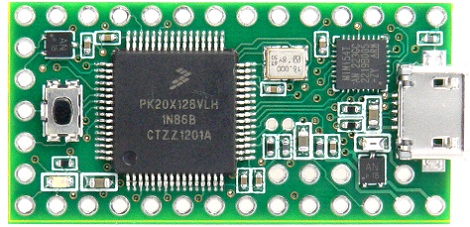
Meet The Teensy 3.0

[Paul Stoffregen], the brains behind the popular and very capable Arduino-compatible Teensy development board, has offered his contribution to the explosion of ARM-powered boards with the Teensy 3.0.

The original Teensy is an AVR-based development board that goes far beyond the official Arduino offerings. The new and improved Teensy 3.0 improves upon an already wonderful platform with a 32 bit ARM Cortex-M4 microcontroller running at 48 MHz. There’s also a lot of pins available for whatever project you have in mind: the Teensy 3.0 supports 14 analog inputs, 10 PWM outputs, a USB host mode, and an I2S audio interface that will be very useful when accessing the microcontroller’s DSP functions.

There are a couple neat features on the Teensy 3.0 [Paul] somehow managed to work in. In addition to supporting a real-time clock, there are also a few extra IO pins in the middle of the board. [Paul] says the extra pins are due to Kinetis not releasing a 48 pin version of the microcontroller in time for production. It may not be what [Paul] originally had in mind, but we’ll take the upgraded board just the same.

Of course the Teensy 3.0 will be compatible with the Teensyduino Arduino IDE add-on, so if you’d like to run your Arduino sketches on a very powerful piece of hardware, this will be the board to use.


RC Plane Made Specifically For UAVs

We’ve seen our fair share of remote-controlled planes turned into UAVs and FPV platforms, but the Techpod is the first airplane we’ve seen specifically designed to be used as a camera-equipped robotic airplane.

The Techpod is the brainchild of [Wayne Garris]. He has been flying camera-equipped FPV airplanes for a while now, but recently realized the current offerings of remote control planes didn’t match his needs. [Wayne] decided to design his own plane specifically designed with a pan/tilt camera mount in the nose.

[Wayne]’s prototype was designed with some very fancy aeronautical design software packages and milled out of foam. From the videos after the break, we can see the Techpod flies beautifully, but needs the Kickstarter community to bring his model to the masses.

The specs for the Techpod put it up there with other high-performances FPV and UAV models; with its 102 inch (2590 mm) wingspan and a pair of batteries wired in parallel, the Techpod can stay aloft transmitting video for up to one hour.

Video of the plane in action after the break.

Continue reading “RC Plane Made Specifically For UAVs” →

There’s Trouble Brewin’ On The ‘ol Kickstarter Site

This Kickstarter campaign, the AmbioLight, brings RGB LED strips to the masses. The only problem is that some of the backers discovered this RGB LED strip is already on the market. Internet denizens are now frothing at the mouth, complaining the designers of the AmbioLight, “haven’t designed anything,” and are, “just reselling parts which [AmbioLight] put together at a higher cost than other products on the market.”

A few backers of the AmbioLight have found what they think to be the original product, an RGB LED strip produced by ELCO Lighting. Comparing the picture of the ‘ballast’ on the AmbioLight Kickstarter to the ELCO controller raises even more suspicions about how involved the AmbioLight team was involved in the design of their product.

Even if the AmbioLight is simply a repackaging of an already existing product, that doesn’t make it against the rules of Kickstarter. I’ve even contributed to Kickstarter campaigns just to get a difficult-to-source component. Still, given the vitriol of the AmbioLight’s comments page, Kickstarter contributors don’t seem to appreciate taking an already available product and reselling it as your own.

What say you, Hackaday reader? Is it right for the AmbioLight team to do this?

EDIT: Kickstarter suspended the funding of AmbioLight a few hours after this was posted.

Turn Signals On Your Head

Several weeks ago, I was in Culver City L.A., and happened to find a hackerspace nearby. It was a pleasant coincidence that the night I chose to randomly show up, was their public meeting which focused more on projects people were doing. The place was packed, I was barely able to squeeze in the door and actually stood outside for part of the meeting, just listening to people talk about what they’re making.

One of the projects I did get to see was this bike helmet built by [Naim]. At first I was amused at the idea, but the idea of putting lights and an accelerometer on a helmet wasn’t that groundbreaking. But as [Naim] kept talking, he caught my attention. For one thing, the one he was showing at the hackerspace seemed to have some built in correction for natural head movement. In this video he does look around a bit without false positives. At the hackerspace he explained the way he monitors the motion to avoid natural movements causing the lights to initialize.

The part I was really interested in was his power. He spent tons of time reducing the power consumption on the base arduino. I believe the number he used was 10 years of standby without causing the battery to vent or die. If you pick up the helmet at any point during that time period, it automatically turns itself on based on the accelerometer’s motion. While the bike helmet itself was a fairly cute idea, I was really trying to get him to send me the information on how he’s saving power. I believe he had to cut the traces to the arduino’s native power management. Hopefully we’ll still hear from him on the details.

Teensy Tiny Arduino Board With An ATtiny85

Planning another Arduino build? If you’re just doing something simple like switching a relay or powering a LED, you might want to think about the Digispark. It’s a very small ATtiny-based Arduino compatible board developed and Kickstarted by [Erik].

The Digispark is based on the very popular Atmel ATtiny85, an 8 pin microcontroller that provides a quarter of the Flash storage and RAM as the ‘official Arduino’ ATMega328p. The lower storage space and RAM doesn’t mean the ’85 is a slouch, though; it can run Arduino code without a hitch, providing six pins for whatever small project you have in mind.

Right now, [Erik]’s Kickstarter is offering three Digisparks for the price of a single Arduino. At that price, it’s cheap enough to leave in a project and not be repurposed after the build is over. [Erik] is also working on a few shields for the Digispark – only RGB LED shield for now, but hopefully he’ll get some more finished by the time the Kickstarter ends.

TangiBot And The Perils Of Open Source Hardware

I’ve commented before on the terrible inefficiency and artificially high expense of the current crop of 3D printers. It simply doesn’t make sense to produce the plastic parts of 3D printer kits on a printer farm when there are literally thousands of Chinese injection molding companies that will make those parts cheaper. It looks like [Matt Strong] heeded my call and now has a Makerbot Replicator clone up on Kickstarter that costs $700 less than the official version. We assume the Makerbot lawyers are having a busy morning.

From the info on the Kickstarter page, [Matt] is used parts from his Makerbot Replicator to design a one-to-one copy. Every part and component on [Matt]’s TangiBot is 100% compatible – and seemingly 100% identical – with the Makerbot Replicator. Like the Replicator, [Matt] is offering a dual extruder version that allows you to print in two colors.

At the bottom of the Kickstarter page, under a section titled, “How is 3DTangible able to make a Replicator Clone?,” you’ll see [Matt]’s reasoning for cloning the MakerBot replicator. He says everything is open source, and, “MakerBot used other open source designs when designing and producing their 3D Printers.” We’ll agree that MakerBot used existing extruder designs (and improved upon them), but MakerBot was not this blatant in borrowing from the RepRap project.

For want of editorializing, I’ve complained about the stupid inefficiency of manufacturing 3D printers with 3D printers before. It was only a matter of time before someone realized current manufacturing techniques can be used to make 3D printers cheaper. [Matt] – dude – you were supposed to clone a RepRap. Makerbot has done some really incredible things for the community such as building Thingiverse and generally being an awesome cheerleader for the 3D printing community. Taking the flagship Makerbot printer and making it cheaper will not make [Matt] any friends on the Internet, but at least the laws of economics are coming to the world of 3D printers.

Thanks [Brad] for sending this in.

[Hacker Dojo] Renovations Kickstarter

hacker-dojo

The [Hacker Dojo], as you might have suspected, is a California based hacker space that would like your money to help with renovations. Sure, there is nothing wrong with a little dust on the ground, but half of this space was apparently deemed unfit to use for it’s member hackers. For this purpose, they are running a Kickstarter campaign to raise $250,000 for renovations. If this seems a little steep to you, keep in mind that this looks like a pretty massive space by most standards, and land prices aren’t exactly cheap in that area.

If you’re not that generous, (Who can resist the sad faces around 0:35 in the video on their Kickstarter?) they are also offering some sweet prizes. Unfortunately, the original Super Pong Machine signed by creator Al Alcorn is already sold, but for only $2 you can have their eternal gratitude! For something a bit more tangible, they have stickers for $8, shirts for $32, and other prizes up to $10,000 for the most expensive of them, “creative input” on a mural.