Build Your Own Lightweight Flash Tripod

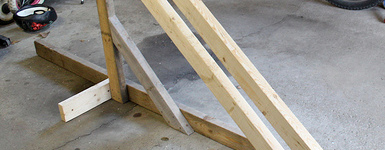
[Peter Karlsson] is a commercial photographer who wanted some ultralight, portable supports for multiple flashes. What he came up with meets those goals; measuring 16 inches long when folded and weighing just 14 ounces. They set up just like a tent because they’re made from tent poles. Like the portable habitats, the tripods have bungee cords running through each section which holds them rigid but allows them to fold for transport. This is a great sister project to the flash synchronizer from yesterday. See the demo and the building instructions after the break.

Continue reading “Build Your Own Lightweight Flash Tripod”

Smart Flash Synchronization

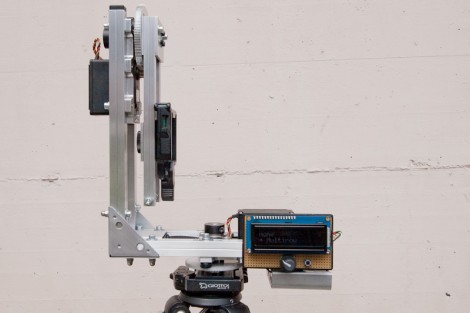
[Max] designed this circuit to add smart flash synchronization to his photography arsenal. He did this because ‘dumb’ TTL based flashes won’t play nicely with more sophisticated systems like the Nikon Advanced Wireless Lighting. By building a microcontroller into the mechanism, he’s added functionality for several different scenarios, ensuring that he’ll never again have problems with early flash triggering. Now that the kinks have been ironed out in the prototype, the code and hardware can be migrated over to whatever microcontroller suits you.

DoomBox: Classic Keys Meet Tiny Screen

The doomBox is a dedicated gaming rig for lovers of ID Software’s classic title. [JJ] built this from an old Kodak DC290 camera that had a broken lens. Since this runs the Digita OS, he was able to use the Doom port that already exists. But the camera’s factory buttons were not well suited as controls. By whipping up his own button board, and using the traditional keyboard keys for the button caps, he achieved a much more comfortable (yet squint-inducing) gaming experience. The finished project resides in an all-too-familiar black project box. See him fire it up after the break.

The original Doom for Digita OS pages seem to be down so here’s an alternate if you’re interested.

Update: Looks like the original website is back up.

Continue reading “DoomBox: Classic Keys Meet Tiny Screen”

High Speed Video From Cheap Digital Camera

Some researchers from Oxford University have come up with a way to produce high-speed video from a one mega-pixel camera. They’re calling the method Temporal Pixel Multiplexing. This method adds a digital micromirror device in line with the camera lens. These chips house over a million mirrors and can be found in home theater projectors. By placing one in front of the digital camera, a longer exposure can be used while the DMD redirects the light. This way, one high-resolution image actually contains multiple frames of lower-resolution video. The video is still decent quality and, at a far lower cost than common high-speed video equipment, this is a worthwhile trade off.

[Thanks Andrew via NewScientist]

Microscope Lens Hack

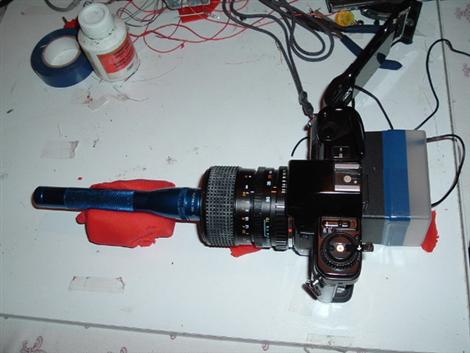
Who doesn’t need to take pictures of the microscopic bits inside of an integrated circuit? [Mojobojo] made an end-run around the expensive equipment by building a microscopic lens from an old camcorder. He’s using a regular digital camera with the lens set to its largest zoom level. The camera is pointed into the salvaged camcorder lens where the fine tuning is done. His first iteration was just taped to the desk with a small hand flashlight illuminating the subject. He upgraded that setup by building a LEGO enclosure and changing to a much brighter light source. The images he’s getting are quite surprising and this will be very useful during those extreme hacks when you need to tap into an IC’s internal data rails.

[Thanks Julius]

HMD Upgrade

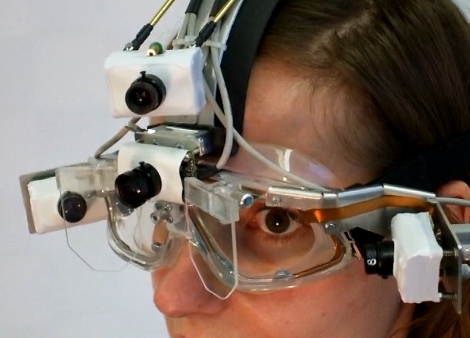
[Banfield Design] has put together this instructable on how to upgrade or re build a head mounted display to be more immersive and add features.  Though you can already buy glasses style viewers for your media devices, they can use some upgrades. For one, you have to supply your own sound, and putting headphones on, over bulky glasses can be painful on your ears. Another area that could use improvement is the light that comes in around the glasses. The current trend is to make them as small as possible, but that tends to let your peripheral vision see the outside world. [Banfield design] wanted to make them more immersive, so he built them into some ski goggles. This not only helped block the light, but allowed for an over the ear style headphone assembly which is much easier on the ears.

A functional improvement came next, by adding a webcam front and center. He could now switch between a live feed of his environment and whatever other inputs he wanted. This could be really fun with some augmented reality. He has a list of future improvements, but he doesn’t mention adding a second camera for stereoscopic viewing of his surroundings. Why would you do that? because it would make augmented reality much cooler.

Precision Erector Set Connects Multiple Cameras

[youtube=http://www.youtube.com/watch?v=nIWGKowjuIo]

Check out the exoskeleton that [Curt von Badinski] built for filming driving scenes. This extremely configurable wrap-around frame resembles a children’s toy from the past but allows an almost unlimited set of configurations. Five cameras simultaneous capture the driving scene. The current setup is used to shoot the television show 24.

[Thanks Robert]