Holy Robin Trap Batman!

[Matt Meerian] introduced us to his kludge of cardboard, tape, mirrors, and electronics in the form of a clever non lethal robin trap. Whenever a pesky robin would enter the box, a sensor is triggered, the solenoid drops a lid, and the bird is contained (and we assume taken far away after that).

Of course the plan backfired; we wont spoil what happened, but you can click the link above to find out.

Related: Arduino Mouse Trap

Houses To Go From Leftover Scraps

[Derek Diedricksen] builds nomadic houses from left over building materials. Some are large enough to haul behind a vehicle or, in the case of the one above, small enough to tote around like a wheelbarrow. We love them because not only do they reuse material that might commonly hit the landfill, but they look good. Check out the first couple of episodes from the Yellow House series after the break. Then take some inspiration from [Derek’s] success and see if you don’t already have enough in your junk pile to get started.


Continue reading “Houses To Go From Leftover Scraps”

Mushroom Terrarium Automation

[youtube=http://www.youtube.com/watch?v=wexdNx_StRc]

Like many specialty plants, growing mushrooms requires that you keep a fine balance between humidity and temperature. this can be fairly tedious at times, so many opt for automated systems. [Anthony_p1234] has chosen to build his own.  Using an Arduino, he controls power to two heating pads, a sonic humidifier, and an air pump to keep his mushrooms happy. He shares the process of building the system, testing and calibrating the parts and putting it all in use. We didn’t see any schematics, but he does describe everything fairly well. The source code is available for download.

Mr. Burns Prevents Sun Burns

[nmcclana] wrote out this very detailed instructible on building Mr. Burns, a sun burn alarm.  Enter your skin type, sunscreen type, and UV levels for the day and Mr. Burns will let you know when it is time to go seek shelter or re-apply that sunscreen. Built on a Propeller platform, he’s using a blue LED as the UV sensor. He mentions that the device is fairly accurate, however people tend to put sunscreen on too thin and that will throw off the readings. There is a video of it in action on the instructible.

Recharging AC With Propane

[youtube=http://www.youtube.com/watch?v=v2vN_mxW4Bc]

As the summer heats up an air conditioning system is a necessity in many climates. [Grayson’s] system suffered some damage over the winter that caused it to vent its refrigerant, avoiding an explosive situation. Before he can chill out inside he’ll need to recharge it and he’s chosen to use propane in his cooling system. According to our friend Google this is not his original idea, but has been done many times before. [Grayson] makes the point that although propane is flammable it’s not necessarily any more dangerous in a fire than Chlorodiflouromethane, or R22, which is the nasty little gas that fled his system for its new home in the upper atmosphere.

The video above includes a brief explanation of recharging the system and the tools needed. We’d need to mill this over for quite a while before working up the gumption to give it a try. For now we’ll stick to [Grayson’s] more pedestrian hacks like making some servo motors sing or easing our yard work woes.

Furniture Bots, Transform

This mechanized table automatically expands from seating for six to seating for twelve. We tried to capture the action with the three images above but don’t miss the transforming goodness in the video after the break. Alas, we’ll never see something like this in real life because it resides on a yacht worthy of Robin Leach’s attention. We wouldn’t have a problem copying the geometry of the tabletop pieces, but there’s got to be some serious design work to pull off the structure controlling the movement. No solid price is listed, but the creators note that construction costs are in the tens-of-thousands of British Pounds. We’ll stick to our Ikea furniture hacks for now.

Continue reading “Furniture Bots, Transform”

SPRIME Controlled AC Outlets

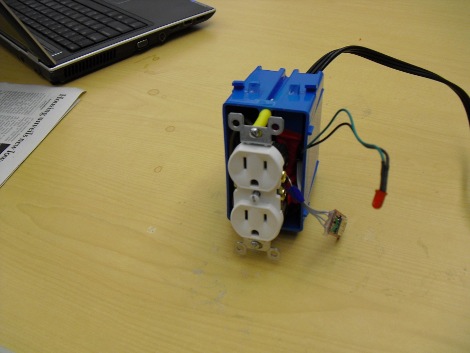
Reader [Tim Upthegrove] sent in a novel take on powering and monitoring AC outlets and devices called SPRIME, or Simple Powerline Remote Interactive Monitor and Enforcer. Compared to previous hacks, such as 120v switching or Quick cheap remote outlets, that only turned an outlet on or off; SPRIME allows not only control over outlets via the internet, but also power usage of devices currently plugged in.

We really liked their idea of giving power companies access to SPRIME outlets to reduce power consumption during peak hours, but sadly we don’t see it being implemented in homes any time soon. Catch a video of SPRIME after the rift.

[Thanks Chris McClanahan and Jeff Starker for the project, and deyjavont for pointing out our silly mistakes]

Continue reading “SPRIME Controlled AC Outlets”