Quick And Easy Personal Evaporative Cooler

This quick and easy evaporative cooler might be just the thing the next time the air conditioning goes on the fritz. [Stephen] saw an eBay listing for a personal air conditioner that used a moist sponge and fan to send some cool relief your way. But he wanted to run his own test to see if it really did anything before laying down the cash.

The idea is to run air past a moisture source. Some of the heat energy in the air is reduced through evaporation resulting in the exhaust air feeling a bit cooler. It’s the same concept used in swamp coolers (an evaporative type of air conditioning). To build his device [Stephen] grabbed a refrigerator deodorizer which uses a hinged plastic cage to hold a packet of baking soda. He attached a small PC fan to the cage, then inserted a damp sponge. This is so easy to put together you could hit the dollar store on your lunch break and have some relief for the second half of the work day.

If you’re looking for a technique that cools just a bit better consider leveraging a beer fridge as a personal cooler.

Continue reading “Quick And Easy Personal Evaporative Cooler”

An Umbrella Stand That Tells You The Weather Forecast

This project takes an umbrella stand and gives it the ability to let you know if you need to take an umbrella when you leave the house. The image above is a concept drawing, but a first prototype was built and seems to work quite well. See for yourself in the video after the break.

The project was put together by openPicus. They sell a prototyping module called the Flyport which provides a WiFi connection to your projects. This board connects to a set of LEDs which are used to illuminate the translucent plastic umbrella stand. But you might not notice the color change if the LEDs were always on. Also designed into the system is a PIR motion sensor. When you walk toward the door to leave for the day it switches on the appropriate color — green for clear, blue for raining, and red for storming — catching your attention in time to grab an umbrella as you pass by.

You don’t need to spend a bundle to pull off a hack like this. You can scavenge for a PIR sensor, use one color of LEDs just to tell you when rain or storms are forecast, and an ENC28J60 is a cheap and easy Ethernet alternative to using WiFi.

Continue reading “An Umbrella Stand That Tells You The Weather Forecast”

[Lou’s] Haircut Really Sucks

Ah yes, at some point a brilliant inventor combined the electric trimmer with a vacuum cleaner and the art of cutting hair was never the same again. [Lou] is showing us how to give a haircut that really sucks up the waste. And he did it using rubbish he had lying around.

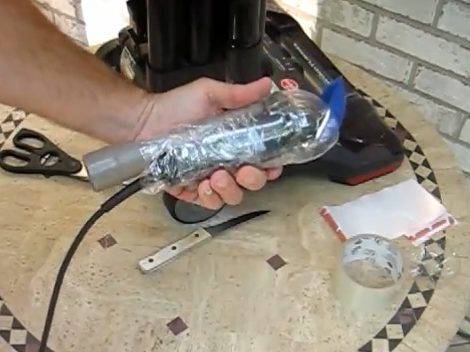
Most people will recognize this as a DIY version of the Flowbee. Not surprisingly, you can still buy one of those if you want, but [Lou] is looking for a vacuum cutter for trimming his dog’s hair so he’s not about to shell out cash for it. He already has the trimmer, and just needed a way to attach the vacuum hose to it. In the image above you can see the grey crevice attachment for his vacuum. He taped it onto the trimmers, then cut a plastic soda bottle to use as a hood near the business end of the trimmer. It’s all wrapped in packing tape to hold everything in place and seal around the joints. You can see it in action in the clip after the break.

Continue reading “[Lou’s] Haircut Really Sucks”

Prosthetic Foot And Ankle Have Amazingly Natural Movement

The natural movement and functional power of the ankle and foot during a step , while appearing fairly simple, are amazingly difficult to replicate with a prosthetic. Usually it requires a fast and fairly powerful motor to provide the forward push and then whip that foot up as we pull our leg forward. However, recent projects have managed to do some amazing jobs at achieving this difficult task. Belgium’s Vrije Universiteit Brussel has released the video (below the break) of the “AMP-Foot 2.0” that pulls this off very well.

The main idea behind the AMP-Foot 2.0 is to have the actuator work longer with a lower power rating while the produced energy is stored in elastic elements and released when needed for propulsion. The device is designed to provide 100% of push-off for a 75 kg subject walking at normal cadence on ground level.

[via Engadget]

Continue reading “Prosthetic Foot And Ankle Have Amazingly Natural Movement”

OLPC Tablet Distribution Proves Concepts Laid Out In ‘The Diamond Age’

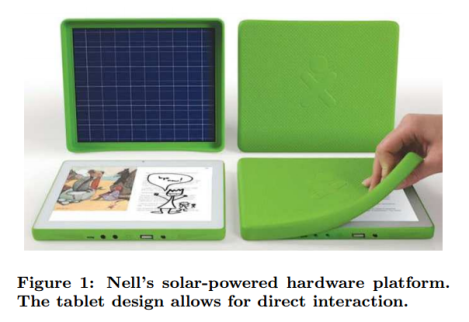
We don’t remember hearing about the One Laptop Per Child initiative distributing tablet computers but apparently a couple of shipments were distributed to rural communities in Ethiopia. The problem one might think of in this scenario is that the literacy rate in the two test villages was basically zero. But that’s exactly the population targeted with thr technology. The tablets were loaded with a software package called Nell. It was designed to guide a child in self learning by telling them engaging stories that include teachable moments. If you check out the white paper (PDF) you’ll find it’s pretty much the exact same teaching technique that [Neal Stephenson] wrote about in his book The Diamond Age. But keep reading that paper and you’ll see that this is because the researchers took their inspiration from that very novel.

Well the results are in and apparently [Neal] knows exactly what he is talking about. Not only did the children learn from the software, but within five months they were hacking the device (which runs Android) to get the disabled camera working.

[Thanks Alexander via Dvice]

Hacking Facebook To Remove The Social Value Facade

We see [Ben Grosser’s] point that all the metrics found on the Facebook user interface make the experience somewhat of a game to see if you can better your high score. He thinks this detracts from the mission of having social interactions that themselves have a value. So he set out to remove the ‘scores’ from all Facebook pages with a project he calls the Facebook Demetricator.

You can see two UI blocks above. The upper offering is what a normal user will see. The lower is the page seen through the lens of the Demetricator. [Ben’s] feels it doesn’t matter how many people like something or share something, but only that you are genuinely interested in it. With the numbers removed you’re unlikely to follow the herd mentality of only clicking through to things that are liked by a huge number of people. He explains this himself in the clip after the break.

The Demetricator works much like the Reddit Enhancement Suite. It’s a browser add-on for Chrome, Firefox, and Safari that selectively strips out the metrics as the page renders.

Tripod Mount Anything!

webcam-mounted

[Shawn] wrote in to tell us about his extremely simple method he used for mounting a webcam on a tripod. His article explains it better, but the basic premise is to glue a 1/4 – 20 nut onto the bottom of it. The hack-worthiness of this could be in question, but the technique could come in handy at some point.

After seeing this tip, I was reminded of a slightly crazier, if effective mount that I made for my state of the art Env2 phone. Referenced in a links post in March, it was made of a 2×4 with a 1/2 inch slot milled in it.  After some thought, it was drilled and tapped for a 1/4 – 20 bolt in the other side to mount it on a tripod. So this could be an option in very limited circumstances.

On the other hand, if you want something a bit more hack-worthy, why not check out this motorized camera rig that we featured in July. Sure, it’s more complicated than gluing a nut onto a webcam, but at least it still uses 2 x 4s in it’s mounting hardware!