100,000 Lumen Chandelier Is Like Having The Sun A Few Feet Above Your Head

[Michail] doesn’t mess around when it comes to lighting. He built this 100,000 Lumen chandelier to make sure his office is bright during the dreary months. The thought is that it will provide the health benefits of long sunny day. It has been hanging for about a year now, and he slowly came to the realization that it’s several times too bright for indoor use.

We know where he’s coming from though. When it’s dark at 5 pm we want it to be plenty bright inside. He started with an incandescent bulb, then moved through compact fluorescent and halogen bulbs before deciding to undertake the build. What you see above are 150W Metal Halide lamps.  There is some danger to using these without an enclosure. They do emit some UV light and they can explode. So whenever you buy a fixture that uses them there’s a sheet of filtering safety glass sealing up the enclosed sockets. [Michail] decided not to bother with this safety feature, instead depending on the benefits of an electronic ballast. He says these reduce the chances of an explosion sending scorching hot glass shrapnel your way.

As we mentioned earlier, his conclusion is that just one of these bulbs is enough to illuminate his small office.

How To Watch Your Own Videos On A Plane: Barf Bag

Air travellers take note, [Asthmaticatom] figured out how to comfortably watch your own videos on the plane. We know you always have your phone with you, now you just need to find a barf bag. A little bit of papercraft turns the waste disposal device into a neat little hanging dock.

The bag in the image above is actually upside down. A rectangle the same size as your phone’s screen is ripped out of the top. The metal clasp used to seal the top of the bag is rolled up to hold the phone securely in place. The bottom of the sack has a flap which acts as a one-way catch. When it is shoved into the crevice on top of the monitor it holds the whole thing in place.

Of course we don’t remember ever having been on a plane where there was a monitor in the seat in front of us, but perhaps we’re just buying tickets on the wrong airlines.

[via Reddit]

Janus: The Gatekeeper

janus-001

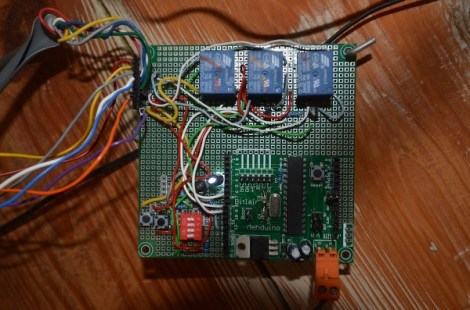
[Piet] wrote in to tell us about his hack that allows for his front gate to be opened without a key. Unlike this hack that we featured in August, you don’t need a subway pass, just a good memory. As explained in his article (and the video after the break) if the proper sequence of doorbell rings is input, the gate unlocks itself.

For hardware a [mehduino] is used to take the doorbell input and decide whether or not the “secret knock” has been achieved. The door can be unlocked remotely via a button on the processor. Reprogramming the code is achieved by simply holding the program button while the code is entered on the “remote ringer” button.

Be sure to check out the video after the break to see this lock in action. The housing application may not be exactly what you expect. Also of interest, is that in true hacker fashion, the bare processor is hanging by a hook on his wall! Continue reading “Janus: The Gatekeeper”

Zelda Engagement Ring Box Seals The Deal

Congratulations to [John Scancella] and his wife to be. Their recent engagement was aided by one of [John’s] projects. Since [Betsy] is a big fan of Zelda, he thought it would be fun to present the ring with the Zelda music playing in the background. He and a friend combined forces to build what you seen in this image.

The music is played by an Arduino with the help of a wave shield. This is pretty much a one-use item so battery life was never a concern. A magnetic switch was used to detect when the box was opened and start the music playing.

You can see the full-sized images after the break, but we can tell that [John] went with a traditional engagement ring. We’re still waiting to see if 3D printed rings are going to catch on in the geek scene. If you just can’t give her anything but precious metal there’s always the idea of encoding messages on the band itself.

Continue reading “Zelda Engagement Ring Box Seals The Deal”

Personal Energy Orb Prevents Your Life From Being Swallowed By The Internets

We love the Internet, but we are definitely guilty of losing track of the time we spend traipsing around our virtual haunts. This project will not only remind you to get out and exercise, it will cripple your digital experience if you don’t heed its colorful warning.

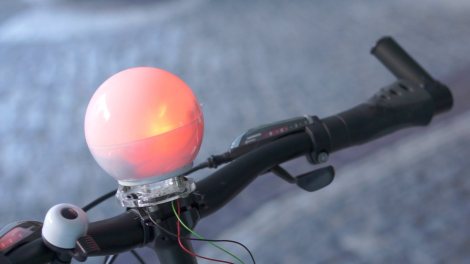
[Janko Hofmann] calls it the Personal Energy Orb. It’s really just an Arduino and an RGB LED. But as with most creations, the idea is what makes it great. The orb has a dock next to your computer. It tracks how much time you spend online, changing colors as you rack up the hours. If you don’t heed the warning signs of overuse it will even start to slow down your mouse cursor. But never fear. Full functionality can be restored by topping off your personal energy. As you can see above, there’s also a docking station on [Janko’s] bicycle. The orb monitors your mileage, moving out of the red zone so that your computer will be unencumbered the next time you sit down for a long session of flash games. Don’t miss his video presentation embedded after the break.

Continue reading “Personal Energy Orb Prevents Your Life From Being Swallowed By The Internets”

3D Printed Exoskeleton Helps This Little Girl Develop More Normal Body Function

This 2-year-old girl has a condition called arthrogryposis which causes her not to be able to move her arms. But with a little help, her muscles can be strengthened to achieve more normal use of her limbs. This is not the first time that an exoskeleton has been used, but the advent of 3D printed parts makes the skeleton work much better.

Previous exoskeletons were made of metal and were quite heavy. When you’re talking about a 25 pound child every extra ounce counts. Moving to plastic parts lightened the load. Now the structure can be mounted on her torso, using rubber bands to aid her movement until her muscles are strong enough to do it on their own.

Of course to [Emma] this isn’t an exoskeleton. It’s her set of magic arms.

Continue reading “3D Printed Exoskeleton Helps This Little Girl Develop More Normal Body Function”

Sip-and-Puff Ipod Dock Highlights Assistive Technology

Check it out, a Sip-and-Puff Arduino shield. This is an assistive technology that allows the physically challenged to control things using a plastic air tube. Different combinations of sucking (Sip) or blowing (Puff) differentiate between control commands.

In this case the device is used to control an iPod dock, but [Bob Johnson’s] Kickstarter project seeks to put the Sip-and-Puff functionality out there so that it can bridge the control gap no matter what the need. One example that he mentions in the video after the break is a Morse Code keyboard.

This shield uses a pressure sensor to receive input from the plastic tubing. But we’ve also seen it done using mechanical pressure switches. That technique is what was used in the Sip-and-Puff Kayak build.

Continue reading “Sip-and-Puff Ipod Dock Highlights Assistive Technology”