An Easy Home Made Electroadhesive

There was a time when if you wanted to scale a wall you had to turn a camera on its side and call [Adam West] or [Lionel Ritchie]. Unless you were a gecko, that is. Their host of tiny bristles and intramolecular forces allow them to run up walls and across the ceiling with ease.

You may have seen synthetic gecko-like adhesive surfaces using the same effect. Some impressive wall-climbing robots have used these materials, though they’ve all shared the same problem. Gecko adhesion can’t be turned off. Happily, for the robot wall climber unwilling to expend the extra force to detach a foot there is an alternative approach. Electroadhesives use electrostatic force to attach a plate held at a high potential to a surface, and today’s featured video is [Carter Hurd]’s home-made electroadhesive panel (YouTube).

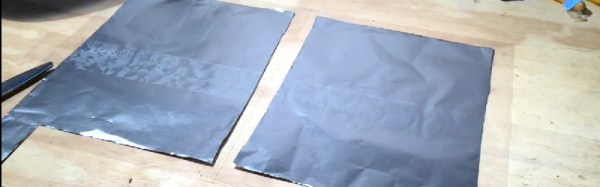
He cites this paper and this description of the technology as the influences on his design, two aluminium foil electrodes sandwiched between plastic sheet and sticky tape. He applies 6kV from an Emco DC to DC converter to his plates, and as if by magic it sticks to his drywall. Of course, it’s not quite as simple as that, he tried several surfaces before finding the one it stuck to. Adhesion is fully under control, and such a simple device performs surprisingly well. The Emco converters are sadly not cheap, but they are an extremely efficient product for which he only needs a few AA cells on the low voltage side.

His full description is in the video below the break.

Continue reading “An Easy Home Made Electroadhesive”

Peculiar Fluid Dynamics Creates Hot And Cold Air

We’re fascinated by things with no moving parts or active components that work simply by virtue of the shape they contain — think waveguides and resonators for microwave radiation. A similarly mystical device from the pneumatics world is the Hilsch Vortex Tube, and [This Old Tony] decided to explore its mysteries by whipping up a DIY version in his shop.

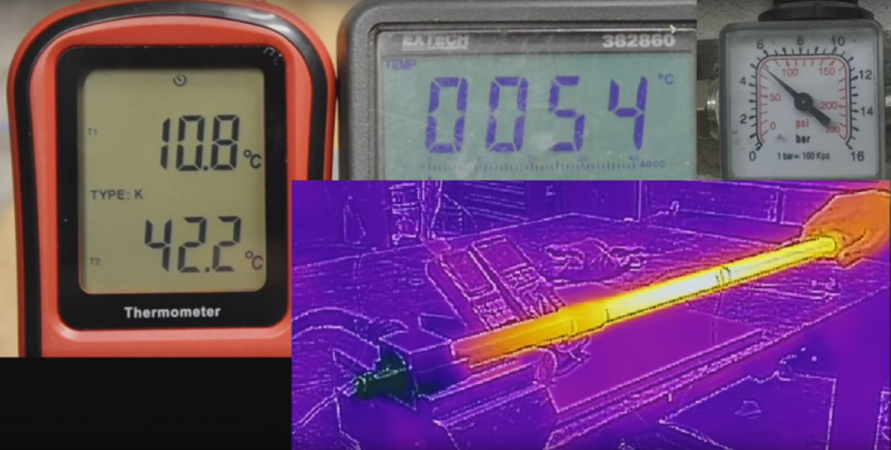
Invented in the 1930s, vortex tubes are really just hollow tubes with an offset swirl chamber. Incoming compressed air accelerates in the swirl chamber and heads up the periphery of the long end of the tube, gaining energy until it hits a conical nozzle. Some of the outer vortex escapes as hot air, while the rest reflects off the nozzle and heads back down the pipe as a second vortex inside the outer one. The inner vortex loses energy and escapes from the short end as a blast of cold air – down to -50°C in some cases. [Tony]’s build doesn’t quite approach that performance, but he does manage to prove the principle while getting a few good-natured jabs into fellow vloggers [AvE] and [Abom79].

We’ve covered vortex tubes before, but as usual [Tony]’s build shines because he machines everything himself, and because he tries to understand what’s making it work. The FLIR images and the great video quality are a bonus, too.

Continue reading “Peculiar Fluid Dynamics Creates Hot And Cold Air”

Two Words That Don’t Mean What You Think They Do

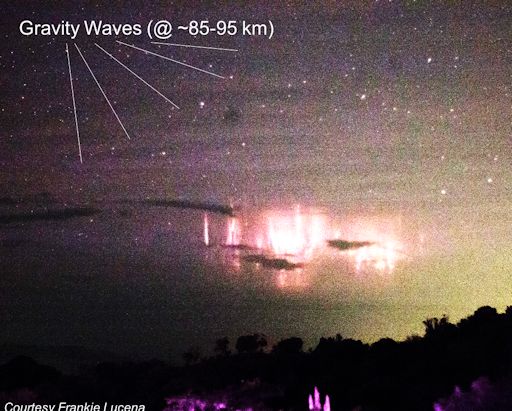
sprites_enhanced_stripWhen you hear “gravity waves” or “sprites”, you’d think you would know what is being discussed. After all, those ripples in space-time that Einstein predicted would emanate from twin, colliding, black holes were recently observed to much fanfare. And who doesn’t love early 8-bit computer animations? So when we were browsing over at SpaceWeather we were shocked to find that we were wrong twice, in one photo (on the right). Continue reading “Two Words That Don’t Mean What You Think They Do”

NASA Knows Where The Meteors Are

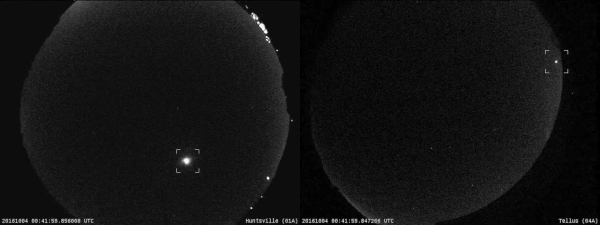
NASA has been tracking bright meteoroids (“fireballs”) using a distributed network of video cameras pointed upwards. And while we usually think of NASA in the context of multi-bazillion dollar rocket ships, but this operation is clearly shoe-string. This is a hack worthy of Hackaday.

droppedimage

The basic idea is that with many wide-angle video cameras capturing the night sky, and a little bit of image processing, identifying meteoroids in the night sky should be fairly easy. When enough cameras capture the same meteoroid, one can use triangulation to back out the path of the meteoroid in 3D, estimate its mass, and more. It’s surprising how many there are to see on any given night.

You can watch the videos of a meteoroid event from any camera, watch the cameras live, and even download the meteoroid’s orbital parameters. We’re bookmarking this website for the next big meteor shower.

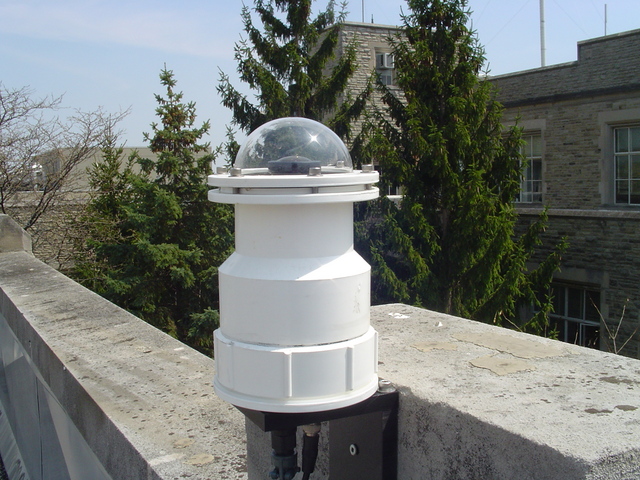
cameraThe work is apparently based on [Rob Weryk]’s ASGARD system, for which the code is unfortunately unavailable. But it shouldn’t be all that hard to hack something together with a single-board computer, camera, and OpenCV. NASA’s project is limited to the US so far, but we wonder how much more data could be collected with a network of cameras all over the globe. So which ones of you are going to take up our challenge? Build your own version and let us know about it!

Between this project and the Radio Meteor Zoo, we’re surprised at how much public information there is out there about the rocky balls of fire that rain down on us every night, and will eventually be responsible for our extinction. At least we can be sure we’ll get it on film.

Feel Better About Yourself With These Ugly Repairs

A fun thread over at the EEVblog forum starts off with [TerraHertz]’s triangle-peg, square-hole capacitor repair job and goes entertainingly down-hill from there.

Everything from horrifying eBay purchases to work (horror) stories can be found in this thread. But you can learn something too. Did you know the correct way to fix a mercury switch stored in the incorrect orientation is to whack it against a table really hard?

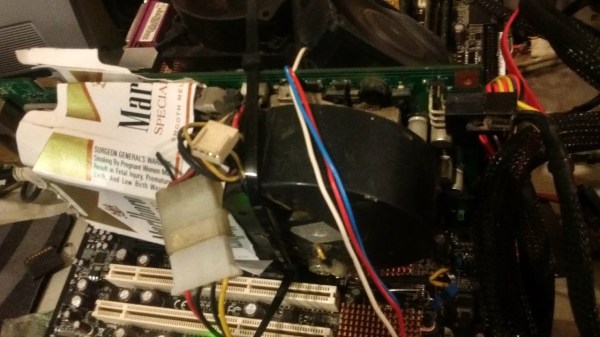
We enjoyed the cigarette box shroud used to fix a graphics card with a defective fan. We’re still not sure about the person who managed to Dremel bits off a graphics card and end up with a working PCI-e card. That one may be a troll.

Regardless, it’s a lot of fun, spanning the hilariously bad and the seriously impressive. We would not be surprised if some of these people met the devil at the crossroads for some soldering skill. Do any of you have an interesting or ugly repair to share? We’d love to see it.

Never Twice The Same Color: Why NTSC Is So Weird

Ever wonder why analog TV in North America is so weird from a technical standpoint? [standupmaths] did, so he did a little poking into the history of the universally hated NTSC standard for color television and the result is not only an explanation for how American TV standards came to be, but also a lesson in how engineers sometimes have to make inelegant design compromises.

Before we get into a huge NTSC versus PAL fracas in the comments, as a resident of the US we’ll stipulate that our analog color television standards were lousy. But as [standupmaths] explores in some depth, there’s a method to the madness. His chief gripe centers around the National Television System Committee’s decision to use a frame rate of 29.97 fps rather than the more sensible (for the 60 Hz AC power grid) 30 fps. We’ll leave the details to the video below, but suffice it to say that like many design decisions, this one had to do with keeping multiple constituencies happy. Or at least equally miserable. In the end [standupmaths] makes it easy to see why the least worst decision was to derate the refresh speed slightly from 30 fps.

Given the constraints they were working with, that fact that NTSC works as well as it does is pretty impressive, and quite an epic hack. And apparently inspiring, too; we’ve seen quite a few analog TV posts here lately, like using an SDR to transit PAL signals or NTSC from a microcontroller.

Continue reading “Never Twice The Same Color: Why NTSC Is So Weird”