‘Duinos And VR Environments

At the Atmel booth at Maker Faire, they were showing off a few very cool bits and baubles. We’ve got a post on the WiFi shield in the works, but the most impressive person at the booth was [Quin]. He has a company, he’s already shipping products, and he has a few projects already in the works. What were you doing at 13?

[Quin]’s Qduino Mini is your basic Arduino compatible board with a LiPo charging circuit. There’s also a ‘fuel gauge’ of sorts for the battery. The project will be hitting Kickstarter sometime next month, and we’ll probably put that up in a links post.

Oh, [Quin] was also rocking some awesome kicks at the Faire. Atmel, I’m trying to give you money for these shoes, but you’re not taking it.

[Sophie] had a really cool installation at the faire, and notably something that was first featured on hackaday.io. Basically, it’s a virtually reality Segway, built with an Oculus, Leap Motion, a Wobbleboard, an Android that allows you to cruise on everyone’s favorite barely-cool balancing scooter through a virtual landscape.

This project was a collaboration between [Sophie], [Takafumi Ide], [Adelle Lin], and [Martha Hipley]. The virtual landscape was built in Unity, displayed on the Oculus, controlled with an accelerometer on a phone, and has input with a Leap Motion. There are destructible and interactable things in the environment that can be pushed around with the Leap Motion, and with the helmet-mounted fans, you can feel the wind in your hair as you cruise over the landscape on your hovering Segway-like vehicle. This is really one of the best VR projects we’ve ever seen.


Starting To Wrap Up Maker Faire

It’s almost a week since the NYC Maker Faire, and it’s about time for us to start wrapping up all the posts we’re doing on everything we’ve seen.

DSC_0216[Chris Mitchell], hackaday favorite from Cemetech did what he always does at Maker Faire: brought some stuff he’s doing with TI graphing calculators.
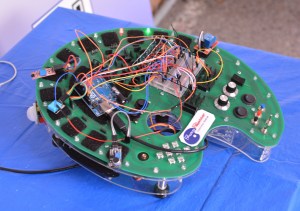
The TI-84 with GPS made a showing, as did the graphing calculator IRC client. By far the coolest looking calculator was the wooden casemod. It’s a TI-82 put into a (what feels and looks like) a maple enclosure. The buttons are painted on, and despite stuffing consumer electronics into a handmade case, it’s still reasonable portable.

DSC_0201There were more Hackaday fans at the faire, but I’m not sure if anyone can beat the guys from Protopalette. Wait. One guy could. Find me in public sometime and I’ll tell you about that.
The Protopalette is a board with a bunch of lights, buttons, switches, sensors, knobs, servos, and buzzers for electronics prototyping. Think of it as a stylized version of the old ‘parts and springs and wire’ radio shack beginner electronic kits.

DSC_0160

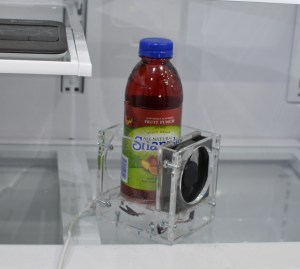
Some of the members of the hackerspace with the craziest group narrative, LVL1 in Louisville, made it to the faire. They’re working with GE to create a ‘maker module’ for appliances. It’s called Green Bean, and GE is actually building support for this into some of their fridges, washers, stoves and dishwashers.

There are a few modules already, like a scale that will send out a message when you’re out of milk. It’s an interesting system, and there are already a lot of appliances that support the system.

Pics below.

Continue reading “Starting To Wrap Up Maker Faire”

Choreographed Iron Dust Dances To The Beat

Up on the second level of World Maker Faire’s main hall, one could hear Technotronic’s hit “Pump up the Jam” playing again and again. We were expecting breakdancing robots, but upon investigating, what we found was something even better. [David Durlach] was showing off his Choreographed Iron Dust, a 9 x 9 grid of magnets covered in iron filings. The filings swayed and danced to the beat of the music, at times appearing more like ferrofluid than a dry material. Two LED lights shined on the filings from an oblique angle. This added even more drama to the effect as the light played on the dancing spikes and ridges.

While chatting with [David] he told us that this wasn’t a new hack. Choreographed Iron Dust made its debut at the Boston Museum of Science back in 1989. Suddenly the 80’s music made more sense! The dust’s basic control system hasn’t changed very much since the 1980’s. The magnets are actually a stack of permanent and electromagnets. The permanent magnet provides enough force to hold the filings in place. The electromagnets are switched on to make the filings actually dance.

Since it was designed in 1989, there were no Arduinos available. This project is powered by the most hacker friendly interface of the era: the PC’s parallel port. As one might imagine, [David] has been having a hard time finding PC’s equipped with parallel ports these last few years.

[David] wasn’t just showing off iron dust. Having spent so much time painstakingly animating the iron filings for various customers, he knew there had to be a better way. He’s come up with ChoreoV, a system which can take recorded video, live performances, or even capture a section of a user’s screen. The captured data can then be translated directly into light or motion on an art piece.

The Abovemarine

Over the course of a few weeks, [Adam] trained his betta fish, [Jose], to jump out of the water to snatch food off his finger. An impressive display for a fish, but being able to train his small aquatic friend got [Adam] thinking. What’s stopping [Jose] from interacting his environment even more? The abovemarine was born.

The abovemarine is a robotic platform specifically built for [Jose]’s aquarium. Below, three omni wheels drive the entire aquarium in any direction. A computer running OpenCV, a webcam, and a few motors directs the abovemarine in whatever direction [Jose] wants to go. Yes, it’s a vehicle for a fish, and that’s awesome.

[Adam] put a lot of work into the creation of the abovemarine, and was eventually able to teach [Jose] how to control his new home. In the videos below, you can see [Jose] roaming the studio and rolling towards the prospect of food.

Because [Jose] is a Siamese fighting fish and extremely territorial when he sees other males of his species, this brings up the idea of a version of Battlebots with several abovemarines. They’re in different tanks, so we don’t know what PETA would think of that, but we do expect it to show up in the Hackaday tip line eventually.

Continue reading “The Abovemarine”

Homemade E-Cigarette Vaporizer

Extensive research shows that tobacco kills. This is common knowledge as of late, which has prompted a flurry of anti-smoking ads to flood in. Regular smokers are now reconsidering their smoking patterns and are looking at healthier alternatives. Among those options are electronic cigarettes that vaporize flavorful liquid into smooth drags of smoke.

Prices for these devices can range anywhere from $40 to $240, which can be quite expensive for those on a budget. So instead of buying one, [MrRedBeard] decided to create his own DIY electronic cigarette contraption out of an Altoids can.

The approximate cost (not including batteries) is about $12. This covers the 5 Amp adjustable voltage regulator and the 500 ohm potentiometer that is best used for a rig like this. The wattage is what drives the heat giving it a more consistent vapor stream of cloud smoke.

For more e-cigarette hacks, check out these ones powered by an NES controller and this vaporizer that can send smells…in space!

Continue reading “Homemade E-Cigarette Vaporizer”

The Reason Dead Batteries Bounce

For the last few years, very well-informed people have been able to tell if an alkaline battery is good or not simply by dropping them. When dropped from an inch or two above a hard surface, a good battery won’t bounce, and will sometimes land standing up. A dead battery, on the other hand, will bounce. Thanks to [Lee] and a few of his friends, we now know why this happens.

While hanging out with a few of his buddies, [Lee] was able to condense all the arguments on why dead batteries bounce to two theories. The first theory, the ‘bounce theory’ said dead batteries had an increase in outgassing in the battery, increasing the pressure in the battery, which increases the spring constant of the battery itself. The second theory, the ‘anti-bounce theory’, said the gel-like properties of the electrolyte worked as a sort of mass damper.

[Lee] designed an experiment to test the outgassing ‘bounce theory’ of bouncing batteries. Instead of dropping a battery, an object – in this case a brass slug – was dropped onto both good and bad batteries. There was no difference. Even after holes were drilled to vent any gasses inside the battery, the brass slug bounced off both good and bad batteries the same way.

This means the reason dead alkaline batteries bounce is due to the electrolyte. [Lee] cut open a few AA cells and found the electrolyte in a good battery was a mushy mess of chemicals. In the dead battery, this same electrolyte hardened into a solid mass. [Lee] compares this to an anti-bounce hammer.

Finally, more than a year after most of us learned about bouncing dead batteries thanks to [Dave Jones]’ video, we have an answer. It’s a chemical change in the electrolyte that turns it from a goo to a solid that makes dead batteries bounce.

Continue reading “The Reason Dead Batteries Bounce”

Radioshack Phone Dialer – Red Box

i thought i’d start out with this hack while we’re in beta, since it was one of the first ones that really got me interested in the way phones worked and how many consumer electronics can be used for new and educational things. a “red box” was a device that would simulate coins being dropped in to a pay-phone, hence free phone calls for many people until the phone systems changed. the most popular device to modify was a radioshack tone dialer, a simple solder of a 6.5536 mhz crystal was all it took and you could “drop” 5, 10 and 25 cents at a time to make calls.

Continue reading “Radioshack Phone Dialer – Red Box”