An Even More Useless Machine

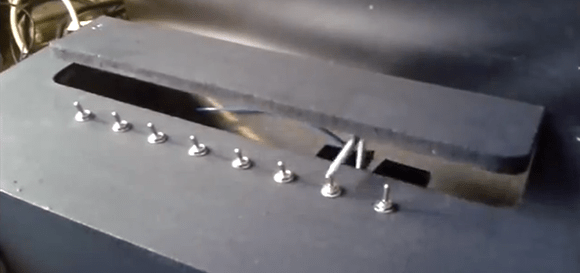
Here’s the most useless machine we’ve seen so far. It comes from the workshop of [forn4x] and happily turns itself off whenever any one of its eight switches are flicked to the on position.

The build began when [forn]’s Canon 850i printer gave up the ghost because of a broken print head. All the other electronics and mechanics were still salvageable, so it was decided to turn this printer into something a little more useless.

The printer used a regular DC motor with an optical encoder to move the print head. [forn] easily found the schematics for this optical sensor, because of the TTL output was able to read out the position of the slider. The rest of the build is an ATMega8, a servo, and an octet of toggle switches. [forn] has been able to get the accuracy of the servo-controlled arm down to about 0.1 mm, more than enough to accurately turn all its switches off.

You can see [forn]’s most useless machine in action after the break.

Continue reading “An Even More Useless Machine”

Building A Tornado In A Bottle

vortex-tornado-machine

Recreate the look of a tornado by building this water vortex art piece. The components that go into it are all very simple and can be found in your recycling bin with the exception of a motor and a way to drive it. The hard part is going to be getting to the point where you don’t have any leaks.

[Ixisuprflyixi] went with an empty salsa bottle to house the vortex. It’s a pleasant shape for the project since it’s both tall and narrow and it’s got a bit of a sexy curve to it. The base of the machine is a plastic bottle which looks like it might have been for Metamucil, but we’re not sure.  The important part is that it needs to be made from HDPE, as a portion of the container will be used to make the impeller. That’s the part that attaches to the motor shaft inside of the container. Give it a spin and you’ve got yourself a tornado in a bottle. See it in action after the jump.

This is a much quicker and easier version than the one we saw [Ben Krasnow] build. He ended up doing some repair work on the gasket that seals the motor shaft. It’s an interesting read if you are thinking of building one of these yourself.

Continue reading “Building A Tornado In A Bottle”

Modifying An EEG Headset For Lucid Dreaming

moddedmindwave4

[Michael], [Tom], and a few other people on the Lucid Scribe Database project have been using off-the-shelf EEG equipment to invoke lucid dreaming. Yes, that’s where you take control of your dreams and become a god. This requires wearing an EEG setup while you sleep, and these products aren’t very comfortable sleeping wear. [Tom] decided to take apart a NeuroSky MindWave and turn it into something comfortable to wear all night.

The folks at the Lucid Scribe Database log their dreams with consumer-level EEG equipment, usually something made by NeuroSky. The NeuroSky MindWave is the smallest and cheapest EEG headset available, but it’s still a hard plastic device not conducive to sleeping.

[Tom] removed all the guts and electronic goodies out of his MindWave and attached them to an elastic headband. The MindWave has two sensors – a forehead and ear lobe sensor. For the forehead sensor, [Tom] simply soldered a piece of wire to a penny and attached it to the elastic. The ear lobe sensor in the stock MindWave is a simple clip that was kept in the stock configuration for [Tom]’s mod.

Now that [Tom] has a much more comfortable EEG setup, he can get on with improving his lucid dreaming skills and even try communicating via Morse from inside a dream.

Comprehensive Home PCB Fabrication Tutorial

home-pcb-fabrication

From what we’ve seen we’d say [Jianyi Liu] is really good at etching PCBs at home. Now you can learn from his experience. He just published a mammoth guide to fabricating your own PCBs at home. That link goes to his index page which leads to all eight parts of the guide.

He starts off by mentioning that fab house boards are rather inexpensive these days. This will save you a lot of trouble (like acquiring the equipment and raw materials needed to get up and running) but you can’t beat the turnaround time of doing it yourself.

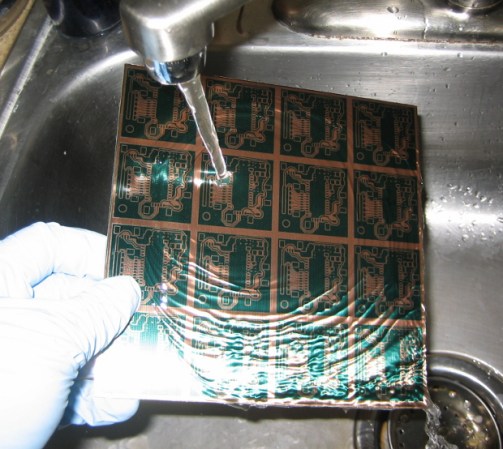
After discussing the particulars about trace width, copper thickness, and a few design considerations he lays out his board and prints the artwork to a sheet of transparency film. A pre-sensitized board is cut to size before a trip through an exposure rig with the film taped onto it. The image above shows him rinsing the board after applying the developer chemical. From here he uses cupric chloride he mixed himself to etch the board. [Jianyi] recommends populating the components before cutting the panel apart — a task which he accomplishes with a hack saw.

Months Of Failure Lead Up To This EL Panel Dimmer That Pulses To The Music

el-panel-dimmer

Way back in March [Ch00f] took on a for-hire project to make a suit that lights up to the music. He decided to build something based around a pulsating EL panel. He’s put a lot of time and tried of a few different techniques, but he finally has a working EL panel dimmer.

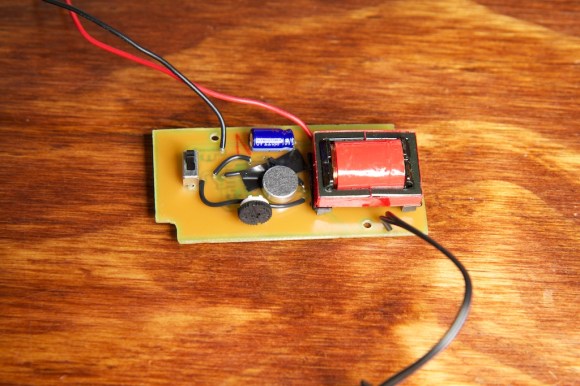
This is a saga we’ve kept our eye on. The fall seems to have been good to him, after a failure using TRIACS he managed to adjust the brightness of some EL wire by messing with the current going to the driver’s oscillator. Standing on the shoulders of that success he designed the board seen above by getting serious about audio signal processing. There’s a microphone on the board which picks up sound which is then processed into a signal responsible for the brightness of the EL panel.

There’s a demo video after the break, but you’ll want to dig into his article to get all the gritty details.

Continue reading “Months Of Failure Lead Up To This EL Panel Dimmer That Pulses To The Music”

244 9 Volt Batteries In Series – Arcing Ensues!

244-9v-batte…n-series

Here’s another hack that we would definitely discourage you from trying at home, 244 9 volt batteries wired in series. There’s really not much more to it than that, but [jersagfast] takes this setup through its paces arcing through air first, a LED light second, and then a CD. The air arc is probably the most impressive, but a CD doesn’t look happy after this kind of abuse either. Around 4:38, a capacitor is abused for yet more arcing.

In theory, 244 9 volt batteries in series should be nearly 2200 volts, but as measured (in sections), it “only” came out to a “measly” 2000 volts. Still plenty of voltage to be harmful or even deadly depending on the current emitted. Passing on this hack at home is strongly encouraged. On the other hand, you should watch the video after the break to see what happens. Much safer. Arcing starts around 1:44!

Continue reading “244 9 Volt Batteries In Series – Arcing Ensues!”

Beautiful Tube Amp Uses A TV Tube

tube-amp-i

Most audio tube amps we see use common tubes – usually a 12AX7 for the preamp and one of the more common power tubes such as an EL34.[Daniel], on the other hand, decided to build his own audio tube amp with a 13EM7, a tube originally used for a television’s vertical oscillator. The resulting project is a wonderful stereo amp that sounds really good, to boot.

[Daniel] picked up the idea of using a 13EM7 tube from [Fred Nachbaur]’s MiniBlok SET amplifier. This very tiny 1-watt tube amplifier uses a single tube originally designed for use in old, old televisions. The secret behind this build is the fact this tube is actually two triodes in one package; one side of the 13ME7 has tons of gain but not much power, making it perfect for a preamp. The other side has a lot of power, useful for delivering two watts of power into a speaker.

After [Daniel] etched a few boards for his amp, he milled out a piece of wood for the chassis. When everything was mounted he had an awesome looking stereo amplifier that also sounds great.