Automated Turret Gives You The Upper Hand In Office Warfare

TI-office-turret

When your co-workers get on your nerves, the mature recourse is to be the bigger person and simply ignore the obnoxious individual. A team of engineers from TI show us a slightly alternative means of dealing with office mates which is not quite as mature, though far more entertaining.

The office toy cum mechanized weapons system relies on a TI MSP430 LaunchPad, coupled with a custom Turret430 breakout board. The former is the brains of the operation, while the latter houses motor drivers for the motorized turret. The system can be steered throughout its 300 degree range of rotation using an attached joystick, but in the interest of catching their target by surprise, they added an automated mode as well. The automated targeting system uses an attached webcam to pick out victims by the color of their clothing, which seems to work pretty well.

To see the system in action, check out the video embedded below.

Continue reading “Automated Turret Gives You The Upper Hand In Office Warfare”

Understanding Op-amps From Simple To Hard

[Tim] wanted to help out a ECE student struggling with some Op-Amp problems. He put together a video which does a good job of explaining what an Op-Amp does, then tackles each of the questions one at a time.

His analogy is illustrated in this image. There’s an operator using a crane to lift a crate. He is watching a ‘radio man’ in a window of the building to know how high it should be lifted. These roles are translated to the function of an Op-Amp in a way that makes understanding the common parts quite easy. The crane is the Op-Amp and the floor to which it is trying to lift the crate is the input pin. The current height of the crate is the output signal. The radio man is the feedback resistor which is trying to get the desired height and current height to equal each other. Watch the video after the break and all becomes clear.

After this analogy is explained [Tim] tackles the actual homework problems. He’s going through everything pretty quickly, and doesn’t actually give the answers. What he does is show how this — like most circuit solving problems — depends on how you group the components in order to simplify the questions. Grab a pen and paper and put on your electron theory hats to see if you can solve the questions for yourselves.

Continue reading “Understanding Op-amps From Simple To Hard”

Building The Most Offensive Video Game Ever

[youtube=http://www.youtube.com/watch?v=4pZ70teW678&w=470]

[Autuin] created the most offensive video game ever. Inside a small cocktail arcade cabinet, he installed his own video game that recreates the experiences of the Space Shuttle Challenger and her crew on their last flight.

The build started off by picking up an old cocktail version of Space Zap from The Hackery, a neat little recycling place that turns old computers, monitors, and even old arcade machines into something useful again. After [Autuin] lugged his arcade machine back to his home base at Free Geek Vancouver.

After drooling over the 30-year-old circuitry, [Autuin] disassembled the old machine and installed a mint condition 19″ VGA monitor where an ancient black and white CRT once resided. The control panels replete with their comically large buttons were refurbished and connected to an Arduino and the whole shebang hooked up to a slightly outdated computer.

The real magic happened when [Autuin] coded his game. He created a few sprites from NASA archival footage and made a game where a shuttle takes off and is controllable by each player. As the most offensive video game ever, the space shuttle blows up shortly after launch, declaring ‘game over’ for both players.

[Autuin] will be showing off his new arcade game with a new bezel and cabinet graphics during Vancouver’s Eastside Culture Crawl this November. The game will probably be updated by then; we suggested editing the ‘time to explosion’ to T+73 seconds, but [Autuin] said he’s thinking of ways to make it even more awful.

Excavate Your Basement Using RC Equipment

basement excavation

Although it could be debated as to whether or not this is a “hack,” since the equipment used is built for excavation, the scale of it seems deserving of a mention. In the linked article, [Joe] is quoted as saying, “the common misconception here is that the RC’s are not here to excavate my basement, but rather the basement excavation project is here for the RC’s.”  This could be a motto for most makers/hackers in that projects are frequently not done for the resulting product, but for the experience of making something your own.

According to [Joe], he excavates 2 – 3 cubic yards per year with his little RC vehicles.  Living in Canada as a rancher and farmer, he’s required to be near his home to feed his hungry animals even during the cold winter months. During this time, there can be very little to do. After sometimes working 16 hour days during the summer, he needed something to keep him occupied close to home. Be sure to check out the excavation video after the break, or check out the original article for even more pictures and video! Continue reading “Excavate Your Basement Using RC Equipment”

Only You Can Kick A Child’s Balls Into Space

We had a lot of fun with that title. Of course when you’re talking about launching a thousand ping pong balls into space there’s no end to the puns which can be made. But this is actually a fantastic initiative to get people of all ages excited about science and near-space experiments. [John Powell] offers school children the opportunity to send an experiment into space. He’s Kickstarting the next launch, which is scheduled to take place in September. This way each entrant can fly their project for free, then get the results and a certificate back once the weather-balloon-based hardware is recovered.

There is one size restriction for the program. Each experiment must fit inside of a ping pong ball. But you’ll be surprised what can be accomplished. [John] reports that the most simple, yet interesting project is to place a small marshmallow inside the ball. As it rises through the atmosphere it will grow to fill the entire ball, then be freeze-dried by the the extreme temperatures. Some are not so low-tech. There’s an image of a tiny PCB holding a DS1337 and some sensors. It’s an atmospheric data logger that will provide plenty of information to analyze upon its return.

[via Hacked Gadgets]

Know Thy Enemy: Open Vias In BGA Footprints

[Andrew Zonenberg] has crossed a line in his electronic hobby projects. The Ball Grid Array (BGA) is a type of chip footprint which most hobbyists leave to the professionals. But he’s learned the skills necessary to use them in his projects. Recently he ran a test batch to show off his soldering process and illustrate one of the errors a novice might make.

For those that are unfamiliar, the BGA footprint is notoriously difficult to accurately solder because it consists of a large grid of tiny points covering the bottom of the chip. There’s no way to get in there with an iron, so soldering depends on accurate placement of solder paste and chip, as well as a near-perfect reflow cycle. Often times it’s difficult for the professionals too. Many blame the heat-failure of Xbox 360 on the complications of the BGA connects for one of the console’s chips.

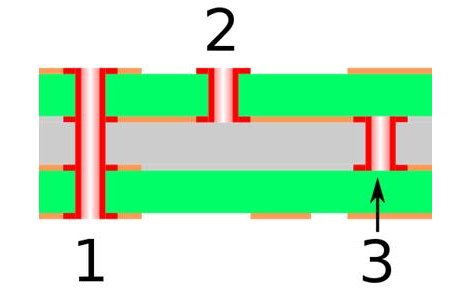
For this experiment [Andrew] wanted to show what happens if you include vias in the BGA footprint. It’s fine to do so, as long as they’re capped. But if a standard via is included, capillary action ends up pulling the solder down into the via instead of making a connection with the chip. The image above is a cross-section of one such uncapped via, seen on the far right.

[Thanks George]

Visualizing Heat With Schlieren Photography

[Kevin] wanted to check out the air patterns present when his 3D printer is in action. This is useful research; slight differences in temperature can affect the quality of his prints. Instead of something like a thermometer, [Kevin] decided to use Schlieren photography to visualize the air around his 3D printer.

If you’ve ever seen very old-school pictures of supersonic research, you’ve seen Schlieren photography. It’s a way of visualizing the density of transparent objects using only mirrors, lenses, and a point light source. The resulting pictures are usually black and white, although some amazing color pictures exist of bullets traveling through the air next to soap bubbles and candles.

The process of creating a Schlieren photograph is actually pretty easy. [Kevin] pointed a light at a used a 4-inch parabolic mirror placed behind his printer. A knife edge is placed at exactly twice the focal length of the mirror, and after putting a camera behind this knife edge, differences in the density of the air are visible.

From [Kevin]’s video of his Schlieren setup (available after the break), you can see the air is extremely turbulent around his print. That might have been obvious given the presence of a cooling fan, but it’s still very, very cool to look at.

Continue reading “Visualizing Heat With Schlieren Photography”