
FCC To Investigate Raised RF Noise Floor

If you stand outside on a clear night, can you see the Milky Way? If you live too close to a conurbation the chances are all you’ll see are a few of the brighter stars, the full picture is only seen by those who live in isolated places. The problem is light pollution, scattered light from street lighting and other sources hiding the stars.

The view of the Milky Way is a good analogy for the state of the radio spectrum. If you turn on a radio receiver and tune to a spot between stations, you’ll find a huge amount more noise in areas of human habitation than you will if you do the same thing in the middle of the countryside. The RF noise emitted by a significant amount of cheaper modern electronics is blanketing the airwaves and is in danger of rendering some frequencies unusable.

Can these logos really be trusted? By Moppet65535 (Own work) [CC BY-SA 3.0], via Wikimedia Commons
If you have ever designed a piece of electronics to comply with regulations for sale you might now point out that the requirements for RF interference imposed by codes from the FCC, CE mark etc. are very stringent, and therefore this should not be a significant problem. The unfortunate truth is though that a huge amount of equipment is finding its way into the hands of consumers which may bear an FCC logo or a CE mark but which has plainly had its bill-of-materials cost cut to the point at which its compliance with those rules is only notional. Next to the computer on which this is being written for example is a digital TV box from a well-known online retailer which has all the appropriate marks, but blankets tens of megahertz of spectrum with RF when it is in operation. It’s not faulty but badly designed, and if you pause to imagine hundreds or thousands of such devices across your city you may begin to see the scale of the problem.

This situation has prompted the FCC Technological Advisory Council to investigate any changes to the radio noise floor to determine the scale of the problem. To this end they have posted a public notice (PDF) in which they have invited interested parties to respond with any evidence they may have.

We hope that quantifying the scale of the RF noise problem will result in some action to reduce its ill-effects. It is also to be hoped though that the response will not be an ever-tighter set of regulations but greater enforcement of those that already exist. It has become too easy to make, import, or sell equipment made with scant regard to RF emissions, and simply making the requirements tougher for those designers who make the effort to comply will not change anything.

This is the first time we’ve raised the problem of the ever-rising radio noise floor here at Hackaday. We have covered a possible solution though, if stray RF is really getting to you perhaps you’d like to move to the National Radio Quiet Zone.

[via Southgate amateur radio news]

1000 CPUs On A Chip

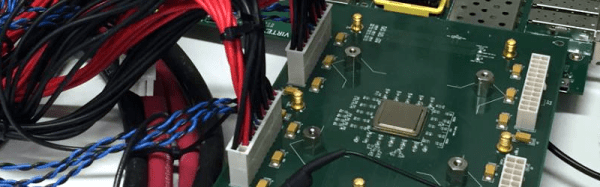
Often, CPUs that work together operate on SIMD (Single Instruction Multiple Data) or MISD (Multiple Instruction Single Data), part of Flynn’s taxonomy. For example, your video card probably has the ability to apply a single operation (an instruction) to lots of pixels simultaneously (multiple data). Researchers at the University of California–Davis recently constructed a single chip with 1,000 independently programmable processors onboard. The device is energy efficient and can compute up to 1.78 trillion instructions per second.

The KiloCore chip (not to be confused with the 2006 Rapport chip of the same name) has 621 million transistors and uses special techniques to be energy efficient, an important design feature when dealing with so many CPUs. Each processor operates at 1.78 GHz or less and can shut itself down when not needed. The team reports that even when computing 115 billion instructions per second, the device only consumes about 700 milliwatts.

Unlike some multicore designs that use a shared memory area to communicate between processors, the KiloCore allows processors to directly communicate. If you are just a diehard Arduino user, maybe you could scale up this design. Or, if you want to make use of the unused power in your video card under Linux, you can always try to bring KGPU up to date.

Graphene Optical Boom Emits Light With No Diode

When a supersonic aircraft goes faster than the speed of sound, it produces a shockwave or sonic boom. MIT researchers have found a similar optical effect in graphene that causes an optical boom and could provide a new way to convert electricity into light.

The light emission occurs due to two odd properties of graphene: first, light gets trapped on the surface of graphene, effectively slowing it down. In addition, electrons pass through at very high speeds. Interestingly, the speeds are nearly the same–that is, electrons and trapped light travel at almost the same speed. The researchers found a way to make the electrons move faster than the speed of light (in the graphene) and thus created Cerenkov emissions. Because of the structure of graphene, the resulting light is intense and tightly focused.

The researchers speculate that this technique could be important in building graphene-based optical chips. We’ve talked about mixed graphene and semiconductor chips before. Graphene is pretty exotic stuff. It can even fold itself.

Premier Farnell Sold To Swiss Firm

According to this article in the Guardian, Premier Farnell, the electronics parts distributor who is also a UK manufacturer of the Raspberry Pi, is going to be sold to Dätwyler. Their share price immediately rose 50%, closing at just under the Swiss firm’s offer price.

Farnell itself had been on a binge, according to Wikipedia anyway, buying up electronics distributorships in Poland, India, and the US. In 2009, they bought Cadsoft, the makers of Eagle CAD software. Now they’re being sold to another distributor.

Bloomberg writes this up as being just more consolidation in an already consolidating market. What any of this will mean for the hacker on the street is anyone’s guess, but we’re putting our money on it amounting to nearly nothing. But still, now’s the time to stock up on your genuine UK-owned, made-in-UK Pis before they become Swiss-owned and made who knows where.

Hackaday Prize Entry: Project Man-Cam

With cameras, robotics, VR-headsets, and wireless broadband becoming commodities, the ultimate, mobile telepresence system – “Surrogates” if you will – is just one footstep away. And this technology may one day solve a very severe problem for many disabled people: Mobility. [chris jones] sees great potential in remote experiences for disabled people who happen to not be able to just walk outside. His Hackaday Prize Entry Project Man-Cam, a clever implementation of “the second self”, is already indistinguishable from real humans.

Instead of relying on Boston Dynamic’s wonky hydraulics or buzzing FPV drones, [chris] figured that he could just strap a pan and tiltable camera to a real person’s chest or – for his prototyping setup shown above – onto a utility cart. This Man-Cam-Unit (MCU) then captures the live-experience and sends it back home for the disabled person to enjoy through a VR headset in real time. A text-based chat would allow the communication between the borrowed body’s owner and the borrower while movements of the head are mapped onto the pan and tilt mechanism of the camera.

Right now, [chris] is still working on getting everything just right, and even if telepresence robots are already there, it’s charming to see how available technology lets one borrow the abilities of the other.

The HackadayPrize2016 is Sponsored by:

Radio Shack Returns

In February 2015, Radio Shack–an icon in American malls and towns–filed for bankruptcy. You could say a lot of critical things about Radio Shack, but in many parts of the country, it was the only place you were going to go find electronic components on short notice. A lot of people of a certain age got their exposure to electronics via Radio Shack kits and parts.

Radio Shack did close a lot of stores. In fact, from 4,000 stores they are down to about 1,700. A New York hedge fund named Standard General bought all the Radio Shack assets and formed a new company (also called, oddly enough, Radio Shack). They just named [Dene Rogers] as CEO. He’s a veteran at retail sales, having been with Target in Australia and Sears in Canada.

Continue reading “Radio Shack Returns”

OpenThread, A Solution To The WiFi Of Things

The term ‘Internet of Things’ was coined in 1999, long before every laptop had WiFi and every Starbucks provided Internet for the latte-sucking masses. Over time, the Internet of Things meant all these devices would connect over WiFi. Why, no one has any idea. WiFi is terrible for a network of Things – it requires too much power, the range isn’t great, it’s beyond overkill, and there’s already too many machines and routers on WiFi networks, anyway.

There have been a number of solutions to this problem of a WiFi of Things over the years, but none have caught on. Now, finally, there may be a solution. Nest, in cooperation with ARM, Atmel, dialog, Qualcomm, and TI have released OpenThread, an Open Source implementation of the Thread networking protocol.

The physical layer for OpenThread is 802.15.4, the same layer ZigBee is based on. Unlike ZigBee, the fourth, fifth, and sixth layers of OpenThread look much more like the rest of the Internet. OpenThread features IPv6 and 6LoWPAN, true mesh networking, and requires only a software update to existing 802.15.4 radios.

OpenThread is OS and platform agnostic, and interfacing different radios should be relatively easy with an abstraction layer. Radios and networking were always the problem with the Internet of Things, and with OpenThread – and especially the companies supporting it – these problems might not be much longer.