The World’s First Android Smartphone

For one reason or another, someone decided smartphones should have personalities. iPhones have Siri, Windows phones have Cortana, but these are just pieces of software, and not a physical representation of a personality. This may soon change with Sharp, with help from famous Japanese roboticist [Tomotaka Takahashi], releasing RoBoHoN, the first robotic smartphone.

RoBoHoN is by any measure a miniature humanoid robot; it can walk on two legs, it can wave its arms, and it can fit into excessively large pockets. This robot is also a phone, and inside its cold soulless chassis is a 2.0″ LCD, camera, pico projector to display movies and pictures on flat surfaces, and the electronics to turn this into a modern, mid-range smartphone.

In the video for RoBoHoN, this friendly little phone can do everything from hail a cab, add stuff to a shopping list, and be the life of the party. According to Akihabara News, Sharp should be releasing this tiny robot sometime in early 2016 but no word yet on price.

Continue reading “The World’s First Android Smartphone” →

Password Haters Can Now Use Parts.io

You can’t be bothered to sign up for a free parts.io account? Fine. You also don’t want to sign in each time you need to look up a component? Got it. You’ve made your point and the folks over at parts.io have made it so.

When the parts.io electronic component search engine was opened up for public use we covered it and gave you the rundown. Some of our readers left comments about things they were unhappy with regarding the parts.io system. Surprisingly, signing in was the most frequently voiced concern. It looks like your complaints were not taken lightly and you no longer have to register with the site to unlock all the parametric search data. There is still some added value to having an account like saving parts to a list for later use or you could get involved by joining the parts.io community on the forum.

Now we just need a parts search that knows what we want without having to actually choose parameters.


Full Disclosure: Parts.io is produced by Supplyframe Inc. Hackaday is an Editorially Independent part of Supplyframe.

Georgia Tech Pumps Water Through Silicon For Chip Cooling

One of the things that stops electronic devices from going faster is heat. That’s why enthusiasts go as far as using liquid nitrogen to cool CPU chips to maximize their overclocking potential. Researchers at Georgia Tech have been working on cutting fluid channels directly into the back of commercial silicon die (an Altera FPGA, to be exact). The tiny channels measure about 100 micron and are resealed with another layer of silicon. Water is pumped into the channels to cool the device efficiently.

A comparable air-cooled device would operate at about 60 degrees Celsius. With the water cooling channels cut into the die and 20 degree water pumped at 147 ml/minute, the researchers kept the chip operating about less than 24 degrees Celsius.

Continue reading “Georgia Tech Pumps Water Through Silicon For Chip Cooling” →

Deuterium Powered Homes And The Return Of Cold Fusion Hype

We’ve been sent this press release claiming a new kind of fusion reaction that works at small scales using an incredibly exotic fuel material: ultra-dense deuterium. We looked into it with an open mind, and if we’re being kind we’ll conclude that there’s a ten-year long research project being undertaken by [Leif Holmlid], a single scientist whose claims would win him one or two Nobel prizes if any of it were true.

If we drop the kindness and approach it rationally, this doesn’t smell right and can’t be believed until it has been reliably reproduced by someone not associated with the original research. Let’s delve into the claim of Deuterium powered reactions, and circle around on the cold-fusion hype we found so sadly entertaining back in the ’90s.

Continue reading “Deuterium Powered Homes And The Return Of Cold Fusion Hype” →

Tech Journos Link Samsung To Volkswagen, Somehow

On Thursday The Guardian published information linking Samsung to the current Volkswagen emissions fiasco. Samsung is accused of installing a ‘defeat device’ on some televisions that uses less energy during official testing conditions than would be found during real-world use.

“The apparent discrepancy between real-world and test performance of the TVs is reminiscent of the VW scandal that originated in the US last week,” wrote [Arthur Nelson] of The Guardian. This report was based on an unpublished lab test by the research group ComplianTV which found discrepancies between real-world and test performance when measuring power consumption. According to ComplianTV, this is due to the ‘motion lighting’ setting included in some Samsung TVs. Samsung vehemently denies this ‘motion lighting’ saying that it is not a method of cheating the consumption tests.

Typical results recognized during testing. Source

Not one to let a good controversy go to waste, the BBC reports a Samsung TV will reduce its power draw shortly after the start of the test. A graph of the power draw of a TV – not explicitly a Samsung television – demonstrating this functionality was found in a PDF of a ComplianTV workshop from last year labeled as, “Typical results recognized during testing” with a decrease in power consumption being a recognized behavior when the appropriate test video was found.

This is not the first time ComplianTV tested a Samsung TV equipped with a ‘motion lighting’ setting. Earlier this year, ComplianTV measured the power consumption of the Samsung UE55H8090 television, and found this TV was compliant with energy regulations. Incredibly, all Samsung TVs listed on the ComplianTV database were found to be compliant with the relevant energy directives.

Samsung’s rebuttal to the Guardian article states the ‘motion lighting’ technology is an ‘out of the box’ feature, active in both the lab and at home. Unlike Volkswagen’s ‘defeat device’ for their diesel engines which is only active during emissions testing, the ‘motion lighting’ technology is active whenever it is enabled in the TV’s settings menu.

Anyone in the US who has shopped for a television in the last four years will have noticed cost-per-year estimates for operating the appliance. This is only an issue if the televisions don’t actually meet that advertised benchmark. Until we see a published study we’re raising our eyebrows at The Guardian, easily one of the most trusted journalistic institutions on the planet, and reserving judgement for Samsung.

Laser Etching Graphene Supercapacitors

The tech is nothing new, but did you know you can make your own graphene using your DVD burner? No seriously — all you need is a light-scribe compatible DVD burner and some graphite oxide.

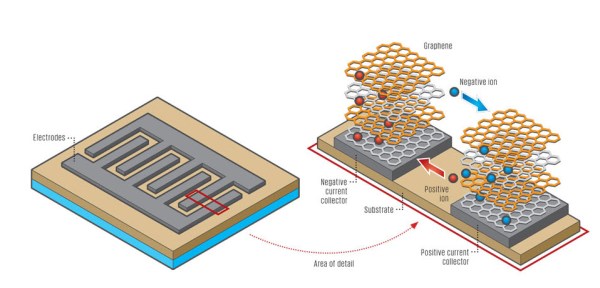
It’s pretty simple. By placing a thin film on top of a DVD (or any plastic CD shaped disc), and coating it with graphite oxide, you can literally print patterns of graphene using the laser in your DVD burner. By making the shapes shown above, you can introduce an electrolyte and turn the whole thing into a supercapacitor. Albeit, a tiny super capacitor. But — you can print hundreds of them on a DVD in less than an hour.

We’ve covered this before a few times now, but that doesn’t make it any less interesting. We’re still waiting for someone (one of you guys!) to do a project that actually makes use of graphene! Hurry up!

[Thanks for the tip John!]

A White Hat Virus For The Internet Of Things

The Internet of Things is going gangbusters, despite no one knowing exactly what it will be used for. There’s more marketing money being thrown at IoT paraphernalia than a new soda from Pepsi. It’s a new technology, and with that comes a few problems: these devices are incredibly insecure, and you only need to look at a few CCTV camera streams available online for proof of that.

The obvious solution to vulnerable Internet of Things things would be to get people to change the login credentials on their devices, but that has proven to be too difficult for most of the population. A better solution, if questionable in its intentions, would be a virus that would close all those open ports on routers, killing Telnet, and reminding users to change their passwords. Symantec has found such a virus. It’s called Wifatch, and it bends the concept of malware into a force for good.

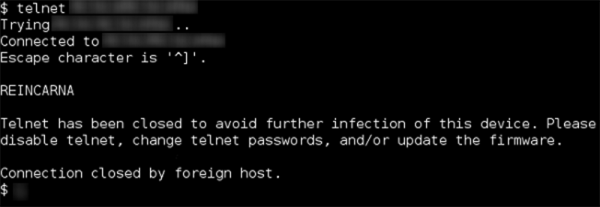
Wifatch is a bit of code that slips through the back door of routers and other IoT devices, closes off Telnet to prevent further infection, and leaves a message telling the owner to change the password and update the device firmware. Wifatch isn’t keeping any secrets, either: most of the code is written in unobfuscated Perl, and there are debug messages that enable easy analysis of the code. This is code that’s meant to be taken apart, and code that includes a comment directed at NSA and FBI agents:

To any NSA and FBI agents reading this: please consider whether defending
the US Constitution against all enemies, foreign or domestic, requires you
to follow Snowden's example.

Although the designer of Wifatch left all the code out in the open, and is arguably doing good, there is a possible dark side to this white hat virus. Wifatch connects to a peer-to-peer network that is used to distribute threat updates. With backdoors in the code, the author of Wifatch could conceivably turn the entire network of Wifatch-infected devices into a personal botnet.

While Wifatch is easily removed from a router with a simple restart, and re-infection can be prevented by changing the default passwords, this is an interesting case of virtual vigilantism. It may not be the best way to tell people they need to change the password on their router, but it’s hard to argue with results.

[Image source: header, thumb]