Sandia Labs “Hopper” Robot

Made by Boston Dynamics under contract from Sandia Labs, this “hopper” is quite incredible as you can see in the video after the break. Boston Dynamics is no stranger to great robotics designs, including the well known “Big Dog” four-legged robot. This robot, although possibly less advanced, has a very unique trick up it’s sleve.

This robot’s distinguishing feature is that it can navigate autonomously not only with wheels, but also with a powerful single leg that allows it to jump over obstacles of up to 25 feet. Although envisioned to “deliver a payload” in an urban environment, one could imagine a terrifying  horde of these ‘bots jumping into action armed with bombs or other weapons.

According to Sandia’s website is that this form of locomotion has been “shown to be five times more efficient than hovering” when trying to get around obstacles under 10 meters. Technical challenges that have been overcome include managing the shock of landing and producing a leg powerful enough to jump to this height. Continue reading “Sandia Labs “Hopper” Robot”


Hackaday In The Social Tangle

Like any other organization out there, we’re always trying to find new ways to reach our audience. Admittedly, we’re not the fastest when it comes to adopting a new social communication site. We’re working on it though, trying to be a bit more interactive … or just plain active.

So, if you’re looking for other ways to get your hacking fix, or see some interesting commentary, find us on facebook, twitter, our own forums, and now G+. We just signed up to G+ and our name is “Hackie Smith”. If you need an invite, email us at theofficialhackaday@gmail.com see below.   Sometimes there’s good discussion in those places that doesn’t end up here on the site.

You can also find several of us spattered across the web in sites like Reddit and Slashdot.

[Update: Our g+ page got shut down. Feel free to find any of the writers on g+. I’ll give out invites, look for “Caleb Kraft” or 60mango@gmail]

Did Microsoft Steal The Kinect?

In 2009, while Microsoft was busy designing and marketing what would become the Kinect, [Carlos Anzola], an inventor, tinkerer, and self-ascribed geek from Bogotá, Colombia, had been working for years on a nearly identical gesture interface for the PC. His creation, the Human interface Electronic Device, or HiE-D – pronounced ‘Heidi’ – was capable of gesture recognition years before Microsoft would release the Kinect.

After developing his gesture recognition device in 2007, Microsoft showed interest in [Carlos]’ device – going so far as to request a prototype. Microsoft suggested that he should apply for a patent on his technology. [Carlos] did just that, sending in patent applications to both the United States Patent and Trademark Office and the World Intellectual Property Organization a mere two days before the announcement of Project Natal and a full seven months before Microsoft applied for their Kinect patent.

Since the release of the Kinect, [Carlos] has been showing the HiE-D around Bogotá and has put a few videos of his technology up on Youtube, one of which can be seen below. You can also check out his Youtube channel for some great demos.

[youtube=http://www.youtube.com/watch?v=f5jfOJ3TwyI&w=470]

Continue reading “Did Microsoft Steal The Kinect?”

Scavenging Ambient Electromagnetic Energy

energy_harvesting_from_radio_waves

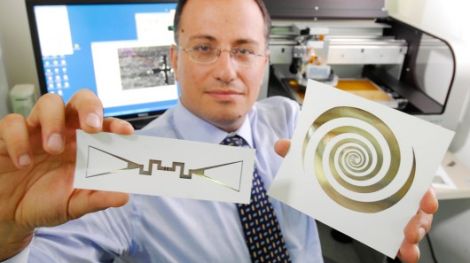
At this very moment, unseen radio waves are bouncing off almost everything that surrounds you. Emitted by everything from radio and TV stations to cell phone networks and satellites, these waves are full of unharnessed energy. That is, until now. Researchers at the Georgia Tech School of Electrical and Computer Engineering have been working diligently to harness this unused energy, and recently unveiled their new antenna technology at the IEEE Antennas and Propagation Symposium.

The team, led by professor [Manos Tentzeris] has been working to develop ultra-wideband antennas to tap into the energy all around us. Using printers filled with a specially-formulated ink compound, they have been able to print these antennas on paper and polymer substrates. The antennas can harness energy stored in radio frequencies ranging from 100 MHz all the way up to 60 GHz, depending on the printing medium.

The team can currently power temperature sensors using television signals, and is preparing a demo in which they will power a microcontroller simply by holding it up in the air. The technology is still in its infancy, but the list of applications is almost endless. We doubt you’ll be powering your TV with this technology any time soon, but it definitely holds promise for things such as wireless sensor mesh networks and the like.

[Thanks, morganism]

A Homemade Electric Chair Reveals A Darker Side Of Hacking

Here is an example of what happens when someone is tempted to use their hacking skills for evil. Hopefully it goes without saying, but do NOT try this one at home.

When his wife asked for a divorce [Andrew Castle] obviously did not like the idea so got busy building himself a DIY electric chair, placing a metal chair in his garage he wired it up to a 240V 13 amp wall output with the intention of luring his wife to sit in the chair for “a chat”. Fortunately the story ends as well as any story involving something as foolish as a homemade electric chair can end. We are guessing that [Andrews] wife’s suspicions were initially aroused when she was invited to sit in the lone metal chair in the garage, whilst he stood behind her holding a rubber cudgel. After a brief struggle she managed to escape unharmed and [Andrew] is now facing 10 years in prison.

All questionable morals aside, from the brief description available it looks like there may have been a few holes in the logic (or lack of) behind the construction of the chair, for one circuit breakers come to mind.

G-men Pay [Kyle McDonald] A Visit

Looks like the men in black have paid [Kyle McDonald] a little visit. The United States Secret Service is investigating him for fraud and related activity for his People Staring At Computers project. We just took a look at that one yesterday, and were thankful that all he was doing was taking people’s pictures and not stealing their information. Looks like [Uncle Sam] wasn’t being as lenient–or it could have been Apple that did the complaining since mums the word from the corporate giant. [Kyle’s] also keeping his mouth shut after soliciting the advice of the Electronic Frontier Foundation.

Since details are scarce, it’s time to play armchair lawyer. Let us know in the comments what you think [Kyle] might be up against, and whether we’ll see this thing hit the courts or not. And remember not to take those comments as legal advice since none of us actually know what we’re talking about.

By the way, the gentleman seen above isn’t [Kyle], he’s one of the unsuspecting ‘victims’ with some wikimedia commons slapped in for effect.

[Thanks Craig, David, and others]

[Phillip Torrone] On Why All Makers Should Learn Chinese

phil_torrone_why_every_maker_should_learn_chinese

A while ago when he was working in China, [Phillip Torrone] started learning Mandarin Chinese in order to help him communicate more efficiently with his peers. Unfortunately, once he returned to the US, he slowly started forgetting most of what he had learned. He recently wrote a piece over at Make: explaining why he’s attempting to learn Mandarin once again, and why you as a maker should consider doing the same.

He starts off citing the economic trends which indicate that China’s global GDP share will likely bypass that of the US in a few short years. While the stats might be a bit boring he says, the rise of a new global superpower is nothing to shrug off.

Economic changes aside, he has found that through his workings at Adafruit and other tech companies, he is frequently being exposed to more and more Chinese on a daily basis. Between emails with suppliers, data sheets, and schematics, he says that learning Chinese is a must for makers.

What do you think? Do any of you full-time makers and hackers see the same trend in your jobs? Let us know in the comments.