Using Google’s ADK On Standard Arduino Hardware

adk_on_arduino

When we heard that Google’s open accessory development standard was forthcoming, we were pretty excited. However once we heard that the reference hardware kit was going to cost nearly $400, our thoughts changed to, “Surely you can’t be serious.”

Well, Google is dead serious (and we hear they don’t take kindly to being called Shirley either.)

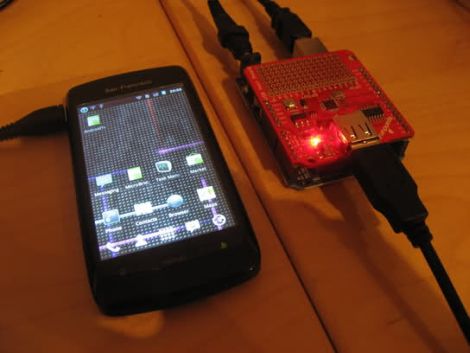
With such a ridiculous asking price, it was only a matter of time before someone tried getting the ADK software running on vanilla Arduino hardware. [Inopia] wrote in letting us know that he did just that.

Using an Arduino Uno and a Sparkfun USB shield, he was able to get the ADK working without a lot of fuss. He tweaked the ADK firmware image in order to bypass a couple of hardcoded pin assignments Google made, and he was good to go. The image boots just fine, though he can’t necessarily guarantee that his setup works with an Android handset, as he doesn’t currently own one that supports accessory mode.

Now that just about anyone can get their hands on the ADK at a reasonable price, we look forward to seeing what you can put together!

Google? In My Lightbulbs? It’s More Likely Than You Think

led_lighting_by_google

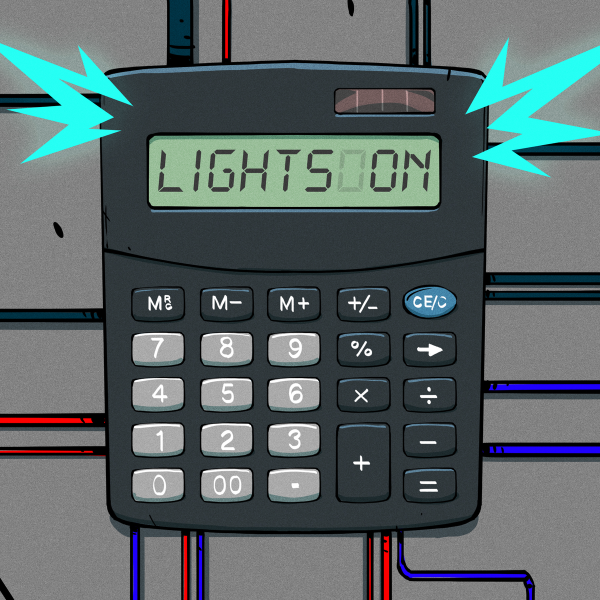
With the recent announcement and release of their ADK, it was only a matter of time before Google started invading your home in a big way. From the looks of it, Google will be jumping into the home lighting market very shortly, which could prove to be quite interesting.

Partnering with Florida-based Lighting Sciences, Google is planning on developing consumer-grade 60W equivalent smart LED light bulbs. The bulbs will be able to wirelessly communicate using Google’s new open-source home networking protocol. The lights will be controllable using any Android device allowing users to dim, brighten and toggle the lights on and off without ever touching a wall switch.

We think it’s an interesting idea, and we’re all for getting quality LED lighting in the home. That said, some of Google’s other utility-centric endeavors such as PowerMeter have met only mediocre success, so it remains to be seen if this concept takes off. If it does however, we can’t wait to see the flood of ADK-based hacks the community puts together. Since their new wireless protocol will likely be extended to all sorts of other household systems, the possibilities are endless.

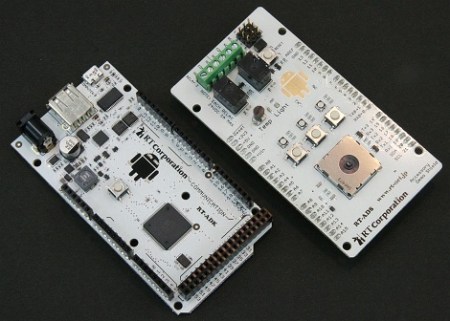
Official Android Open Accessory Development Kit – It’s An Arduino

A new development kit for android was unveiled at the Google I/O 2011 developer conference that officially supports the Arduino.

It looks like Google took a cue from Circuits@Home, because the interesting part of this dev kit is the fact that the shield can be put into USB Host mode. That’s great for phones and tablets that can’t act as a USB host themselves. Google will also release the APIs for this Android/Arduino mashup for 3.1, but it will thankfully be backported to Gingerbread.

We covered the IOIO breakout board for Android last month, but the Google board will be based off of the Arduino Mega 2560, a far more capable device. Interestingly, it appears this board is available now for about $400 USD. We’re not so sure a hobbyist will be buying it at that price.

While this board doesn’t do anything you couldn’t do before with a bluetooth shield, it’s great to see a company supporting all the builders out there.

Open Source Linear Bearing System

makerslide

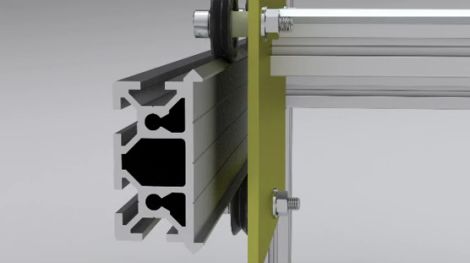
While we normally don’t make it a habit to feature Kickstarter projects, we couldn’t pass this one up. [Barton Dring] from BuildLog.net is putting together a project called MakerSlide that we’re sure will interest many of you out there.

Through his various CNC builds, he has found that one of the more expensive and frustrating components to obtain is a linear bearing system. He notes that commercial systems are expensive, and while an occasional eBay bargain can be found, it’s not the ideal way of going about things. He also points out that homebrew systems usually work after some tuning and adjustments, but can be time consuming to build.

He is proposing a v-groove bearing system, complete with wheels made from Delrin, as a standardized replacement for all of the aforementioned solutions. He anticipates selling the rails for about 10 cents per centimeter, putting the average cost of a 4 foot system around $20.

As a bonus, he is offering up free MakerSlide materials to anyone that sends him a “new, innovative  or interesting open source design or basic idea that uses the material.” You would only have to pay shipping in order to get your new project off the ground.

Standardization is always good, and seeing this rail system go into production would definitely benefit the hacker community. Take a minute to check it out if you are so inclined.

Juggling With Kinect

kinect_juggling

Some of the Kinect hacks we have featured here are quite useful in the realm of assisted living, others showcase what can be done with the clever application of video filters. Some…are just plain fun.

This pair of Kinect hacks are not necessarily going to win any awards for usefulness, but they are big on fun. [Tom] put together a neat juggling application that watches for your hands to disappear behind your back, generating a glowing ball once they return to the camera’s field of vision. The balls can be tossed away or juggled as you can see in the video below. It looks like it could be pretty fun and most definitely easier than chasing balls around while learning to juggle.

[Tom’s] hack was based off code he saw demonstrated in a video by YouTube user [hogehoge335]. His application for the Kinect allows him to replicate the Kamehameha attack from Dragonball Z, flowing hair and all.

Check out the videos below for a demonstration of both Kinect hacks, and swing by the respective Google Code sites if you want to give them a try.

Continue reading “Juggling With Kinect”

Photon Banner

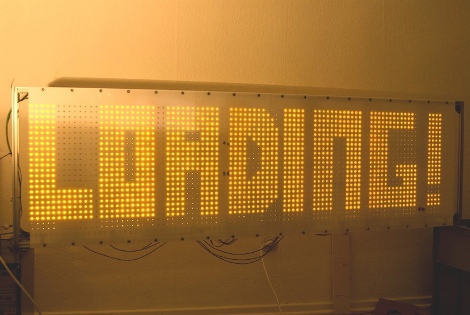
The Revision 2011 demo party that brought us” table for two” a little while ago along with some super demos for PC’s, retro, and state of the art, has also brought us the Photon Banner(google translate). The Photon Banner is a 96X24 led matrix that was made with (of course) 2304 5mm leds, and a atmega 644 clocked at 20MHz.

The end result is a 192cm X 48cm display area that uses the single micro controller, that has been beefed up with 2 megs of SPI flash memory, 6 driver boards, and took about a month just to construct. The software to drive the show took another 15 days, and it is pretty darn impressive.

The website above contains a bunch of photos, parts lists, and schematics. Before you go running off you should join us after the break for a couple of quick videos.

Continue reading “Photon Banner”

raspberry_pi

Miniature PC Packs A Big Punch

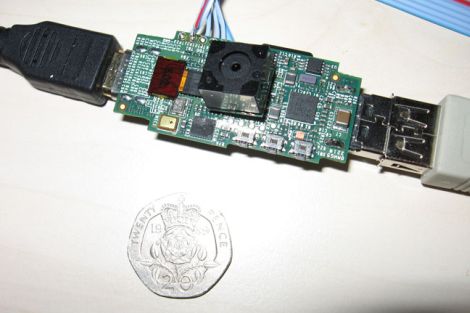
We are always looking out for smaller yet capable computers for our projects, and this newest offering by [David Braben] is looking mighty nice. [David] is the head of a UK-based games studio, but has recently been focusing on bringing small, affordable PCs to classrooms around the world.

The computer, called Raspberry Pi,  is about the size of your standard USB thumb drive and contains a 700 MHz ARM 11 processor as well as 128 MB of memory. It has an HDMI port which can display 1080p video on any compatible screen, along with a USB port for input peripherals. Mass storage is provided courtesy of an on-board SD card slot, and it looks like the ability to utilize add-on modules will be available as well.

There is sure to be no shortage of willing buyers if [David] is able to bring these computers to market within a reasonable timeframe. With a projected cost of about $25, this will certainly give the OLPC and others a run for their money.

Thanks to everyone who sent this story in… all of you. You can stop now… please. (don’t stop sending us tips, we’re just joking around)