Touch Sensors: Overview, Theory, And Construction

This collection of touch sensor information should be of interest to anyone who liked the simple touch sensor post from Thursday. That was a resistive touch sensor and is covered in detail along with AC hum sensors that trigger based on induced current from power lines around you, and capacitive touch switches like we’ve seen in past hacks. Each different concept is discussed and clearly illustrated like the slide above. [Giorgos Lazaridis] has also put together individual posts that build and demonstrate the circuits. We’ve embedded his resistive sensor demo video after the break and linked to all three example circuits.

Continue reading “Touch Sensors: Overview, Theory, And Construction”

555s For Your Mouse And R/C Airplane

[lenny] decided to build a 555-based auto-firing mouse based on a 555 after seeing a similar PIC-based project we posted earlier. Lenny’s version is self-contained in one mouse without requiring a second mouse to act as the rapid-fire button. It uses only a handful of components, costs less than $5 to build, and doesn’t require any programming.

But then, [wfdudley] shakes things up a bit. He added a 4022 counter IC and some diodes to act as logical “OR” gates in order to create a unique blinking pattern (short-short-long) for the lights on a friend’s RC airplane. While this project involves more components, it’s definitely a trickier problem to solve with a 555 timer IC. We love seeing people choosing simplicity in design over popular off-the-shelf microcontroller frameworks as these two have done.

Don’t forget, the 555 Design Contest is still going strong, and you’ve got the entire month of February to submit your awesome designs. We wanted to highlight two of the more clever 555-based hacks that we’ve had in our backlog for a while, though.

Etch-a-Sketch Computer Is A Surprisingly Simple Hack

We’re not sure whether to call this an Etch-a-Sketch upgrade or a computer interface downgrade but either way it’s unique. [Martin Raynsford] added a familiar red frame to his computer monitor with classic white knobs that control horizontal and vertical cursor movement. There’s even the click option by pressing the buttons in and, as you can see after the break, the modifications result in a perfectly usable digital Etch-a-Sketch. We’ve seen a lot of computer controlled versions of the toy which use fancy parts and take quite a bit of skill to build. This mimicry of the functionality is easy to build and the idea is genius in its simplicity. [Martin] separated the encoder wheels from a mouse. He placed each on one of the knobs and ran wires for sensors and micro-switches back to the original PCB which is stuck to the back of the monitor. From the computer’s point of view it looks and acts like a normal mouse but this is so much more fun (and less productive). Continue reading “Etch-a-Sketch Computer Is A Surprisingly Simple Hack”

Printable Wax As PCB Etch Resist

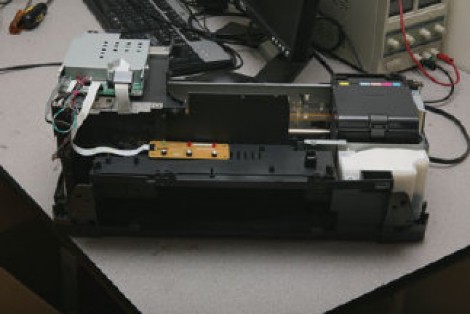
What if there were only two steps for making your own printed circuit board; print, etch? That’s what [Jeff Gough] has been working on and he presented the process in his talk at 27C3. In the first portion of the video after the break [Jeff] talks about various industrial PCB manufacturing processes in a depth you may not have heard before. We found it to be interesting but at about thirty minutes into the clip he begins the presentation of his modified printer. It’s an inkjet that can print wax onto copper clad board. The wax acts as a resist for chemical etchants, and provides very high resolution. He’s using a heavily modified print head, which brings to mind that diy piezo inkjet head which also has wax printing in its future plans. This certainly seems promising and if the process can be simplified it might do away with the toner transfer method.

Continue reading “Printable Wax As PCB Etch Resist”

Patching Into An Optical Mouse With A PIC

[MikyMouse] cracked open a couple different optical mice (or is it mouses?) in order to play with the data communications coming off of the chips inside. Once he figured out the protocol, it wasn’t too hard to grab the data for use in his own projects. The chip that controls the mouse is one of two he looked at, either an ADNS2051 or an ADNS2610. They run at 5V and use serial communications via SDIO and SCK pins. The clip after the break shows the test apparatus displaying coordinates of the mouse on an LCD screen. This seems like an easy and inexpensive way to get position data from your project. The only tricky part is going to be deciding when and how to to zero out the location.

Not interested in this type of mouse hack? Can we spark your curiosity with this mouse auto-fire project?

Continue reading “Patching Into An Optical Mouse With A PIC”

Is Your Camera Lying?

It is easy to rely on the ratings marked on different tools, whether it is a power supply, scale, or speedometer. However calibration is essential for any part that is relied upon either professionally or for a hobby. [Jeremy] wanted to see if his Lomography camera shutter really was only open for 1/100ths of a second when set to that. In order to test his rig, he set up an LED on one side of the shutter, and a high speed phototransistor to gauge the time spent open, using an oscilloscope to measure the time the reference point was pulled low. In his case, when the camera was set to 1/100, the shutter was actually open for closer to 1/150th of a second (the mean was 1/148ths of a second, with a standard deviation of 417 uSecs). This difference can make a large difference in picture brightness.

Be sure to check his blog for more pictures of the setup, as well as some useful part references and circuit diagrams.

Drill-based Kinect Camera

[Brett Graham] and [David Cox] are taking the Kinect out into the world thanks to this handheld hack they call the Drill of Depth. Apparently, the Kinect wants 12V at 1A which is quite easy to provide with a rechargeable power tool like this Ryobi drill. The setup features a 4.3″ touchscreen display, connected to the Gumstix Overo Air that is running Linux. They claim that there’s a “legitimate scientific reason” for building the device but they’re not sharing it yet.

So what would you use this for? We wonder if it would be possible to roll a GPS into the mix, then use post processing from the captured data to recreate the environment in a virtual setting? Imagine if a weekend spent walking around campus and processing the results let you model your University and make it an add-on level for your favorite game. Or perhaps this could be paired with a regular camera to generate high-quality 3D skinning data for Google Earth. That’s what we came up with, what do you think?