XBMC Hiding In An SNES Controller

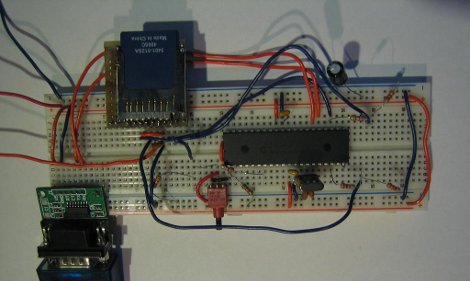
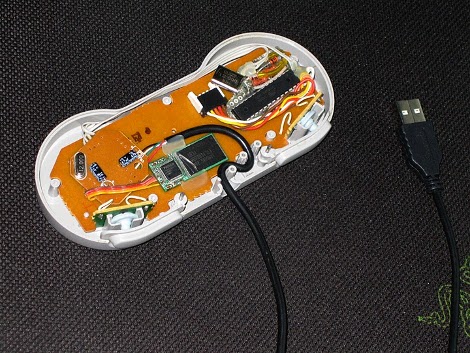
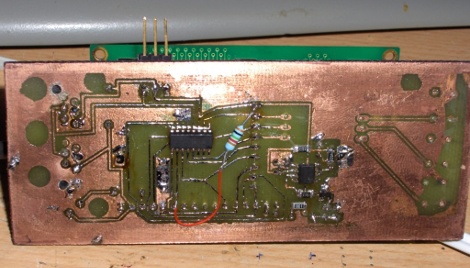
Here’s another SNES controller converted to house a USB system. The one we saw last time used a kit as an adapter for the controller but this version uses a home-built PCB and an ATmega8 microcontroller with the latest revision of an open source adapter for NES and SNES controllers. As you can see after the break, [Atarity] built the adapter, then added it along with a USB hub and thumb drive so that he could run a copy of XBMC from the controller. Now he’s got XBMC as a way to launch emulators for those classic games, as well as play traditional media.

You will be seeing more of this type of mod soon. We were tipped off that an in-depth tutorial for SNES controller hacking is on its way, although that is unrelated to [Atarity’s] work.
Continue reading “XBMC Hiding In An SNES Controller”

Massive No-touch Physically-interfaced Display

[youtube=http://www.youtube.com/watch?v=8bHWuvzBtJo]

[Daniel] wrote in to show us the project his group has been working on. It is a massive display wall consisting of 28 projectors and 30 computers.  With a resolution of 7168×3072, viewing a 13.3 gigapixel image is a treat. That treat is made even stronger by the fact that navigating the image is done multitouch style with a touchless system built from web cams.  We’ve seen lots of projects come out of the NUI group with similar interfaces, but none that used the webcams like this. Usually, the webcam is detecting some kind of interaction between the person and an infra red light source. Maybe that is happening here and we just don’t see it.

1-Wire LAN With An LCD

[Viktor], one of our favorite avid hackers, has been playing around with 1-wire systems all this month. What started out as a MicroLAN Fonera has turned into an iButton interface, to a 1-wire powered hub, and finally a 1-wire character driven LCD. Anyone looking at 1-wire systems or OWFS could surely benefit from his testing.

However, if you still haven’t gotten your fill of 1-wire goodness, let us remind you of the 1-wire HVAC and IPv6 to 1-wire protocol translator.

[Thanks Juan]

Intense Kit Turns Wacom Tablet Into Cintiq Clone

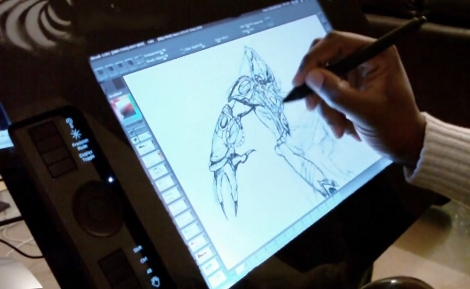
[Lesa Wright] just started selling enclosure kits used to convert a Wacom tabet into a Cintiq clone. You need to start with your own Wacom tablet, there are kits for four different models. You’ll also need to track down some other parts: a compatible laptop LCD screen, controller kit, and some cable extenders. From there, the kit takes over, with several pieces of laser-cut acrylic needing to be glued together properly, then a surprising number of spacers need to be cut from foam board in order to mount everything..

The kits come in at around $225. That might seem a bit steep since you need to bring your own electronics to the party, but have you checked out the price of the original Cintiq? You can expect to drop about twelve-hundred bones on a ready-to-use model. Before you take the dive, you should watch their collection of assembly videos, it’s quite a process.

Storage For Your Hacking Needs

Sometimes your project needs a lot of non-volatile ROM, right on cue [Matthew] let us know how to not only connect, interface, read, and write to SD cards with a PIC over serial, but also how to do the above mentioned with an old PATA HDD. For those without a PIC/serial connection don’t fret, [nada] let us know about his Bus Pirate SD card hack, of which our personal favorite part is the creative use of an old 5.25″ floppy connector as the SD card socket.

DIY Scratch Controller

[youtube=http://www.youtube.com/watch?v=eHI2q-x0ke0]

There’s something viscerally pleasing about simple solutions. [Kip] came up with one in the form of a scratch controller. The spindle from an optical drive is used to hold a CD in place, which acts as the LP for scratching. The sensor from an optical mouse is mounted upside down below the CD and detects the rotation of the disc. From there it’s just a matter of setting up your software to get the reading from that mouse. He’s had some trouble finding disc surfaces that the mouse sensor will read reliably.  We’d recommend trying some of those stick-on inkjet CD labels.

This is similar to a scratch controller we saw in 2008. That one was actually repurposing the IR encoding from inside of a mouse. We’re not sure which method would work better, but either controller will make a nice addition to a Flexi Knob setup.

Will This Mouse Get Me Kicked Out Of The Coffee Shop?

This [Dwight Shrute]-esque project will let you try out your taxidermy skills. Apparently you can acquire a ‘wetware’ mouse fresh or frozen from pet stores. We just need to wait until fall when our pantry is visited by the less-domesticated variety.

A travel-sized optical mouse acts as the replacement guts. Some creative dremeling brings the plastic housing down to a more acceptable shape. The furry bits need to be processed using the mouse taxidermy guide before they are fit over the electronics. What you end up with is a creepy peripheral that nobody wants to use.